

Lessons Learned Keep Paying Off
February 8, 2013
By Terri Finch Hamilton
Reprinted with permission of CMUChippewas.com
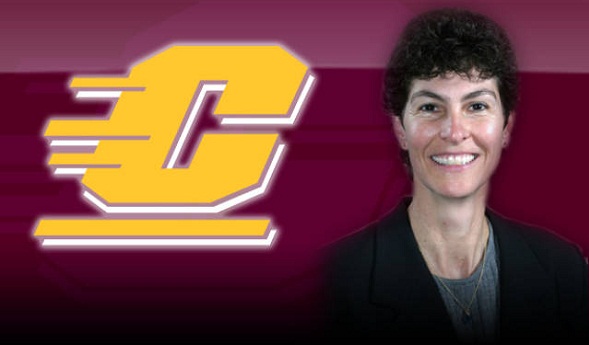
Gina Mazzolini's parents taught her to be a good person first, a good student second, and a good athlete after that. But Mazzolini says her involvement in sports at CMU taught her things that went way beyond the classroom.
"At Central, I learned women are just as good as men -- or better," says Mazzolini, assistant director at the Michigan High School Athletic Association. "I learned that if we put our minds to it, we can do anything."
A star athlete in volleyball and basketball at CMU from 1974 to 1978, Mazzolini says college sports helped her soar after the limitations for girls in high school sports in the early 1970s.
"In high school, women were always taking the back seat to men," says Mazzolini, 57. "I didn't see women in leadership positions in high school. Girls couldn't use the weight room -- we had to sneak in, then we'd get kicked out. They'd look at me and say, 'Why would you want to lift weights?'
"When the guys were done with the gym, then we could use it."
As an athlete at St. Johns High School, Mazzolini was just starting to compete competitively, she says. She won the school's first ever female athlete of the year award.
"Then I went to Central Michigan, and my teammates were all the best kids from their high school teams. Suddenly, everybody was good. And everybody we played against was good."
It was eye opening, she says.
"You learn a lot about yourself," she says. "If you can survive a practice, if you can survive playing Michigan State, you get confidence. I realized I was good. I learned how to be competitive, in a good way."
In basketball, she led the Chippewas in scoring and rebounding three straight seasons - averaging in double figures in both categories. After graduating from CMU, Mazzolini went on to teach and coach at the high school and college levels. She was inducted into the CMU Athletic Hall of Fame in 1992.
A few years later, Mazzolini received the 2009-10 Women In Sports Leadership Award by the Representative Council of the MHSAA.
So much of what she learned on the college volleyball and basketball courts prepared her for later success, Mazzolini says.
"In athletics, you can't worry about what just happened," she says. "You control your emotions, you take a deep breath, you move forward."
Good advice on any day, she says.
"You learn that you don't always win, and you learn to take defeat gracefully," she says. "Later, in your business life, you're not going to win everything, either. Sports teaches you how to deal with setbacks, how to work hard and rearrange your goals so that you do better next time.
"You learn if you work together, you can achieve amazing things."
CMUChippewas.com is running a series of stories to celebrate the 40th anniversary of Title IX legislation. Click to see more of the series.
MHSAA Update Meeting Series Returns for 49th Year
By
Geoff Kimmerly
MHSAA.com senior editor
September 1, 2026
The Michigan High School Athletic Association will conduct its 49th annual Update Meeting series during September and October, and this year’s schedule will again offer in-service programming for athletic directors at six of the seven locations.
The Update series is annually attended by more than 800 school administrators. During the meetings, information about current MHSAA activities is disseminated, issues affecting interscholastic athletics are discussed and attendees are surveyed on various topics.
Six luncheon meetings are scheduled in the Lower Peninsula, and a morning meeting is scheduled for Marquette in the Upper Peninsula. MHSAA Executive Director Mark Uyl will address high school superintendents, principals, athletic directors and school board members on a variety of topics at these meetings. Update Meetings also provide school administrators an opportunity to ask questions and discuss any recent changes in the Association's rules and regulations.
This also will be the 24th year of Athletic Director In-Service programs conducted during morning-long sessions prior to most of the Update Meetings. These workshops are designed to help prepare those administrators for the rigors of their jobs, and with the Update Meetings offer those in attendance an opportunity to meet with administrators from neighboring school districts with whom they normally are not able to have day-to-day contact.
The meeting in Bath on Sept. 23 also will serve as the Annual Business Meeting for the MHSAA. The registration form for Athletic Director In-Service and Update Meetings is available on the Administrators page.
Here is a schedule of the 2026 Update Meetings:
• Sept. 8 – Radisson Plaza Hotel & Suites, Kalamazoo (Noon – Preceded by AD In-Service at 8:30 a.m.)
• Sept. 14 – Ukrainian Cultural Center, Warren (Noon – Preceded by AD In-Service at 8:30 a.m.)
• Sept. 21 – Prince Conference Center, Grand Rapids (Noon – Preceded by AD In-Service at 8:30 a.m.)
• Sept. 23 – Eagle Eye Banquet Center, Bath (Noon – Preceded by AD In-Service at 8:30 a.m.)
• Sept. 28 – Otsego Club & Resort, Gaylord (Noon – Preceded by AD In-Service at 8:30 a.m.)
• Sept. 30 – Zehnder's Restaurant, Frankenmuth (Noon – Preceded by AD In-Service at 8:30 a.m.)
• Oct. 16 – Northern Michigan University Superior Dome, Marquette (10 a.m.)
The MHSAA is a private, not-for-profit corporation of voluntary membership by more than 1,500 public and private senior high schools and junior high/middle schools which exists to develop common rules for athletic eligibility and competition. No government funds or tax dollars support the MHSAA, which was the first such association nationally to not accept membership dues or tournament entry fees from schools. Member schools which enforce these rules are permitted to participate in MHSAA tournaments, which attract more than 1.4 million spectators each year.