

'Mailloux Management' Goes Global
By
Geoff Kimmerly
MHSAA.com senior editor
December 17, 2013
By Geoff Kimmerly
Second Half editor
Leslie (Barnhart) Mailloux graduated from Ogemaw Heights High School in 1999 and since has lived in New Mexico, Texas and Ohio twice.
She’s traveled to parts of Africa and Europe multiple times, plus Haiti, with a voyage to Switzerland planned for next month.
She’s served as a supervisor in a foreign exchange program, mentoring students as they make adjustments to living in the U.S.
 Needless to say, Mailloux has gained plenty of worldly knowledge since becoming an MHSAA Scholar-Athlete Award winner as a high school senior in 1999.
“It was good to get out of the small-town America, meeting people of all walks of life,” Mailloux said. “People are different, but we’re all doing the same things: having families, working. We just do it differently.
“We’re all different, but we’re all the same. We’re on this planet for a reason ... and we can learn from each other.”
 A three-sport athlete – who played volleyball, basketball and soccer – Mailloux (pronounced May-you) was one of 24 scholar-athletes recognized during the winter of 1999 by the MHSAA and Farm Bureau Insurance, which continues to sponsor the Scholar-Athlete Award program that has grown to 32 recipients. In advance of this March’s 25th celebration, Second Half is catching up with some of the hundreds who have been recognized.
Leaving home
Mailloux, now 32, met her husband Logan while earning a degree in architecture at Southfield’s Lawrence Technological University.
Logan grew up in Farmington Hills and when they met told Leslie he never wanted to leave Michigan. But that was before he joined the Air Force and ascended to the rank of major, which led to the family's moving to the southwest and now back to the Dayton, Ohio, area for the second time.
When Leslie and Logan moved to New Mexico, she had initial thoughts they’d landed in a ugly desert. But they fell in love with their new home: “You learn to appreciate different kinds of beauty. Fountains, blue skies, you appreciate the creation,” she said. “You really have to keep your eyes open.”
While in New Mexico, Mailloux found a way to mix working abroad with an opportunity to become involved in that community. Through a posting on Craig’s List she landed with the Council of International Education Exchange, a program that specializes in study abroad. As a coordinator for the CIEE, she helped foreign students “make the jump” to living here while providing them support and mentoring.
She also has managed to stay active athletically, playing volleyball competitively including on two teams that have advanced to USAV national tournaments. And she has passed on the lessons she's learned on the court and field during two high school coaching stops, including as the varsity head coach at Dayton Christian High School during the couple's first stop in Ohio.
“Hard work does pay off,” Mailloux said of her coaching focus. “Obviously (my players) had some God-given talent; some had a lot of talent and some a little. But with hard work they could be good, whether it’s in a sport, career or school. If you work hard, you’ll succeed.”
Traveling abroad
Mailloux no doubt has seen plenty as well during her international travels, including the mission trip she took to Haiti while in college. But her favorite excursion surely came a little more than three years ago, when Mailloux and her husband journeyed to Ethiopia to bring home their adopted twin sons.
Leslie had hoped to adopt siblings and was drawn to Ethiopia with a sister living there at the time. After some prayerful consideration, she and Logan began a two-year process that led to then 6-month-old boys Nathan and Issac becoming part of Mailloux family.
“Finally having the babies in our arms that God wanted us to have, it was a beautiful moment,” Mailloux said.
Her sons “are all boys, 250 percent," and keep her running around most of the day – Mailloux calls that fulltime job “Mailloux Management.” But she also does contract residential design work for Archetype Designs, a firm based in Texas.
She wasn’t alone among family members who journeyed far from home. In addition to her sister who lived in Ethiopia for three years, another sister plus her brother both moved to Seattle.
The sister in Seattle has moved back to Michigan, and the Maillouxs now are only six hours from West Branch. It could be only a matter of time before Leslie and Logan consider making good on his original desire to stay close to home now that they've experienced so much in this country and abroad.
“When it’s your roots, it’s still in your blood,” Leslie said. “We still love Michigan.”
Click to read the series' first installments:
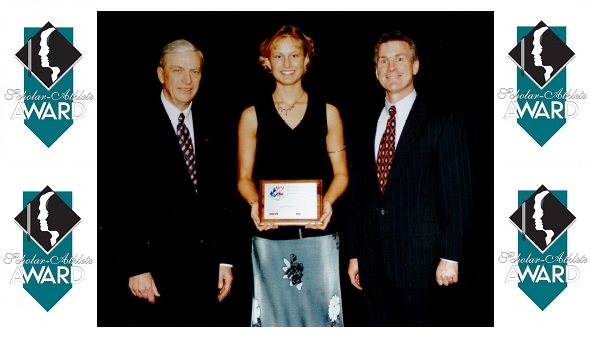
PHOTO: Ogemaw Heights' Leslie Barnhart (middle) poses with her Scholar-Athlete Award next to Larry Thomas (left), the then-executive vice president of Farm Bureau Insurance, and MHSAA Executive Director Jack Roberts.

Soccer Hall of Famer Seitz, NFL Analyst Pereira Headline Officiate Michigan Day 2026
By
Geoff Kimmerly
MHSAA.com senior editor
July 14, 2026
Officiate Michigan Day 2026 will welcome more than 1,000 Michigan High School Athletic Association-registered game officials July 25 to DeVos Place in Grand Rapids, where they will receive knowledge and instruction from several high-profile voices headlined by recent National Soccer Hall of Fame inductee Kari Seitz – a Brighton High School graduate – and one of television’s most recognizable rules analysts, Mike Pereira.
Officiate Michigan Day is designed to benefit officials with any level of experience, veteran to beginner. High-profile clinicians representing several sports and all levels including the NFL, NBA, MLB, NCAA, FIFA and the National Women’s Soccer League (NWSL) will provide face-to-face training during four sport-specific breakout sessions throughout the conference.
Pereira, a past collegiate and NFL football official who also has served as the NFL’s vice president of officiating, will present the opening address at 9 a.m. He has provided his knowledge during FOX Sports football broadcasts since 2010, explaining rules scenarios on-air as situations unfold in-game.
Seitz, also a graduate of Michigan State University, refereed Women’s World Cups in 1999, 2003, 2007 and 2011 and Olympics tournaments in 2004, 2008 and 2012, and will deliver the conference’s closing message. She’s currently the vice president of refereeing for U.S. Soccer and formerly served as FIFA’s heading of refereeing.
This will be the third Officiate Michigan Day, joining events in 2013 and 2018. OMD 2026 will accompany the annual National Association of Sports Officials (NASO) Summit that will take place July 26-28, also at DeVos Place.
Officials may continue to register on the Officials page. Cost is $50. Additional details, including the full lineup of speakers and clinicians, also is available at that link.