

'Mailloux Management' Goes Global
By
Geoff Kimmerly
MHSAA.com senior editor
December 17, 2013
By Geoff Kimmerly
Second Half editor
Leslie (Barnhart) Mailloux graduated from Ogemaw Heights High School in 1999 and since has lived in New Mexico, Texas and Ohio twice.
She’s traveled to parts of Africa and Europe multiple times, plus Haiti, with a voyage to Switzerland planned for next month.
She’s served as a supervisor in a foreign exchange program, mentoring students as they make adjustments to living in the U.S.
 Needless to say, Mailloux has gained plenty of worldly knowledge since becoming an MHSAA Scholar-Athlete Award winner as a high school senior in 1999.
“It was good to get out of the small-town America, meeting people of all walks of life,” Mailloux said. “People are different, but we’re all doing the same things: having families, working. We just do it differently.
“We’re all different, but we’re all the same. We’re on this planet for a reason ... and we can learn from each other.”
 A three-sport athlete – who played volleyball, basketball and soccer – Mailloux (pronounced May-you) was one of 24 scholar-athletes recognized during the winter of 1999 by the MHSAA and Farm Bureau Insurance, which continues to sponsor the Scholar-Athlete Award program that has grown to 32 recipients. In advance of this March’s 25th celebration, Second Half is catching up with some of the hundreds who have been recognized.
Leaving home
Mailloux, now 32, met her husband Logan while earning a degree in architecture at Southfield’s Lawrence Technological University.
Logan grew up in Farmington Hills and when they met told Leslie he never wanted to leave Michigan. But that was before he joined the Air Force and ascended to the rank of major, which led to the family's moving to the southwest and now back to the Dayton, Ohio, area for the second time.
When Leslie and Logan moved to New Mexico, she had initial thoughts they’d landed in a ugly desert. But they fell in love with their new home: “You learn to appreciate different kinds of beauty. Fountains, blue skies, you appreciate the creation,” she said. “You really have to keep your eyes open.”
While in New Mexico, Mailloux found a way to mix working abroad with an opportunity to become involved in that community. Through a posting on Craig’s List she landed with the Council of International Education Exchange, a program that specializes in study abroad. As a coordinator for the CIEE, she helped foreign students “make the jump” to living here while providing them support and mentoring.
She also has managed to stay active athletically, playing volleyball competitively including on two teams that have advanced to USAV national tournaments. And she has passed on the lessons she's learned on the court and field during two high school coaching stops, including as the varsity head coach at Dayton Christian High School during the couple's first stop in Ohio.
“Hard work does pay off,” Mailloux said of her coaching focus. “Obviously (my players) had some God-given talent; some had a lot of talent and some a little. But with hard work they could be good, whether it’s in a sport, career or school. If you work hard, you’ll succeed.”
Traveling abroad
Mailloux no doubt has seen plenty as well during her international travels, including the mission trip she took to Haiti while in college. But her favorite excursion surely came a little more than three years ago, when Mailloux and her husband journeyed to Ethiopia to bring home their adopted twin sons.
Leslie had hoped to adopt siblings and was drawn to Ethiopia with a sister living there at the time. After some prayerful consideration, she and Logan began a two-year process that led to then 6-month-old boys Nathan and Issac becoming part of Mailloux family.
“Finally having the babies in our arms that God wanted us to have, it was a beautiful moment,” Mailloux said.
Her sons “are all boys, 250 percent," and keep her running around most of the day – Mailloux calls that fulltime job “Mailloux Management.” But she also does contract residential design work for Archetype Designs, a firm based in Texas.
She wasn’t alone among family members who journeyed far from home. In addition to her sister who lived in Ethiopia for three years, another sister plus her brother both moved to Seattle.
The sister in Seattle has moved back to Michigan, and the Maillouxs now are only six hours from West Branch. It could be only a matter of time before Leslie and Logan consider making good on his original desire to stay close to home now that they've experienced so much in this country and abroad.
“When it’s your roots, it’s still in your blood,” Leslie said. “We still love Michigan.”
Click to read the series' first installments:
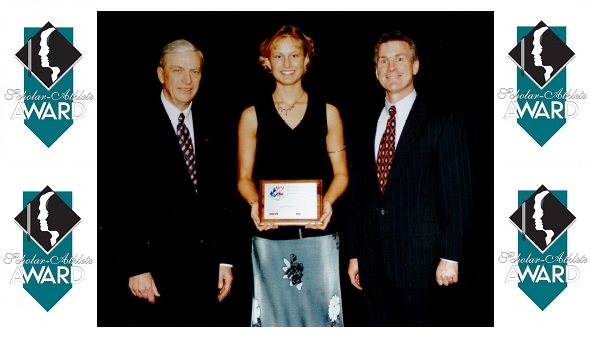
PHOTO: Ogemaw Heights' Leslie Barnhart (middle) poses with her Scholar-Athlete Award next to Larry Thomas (left), the then-executive vice president of Farm Bureau Insurance, and MHSAA Executive Director Jack Roberts.
Herd dat? Buchanan Back for BOTF III
January 21, 2014
By Geoff Kimmerly
Second Half editor
BUCHANAN – Andi Frost might be walking the hall between classes with some of her senior friends when a freshman will approach and ask about the next theme night.
Or a quick trip to the gas station could turn into a conversation with locals about what she and her classmates have planned for Friday’s basketball game.
Once, during a trip to a few miles south to Steak & Shake in South Bend, a patron from across the border noticed her “Herd” shirt and asked if she was from Buchanan.
 Plenty of notice has come this small town’s way since “The Herd” student cheering section won last year’s MHSAA Battle of the Fans II. No question, the championship helped some find the small southwestern school on the map – including one Twitter follower who made contact from Nebraska.
The recognition has been fun and the friendly comments from all over the state much appreciated. But the best to come from last year’s formation of The Herd, without doubt, is the sense of togetherness that was cultivated in the bleachers but has infused the entire community.
“The best thing that happened from this whole experience is that it’s even higher than a title now,” Frost said. “It’s our way of life in Buchanan. It’s the whole school, all the teachers, everyone in the community. Grandparents, moms, dads and little brothers; it’s the whole town.
“You sense it in the building; we’re not just a school with different grades. We know everybody now. Everybody has become a big family.”
Buchanan on Friday was the first stop on this season’s Battle of the Fans III finalists tour. MHSAA staff and Student Advisory Council members will visit Beaverton, Bridgman, Frankfort and Traverse City West for home games later this month and during the first two weeks of February. The winner will be determined by an Advisory Council vote weighted by a public vote on the MHSAA’s Facebook, Twitter and Instagram sites from Feb. 18-20. The champion will be announced Feb. 21 and recognized March 21 during the Boys Basketball Semifinals at Michigan State’s Breslin Center.
Buchanan’s Herd got its start during an MHSAA Sportsmanship Summit during fall 2012 after a presentation on the benefits of a positive, fun student cheering section and the Battle of the Fans contest in particular.
 Section leaders and teacher “shepherds” did some quick work to make The Herd formidable – and start the ball rolling toward a culture change in the school and a new unity felt throughout the town of roughly 4,500 residents.
This school year, The Herd came back – and this time much more organized.
Nearly 40 students showed up for the section’s first meeting last spring as it looked ahead to 2013-14. A group of roughly 60 – or 13 percent of the student body – came to another planning meeting over the summer.
Leaders of the section realized early that with so much interest, organization would be key. They split their classmates into small groups and gave each a task – coming up with theme night ideas, new cheers or planning pep rallies or “traveling pep rallies” to the middle and elementary schools.
What emerged was a fall schedule that included plans for attending not only home football games, but also Herd gatherings at volleyball and soccer games and a cross country race. The section has a full line-up for its home basketball games, both boys and girls, including individual cheers for every player and 22 cheers/chants/dances to break out during time-outs.
“We’ve made such a big deal out of all of this, there’s such good positivity everywhere, and everyone just loves it. So we definitely want to keep it as a tradition,” said junior Ellie Hurd, also a section leader last year as a sophomore.
One of the reigning champ’s biggest challenges this fall was coming up with fresh material to blend in with some that leaders wanted to carry over from the section’s inaugural season.
Last year’s favorites are mixed with versions of more recently popular “Timber” and “Wrecking Ball.” Pregame introductions are still lights-out with Herd members providing cell phone spotlights. And the Herd continues to sing the national anthem before games, on this night with Frost on the microphone leading the crowd.
Perhaps the most compelling part of Buchanan’s victory story in 2013 centered on one of the section’s main motivations – the untimely death the summer before of classmate Dilan Shearer. Another challenge this past summer was deciding how best to continue on while keeping intact the togetherness that sad event helped create.
Similar to last season – when the section finished game nights by singing Shearer’s favorite song, “Springsteen” – every home night this winter ends with another community song – Jason Aldean’s “Tattoos On This Town.”
“Last year we had all of that positive energy taking something bad, some sadness, and we turned it into something better,” Martinez said. “This year, we turned what we did last year, all of the good things that happened, and made it into something more.”
The Herd isn’t just about showing up strong at games. They’re frequently called to show up at events in the community and have used their powers of influence to help their neighbors – raising roughly $1,300 plus clothing donations after a local apartment fire and a few thousand dollars to assist community supporter Don Ross, who died Thursday after suffering from Lou Gehrig’s Disease.
“‘It’s left our mark on us, and we’ve left our mark on it,’ and that’s what we’ve done,” Frost said, referring to a favorite lyric from Aldean’s song.
“We’ve built everlasting memories,” Martinez added, “just by all of the stuff we’ve done with The Herd.”
Filling the stands for every home varsity hoops game meant five nights of basketball last week. But the Herd showed en masse, and it’s fair to believe made a difference – the boys team in particular hasn’t lost a home game since the first of 2012-13 and came back from 20 points down to beat a rival earlier this season.
When senior A.J. Reed’s seventh grade brother told A.J. he was considering leading The Herd in high school instead of playing basketball, A.J. was stunned (and told his brother to stick with his sport). But in just over a year, the section has established that level of presence within the school.
“Traditional high schools, you think about if they have a good football team or a good basketball team every year,” said Reed, who like other section leaders plays at least one sport. “I think when a lot of people think of us, now recently, they’ve thought of the student section. It’s almost like a sport to us. We are a team.”
Battle of the Fans III is sponsored in part by the United Dairy Industry of Michigan.
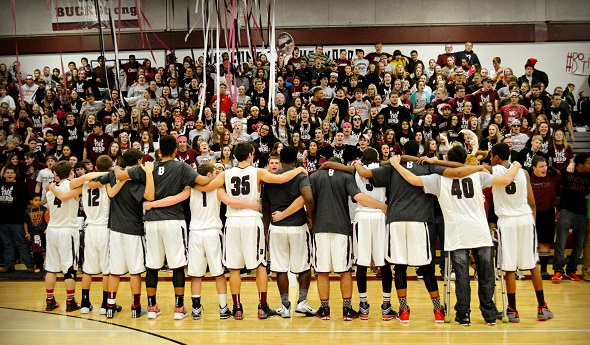
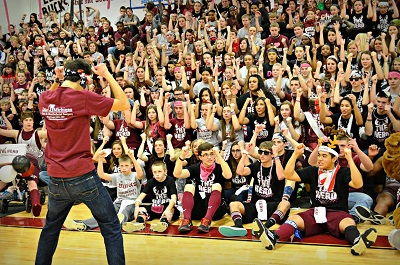
PHOTOS: (Top) Buchanan's "Herd" and its boys basketball team gather for "Tattoos On This Town" after Friday's win over Niles Brandywine. (Middle) Members of the student section lock in for a rollercoaster ride during halftime Friday. (Photos courtesy of Jessica Cornelius.)