


Mazzolini's Impact Felt Across Generations
By
Geoff Kimmerly
MHSAA.com senior editor
July 14, 2016
By Geoff Kimmerly
Second Half editor
A lifetime in competitive athletics has provided piles of memories for retiring MHSAA assistant director Gina Mazzolini.
 Four decades as an athlete, coach and association administrator also left her with plenty of souvenirs to sort through as she finishes her final days in the East Lansing office.
There’s a letter dated 1976 – and passed on to Mazzolini in 2004 – from the MHSAA to tennis coaches warning against stacking their lineups, an issue she’s worked to resolve over the last 20+ years.
Autographs from famous coaches John Wooden and Tom Landry made a 1991 National Federation Hall of Fame program worth saving. Just as significant was a thank-you from legendary Battle Creek St. Philip volleyball coach Sheila Guerra – who led teams to nine MHSAA titles from 1983-97 – sent in 2005 after Guerra’s daughter Vicky Groat led the Tigers to the first of what has become 10 Class D championships over the last 12 seasons.
In a number of high school sports circles, Mazzolini’s contributions are considered similarly legendary. She’s frequently been referred to as a “pioneer” – one of the first star female high school athletes from the Lansing area who went on to star at Central Michigan University and then lend her expertise to growing girls sports in this state and beyond.
“I didn’t do it because I was a woman and wanted to be the first,” Mazzolini said. “That’s just what I wanted to do, and after Title IX those jobs just opened up. And because I had some experience in coaching, officiating and playing, they took a chance on me, or they recruited me because they needed someone to run girls programs.
"I will miss people and relationships, watching things start, grow and get better.”
Mazzolini recently was recognized with a Citation from the National Federation of State High School Associations after a career that began in 1981 with Texas’ University Interscholastic League and ends after the last 23 years as an assistant director in her home state – and a mere 20 miles south of where she took the first steps toward a career that covered nearly the whole of female high school and college sports in Michigan, as a first-generation athlete and the builder of games for generations of girls and women to come.
Pioneer, indeed
Mazzolini’s senior year at St. Johns High School, 1973-74, was the first for girls basketball playoffs sponsored by the MHSAA, and Mazzolini led the Redwings to a District title that fall. She went on to star in both basketball and volleyball at CMU – still ranking among the Chippewas’ all-time hoops statistical leaders – and then to coach volleyball at Ovid-Elsie High School, Michigan State and the University of Texas.
All of that set Mazzolini up to provide a key voice and insight to rules-making bodies at the state and national levels. She’s retiring as MHSAA administrator for girls volleyball, swimming & diving, alpine skiing and tennis, and also has handled the sanctioning of out-of-state competitions and foreign exchange and international student issues. Nationally, she’s served multiple times on rules committees for soccer, swimming & diving and volleyball.
“Having worked in athletics for 46 years, I know few, if any, administrators who have a passion for excellence as does Gina Mazzolini in everything she undertakes,” wrote Marcy Weston, a retired executive associate director of athletics at CMU. “Ethics, integrity, creativity, loyalty and fortitude are just a few words that describe Gina’s work persona. And compassion, kind and supportive are words that siblings and friends access when they describe Gina.”
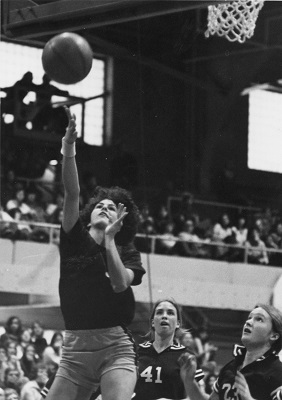 Weston coached Mazzolini on the CMU volleyball team for four seasons and women’s basketball team for two. At that time, with those programs and women’s college athletics as a whole in their early stages, Mazzolini and her teammates wore the same uniforms for both sports for two years.
Obviously, much has changed. And she’s played a large part.
Mazzolini first got involved as more than an athlete after taking Weston’s officiating class at CMU. Mazzolini registered as an MHSAA official – but all she knew of the MHSAA was that was where she paid her registration fee.
She still didn’t know much about state association work when offered a job at the UIL by then-executive director Bailey Marshall, who was familiar with Mazzolini because his wife Becky was the trainer for the University of Texas volleyball team when Mazzolini was an assistant coach.
“He said we’ve got to add women’s sports – they had them but not as many,” Mazzolini said. “I applied for the job and got it, and I’m still not sure what I’m going to do.”
What she lacked in initial knowledge, she made up for in passion.
Texas’ high school association at that time was adding girls tennis and soccer, beefing up some of its other offerings and reworking other sports to put females on a level playing field.
Her work there led to her first of many contributions to national rules-making committees. Early on, Mazzolini brought the perspective of someone who had played to groups that often included many who had not. She eventually chaired the volleyball committee from 2004-08 and worked with notable contributors to amateur sports including the first NCAA national coordinator of officials, Joan Powell.
“A number of people have made comments that when Gina was appointed to a national committee, the National Federation staff would breathe a sigh of relief because she would bring her patience and perspective to the table when they were forming national rules,” said MHSAA Executive Director Jack Roberts, who has served in his position since 1986.
“It’s clear to me that not just in Michigan, but across the country, there are several people who have affection for Gina as a person.”
Leaving a legacy
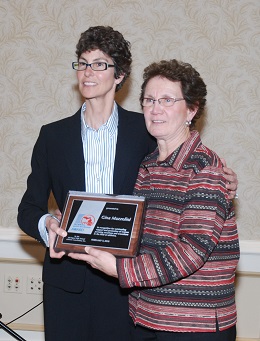
In addition to her recent Citation, Mazzolini is a member of the CMU Athletic Hall of Fame and received the MHSAA’s Women in Sports Leadership Award in 2010. This winter, she became the first woman to receive the MHSAA’s Charles E. Forsythe Award for her contributions to interscholastic sports.
It didn’t take long for Michigan coaches to realize she would make an impact.
 Among accomplishments she’s most proud of from her time at the MHSAA are improved relationships with the tennis and swimming communities, developed by increased communication and with the help of longtime veterans like Gary Ellis and Tiger Teusink in tennis and Denny Hill in the pool.
She was once told by a coach she was brave to show up at a regular-season event because of the grumbles toward the MHSAA in that sport – but soon another coach told her, “I wanted to hate you, but I like you.”
Mazzolini may choose to stick around athletics as an official, but only at the middle school level. She’ll definitely have no problems continuing to attend some of her favorite events in the sports she’s helped form over the years.
And it seems just a little coincidental that she’s stepping away from a community she’s affected so greatly at the end of the same school year that saw one of her nieces, St Johns senior Brooke Mazzolini, help the Redwings to their first MHSAA Girls Basketball Semifinal in nearly 20 years – the latest step on a path her aunt began to blaze 40 years ago, even as Gina doesn’t see herself as the “pioneer” she’s frequently made out to be.
“I played because I loved to play. I got that from my dad, and we were in an athletic neighborhood. I got into officiating and that was fun,” Mazzolini said. “And then (athletic director) Bob Forebeck at Ovid-Elsie called and said, ‘Hey I need a volleyball coach; what do you think?’ And that was a blast.
“And then I got into state associations, and I’ve really enjoyed that. There were rough patches – like when you tell people ‘no’ – but everything I’ve done, I’ve loved it. It’s hard to consider it a job, because you look forward to doing most of it.”
PHOTOS: (Top) Gina Mazzolini poses briefly while directing an MHSAA Final in skiing. (Middle) Mazzolini starred for the Central Michigan University women's basketball team. (Below) Mazzolini stands with her St. Johns high school basketball coach Beth Swears after receiving the MHSAA Women in Sports Leadership Award in 2010.

Fall Sports Practices Begin Next Week
August 3, 2018
By Geoff Kimmerly
Special for Second Half
More than 100,000 student-athletes will begin practices next week in nine sports in which the Michigan High School Athletic Association sponsors postseason tournaments, signaling the beginning of the 2018-19 Fall sports season.
Practice in football may begin Aug. 6 for all schools wishing to begin regular-season games the weekend of Aug. 23-25. Schools must have 12 days of preseason practice at all levels before their first game, over a period of 16 calendar days before the first kickoff.
Practice sessions for all other sports begin Wednesday (Aug. 8). In golf and tennis, competition may commence no earlier than after three separate days of team practice, and not before seven calendar days. The first day competition may take place in golf and tennis is Aug. 15. In all other fall sports, contests can take place after seven days of practice for the team and not before nine calendar days. The first day competition may take place in cross country, soccer, swimming & diving, and volleyball is Aug. 17.
This fall, two football game dates again precede Labor Day, and a number of MHSAA schools will play their first varsity games Thursday, Aug. 23. In Week 1, 146 varsity games will be played on Thursday, 152 contests will be played Friday, and 12 games will be played Saturday. During the second week, one game will be played Wednesday, 245 games will take place Thursday, 62 will be played Friday, and one contest is scheduled for Saturday.
For fall sports, perhaps the most discussed change will concern MHSAA Tournament classification in volleyball. For the first time, volleyball teams are classified in four equal divisions instead of the traditional Class A-B-C-D. Class no longer will be used to organize the postseason for any sport, including girls and boys basketball in the winter. All other sports previously had switched from classes to divisions.
While most fall sports face at least minor rules changes this season, a few of the most noticeable adjustments in fall sports will come in football, volleyball, boys soccer and girls swimming & diving.
• In an effort to improve football pace of play by reducing re-kicks after a free or scrimmage kick (generally kickoffs or punts, respectively), an option has been added allowing the receiving team to accept a penalty and tack on the awarded yardage to the spot where the kick or punt return ended. This option incentivizes the receiving team to forgo a re-kick, and joins three other options after a penalty on the kicking team. The receiving team also may continue to accept a penalty from the previous spot and have the kicking team re-kick; and on kickoffs that travel out of bounds, the receiving team may continue to accept the ball and begin possession 25 yards from where the kickoff occurred or decline the penalty and begin possession where the kick flew out of bounds.
• Additionally for football, players who fail to properly wear required equipment or are missing required equipment during a down shall be replaced for one down rather than incur a yardage penalty. Previously, a penalty was assessed for delay of game in this scenario. If a player’s proper or legal equipment has become improperly worn through use and prompt repair is possible and does not cause a delay in game, that repair may be made without the player being replaced for the next down.
• A change in volleyball will allow teams to substitute for an injured/ill player prior to a replay; previously a replay would take place with no changes on the floor after the point was originally contested.
• Also in volleyball, with an eye on risk minimization, teams will be allowed to warm-up between sets only in their playing area and may not hit volleyballs over the net into the opponents’ playing area.
• For soccer – both boys this fall and girls in the spring – teams may continue to play up to two multi-team events every season, but beginning this fall a multi-team event can include two full 80-minute games the same day and still be counted as only one of a team’s 18 regular-season contests. Teams also may continue to play multi-team events with 30-minute halves and no more than 180 minutes total in one day (for example, three games with 30-minute halves) and call it just one contest of the 18.
• Another significant soccer change will switch the home team to wearing the dark uniform and the away team to wearing the white uniform. The change was made to allow home teams to wear their school colors – it does not require teams to purchase new uniforms, but only switches which team wears dark and which wears white.
• Also for soccer, a change has been made to the penalty when a player is whistled for denying the other team an obvious goal-scoring opportunity. If a player, in the penalty area, commits an infraction while attempting to play the ball, and that infraction results in a penalty kick, that offending player will receive a yellow card – previously this would have been a red card. If the player is not attempting to play the ball when an infraction is called in the penalty area that results in a penalty kick, the offending player still will receive a red card along with the opposing team being awarded the penalty kick.
• In swimming & diving regular-season competition, a pair of changes will provide more opportunities for divers. The diving event in dual, double-dual or other multi-team non-championship competition has been limited to six dives, but now may be expanded to an 11-dive competition – giving divers another opportunity to prepare for the 11-dive competitions at the MHSAA Qualification Meets and Finals levels. Also, while diving traditionally has been placed in the middle of the event order of a dual or other regular-season meet, it may now be conducted first, last or simultaneously with the swimming events. (Both require prior mutual consent by competing teams and officials.)
• Also in swimming & diving, visible 16.4-yard (or 15-meter) marks must be made visible on both sides of the pool deck to assist swimmers during competition.
The 2018 Fall campaign culminates with postseason tournaments beginning with the Upper Peninsula Girls Tennis Finals the week of Oct. 1 and wraps up with the 11-Player Football Playoff Finals on Nov. 23 and 24. Here is a complete list of fall tournament dates:
Cross Country
U.P. Finals – Oct. 20
L.P. Regionals – Oct. 26 or 27
L.P. Finals – Nov. 3
11-Player Football
Selection Sunday – Oct. 21
Pre-Districts – Oct. 26 or Oct. 27
District Finals – Nov. 2 or 3
Regional Finals – Nov. 9 or 10
Semifinals – Nov. 17
Finals – Nov. 23-24
8-Player Football
Selection Sunday – Oct. 21
Regional Semifinals – Oct. 26 or Oct. 27
Regional Finals – Nov. 2 or 3
Semifinals – Nov. 10
Finals – Nov. 17
L.P. Girls Golf
Regionals – Oct. 10 or 11 or 12 or 13
Finals – Oct. 19-20
Soccer
Boys L.P. Districts – Oct. 15-20
Boys L.P. Regionals – Oct. 23-27
Boys L.P. Semifinals – Oct. 31
Boys L.P. Finals – Nov. 3
L.P. Girls Swimming & Diving
Diving Regionals – Nov. 8
Swimming/Diving Finals – Nov. 16-17
Tennis
U.P. Girls Finals – Oct. 3 or 4 or 5 or 6
L.P. Boys Regionals – Oct. 11 or 12 or 13
L.P. Finals – Oct. 19-20
Girls Volleyball
Districts – Oct. 29-Nov. 3
Regionals – Nov. 6 & 8
Quarterfinals – Nov. 13
Semifinals – Nov. 15-16
Finals – Nov. 17
The MHSAA is a private, not-for-profit corporation of voluntary membership by more than 1,500 public and private senior high schools and junior high/middle schools which exists to develop common rules for athletic eligibility and competition. No government funds or tax dollars support the MHSAA, which was the first such association nationally to not accept membership dues or tournament entry fees from schools. Member schools which enforce these rules are permitted to participate in MHSAA tournaments, which attract more than 1.4 million spectators each year.