


MHSAA Announces 2016-17 Concussion Data
August 7, 2017
By Geoff Kimmerly
Second Half editor
The Michigan High School Athletic Association has completed its second year of collecting head injury reports from member schools as it continues to build data that will assist in identifying trends and progress being made to reduce the incidence of head injuries in school sports.
Following a first mandate to do so in 2015-16, member schools again were required to report head injuries to the MHSAA identifying the sport that each student-athlete was participating in and whether the injury was sustained during practice or competition. As reporting for the 2017-18 school year is now underway, schools again are required to designate if potential concussions occur during competition or practice and at which level – varsity, junior varsity or freshman.
The full report of all head injuries experienced during 2016-17 by student-athletes at MHSAA member high schools – including percentages by sport (per 1,000 participants), gender and team level, as well as data tracking when athletes returned to play – is available on the Health & Safety page of the MHSAA Website.
As with the first year of reporting, the MHSAA received data from more than 99 percent of its member high schools after the fall, winter and spring seasons and continued to track each injury report through its conclusion this summer. Member junior high and middle schools also were allowed, although not mandated, to report their potential head injuries; and those findings are not part of the published report.
The 2016-17 concussion report found an 11-percent decrease in the number of confirmed concussions from the previous year. Student-athletes at MHSAA member high schools encountered during 2016-17 a total of 3,958 head injuries – or 5.2 per member school, similar but lower than the 2015-16 average of 5.9. Total participation in MHSAA sports for 2016-17 was 283,625 – with students counted once for each sport he or she played – and only 1.4 percent of participants experienced a head injury; that percentage in 2015-16 was 1.6.
However, MHSAA Executive Director John E. “Jack” Roberts said that while it’s significant to note the similarity in those statistics over the first two years of injury report collection, the lower percentages in 2016-17 don’t necessarily represent a trend – that conclusion can only be made after more data is collected in years to come. Some differences in data from the first year to the second could be the result of schools’ increased familiarity with the reporting system, the refinement of the follow-up reporting procedure and other survey error that is expected to decrease with future surveys.
“Our first survey in 2015-16 raised some initial themes, and the data we collected this past year and will continue to collect will help us identify the trends that will guide our next steps in reducing head injuries in interscholastic athletics,” Roberts said. “However, the necessity for more data to determine these trends should not delay our efforts to experiment with more head protection and modified play and practice rules in contact sports like ice hockey, soccer, wrestling and lacrosse – which all ranked among the top 10 sports for numbers of head injuries per thousand participants.
“We will continue to look for ways to make our good games better and our healthy games safer, and the collection of this data will continue to prove key as we work toward those goals.”
Although the total number of confirmed concussions was significantly lower in 2016-17, a number of findings detailing those injuries fell in line with results of the 2015-16 survey.
Boys experienced 2,607 – or 66 percent – of those injuries, nearly the same ratio as 2015-16 and as boys participation in sports, especially contact sports, remained higher than girls. More than half of head injuries – 55 percent – were experienced by varsity athletes, which also fell within a percent difference of last year’s findings.
A total of 2,973 head injuries – or 65 percent – came in competition as opposed to practice. More than half took place during either the middle of practice or middle of competition as opposed to the start or end, and 52 percent of injuries were a result of person-to-person contact. The largest percentage of athletes – 27 percent – returned to activity after 6 to 10 days, while 23 percent of those who suffered head injuries returned after 11-15 days of rest. All of these findings were within 1-4 percent of those discovered from the 2015-16 data.
Contact sports again revealed the most head injuries. Ranking first was football, 11 and 8-player combined, with 44 head injuries per 1,000 participants – a decrease of five head injuries per 1,000 participants from 2015-16. Ice hockey repeated with the second-most injuries per 1,000, with 36 (down two injuries per 1,000 from 2015-16), and girls soccer was again third with 28 head injuries per 1,000 participants (also down two from the previous year).
In fact, after football and hockey, four of the next five sports to show the highest incidences of head injuries were girls sports – girls soccer followed by girls basketball (23 per 1,000), girls competitive cheer (22) and girls lacrosse (20). Although girls basketball again showed the fifth-highest ratio, it did see a decline of six injuries per 1,000 participants from 2015-16.
Startling indications of another potential trend were seen again in the number of reported head injuries suffered by girls and boys playing the same sports. Soccer, basketball and baseball/softball are played under identical or nearly identical rules. Just as in 2015-16, females in those sports reported significantly more concussions than males playing the same or similar sport.
Female soccer players reported double the concussions per 1,000 participants as male soccer players, while female basketball players reported nearly triple the number of concussions per 1,000 participants (23 to 8). Softball players reported 11 concussions per 1,000 participants, and baseball players reported four per 1,000. The numbers from all three comparisons remained consistent from what the survey found in 2015-16.
It is the hope that Michigan’s universities, health care systems and the National Federation of State High School Associations will take part in analyzing the data and questions that have arisen during the past two years. Michigan State University’s Institute for the Study of Youth Sports submitted a paper titled “Gender Differences in Youth Sports Concussion” based on the 2015-16 results, and that subject will remain closely monitored in 2017-18 and beyond.
“The Institute’s research concluded that there is merit for believing females may be more susceptible than males to having concussions because of structural differences to the neck and head, and also due to neurological differences in the brains of females and males. But the findings also show merit for believing females may be more honest in reporting concussions,” Roberts said.
“We need to find out why. Are girls just more willing to report the injury? Are boys hiding it? These are some of our most important questions moving forward, and they will be critical in our efforts to educate athletes, their parents and coaches on the importance of reporting and receiving care for these injuries immediately.”
Schools report possible concussions online via the MHSAA Website. Reports are then examined by members of the MHSAA staff, who follow up with school administrators as those student-athletes continue to receive care and eventually return to play. Student privacy is protected.
The reporting of possible concussions is part of a three-pronged advance by the MHSAA in concussion care begun during the 2015-16 school year. The MHSAA completed this past spring (2017) the largest-ever state high school association sideline concussion testing pilot program, with a sample of schools from across the state over the last two years using one of two screening tests designed to detect concussions. The second year of the pilot program (2016-17) allowed participating schools to use the sideline detection tests in all sports but mandated they be used in sports (11 total over three seasons) showing the highest prevalence of concussions.
The MHSAA also was the first state association to provide all participants at every member high school and junior high/middle school with insurance intended to pay accident medical expense benefits – covering deductibles and co-pays left unpaid by other policies – resulting from head injuries sustained during school practices or competitions and at no cost to either schools or families. During 2016-17, a total of 139 claims were made – 20 fewer than in 2015-16 – with football (44) and girls basketball (27) the sports most cited in those claims for the second straight year.
Previously, the MHSAA also was among the first state associations to adopt a return-to-play protocol that keeps an athlete out of activity until at least the next day after a suspected concussion, and allows that athlete to return to play only after he or she has been cleared unconditionally for activity by a doctor (M.D. or D.O.), physician’s assistant or nurse practitioner.
In addition, the MHSAA’s Coaches Advancement Program – which includes courses that must be completed by all varsity head coaches hired for the first time at a member school – has augmented for this fall its already substantial instruction on concussion care. Separately, rules meetings that are required viewing for all varsity and subvarsity head and assistant coaches at the start of each season include detailed training on caring for athletes with possible head injuries.
The MHSAA is a private, not-for-profit corporation of voluntary membership by more than 1,400 public and private senior high schools and junior high/middle schools which exists to develop common rules for athletic eligibility and competition. No government funds or tax dollars support the MHSAA, which was the first such association nationally to not accept membership dues or tournament entry fees from schools. Member schools which enforce these rules are permitted to participate in MHSAA tournaments, which attract more than 1.4 million spectators each year.
Scholars & Athletes 2020: Class A
By
Geoff Kimmerly
MHSAA.com senior editor
February 17, 2020
The Michigan High School Athletic Association has selected 12 student-athletes from Class A member schools to receive scholarships through the MHSAA/Farm Bureau Insurance Scholar-Athlete Award program.
 Farm Bureau Insurance, in its 31st year of sponsoring the award, will give $1,000 college scholarships to 32 individuals who represent their member schools in at least one sport in which the Association sponsors a postseason tournament. The first 30 scholarships are awarded proportionately by school classification and the number of student-athletes involved in those classes; also, there are two at-large honorees who can come from any classification.
Students applying for the Scholar-Athlete Award must be carrying at least a 3.5 (on a 4.0 scale) grade-point average and have previously won a letter in a varsity sport in which the Michigan High School Athletic Association sponsors a postseason tournament. Other requirements for the applicants were to show active participation in other school and community activities and produce an essay on the importance of sportsmanship in educational athletics.
Each of the scholarship recipients will be honored at a halftime ceremony during the Division 3 Boys Basketball Final, March 28, at the Breslin Student Events Center in East Lansing. Commemorative medallions will be given to the finalists in recognition of their accomplishments.
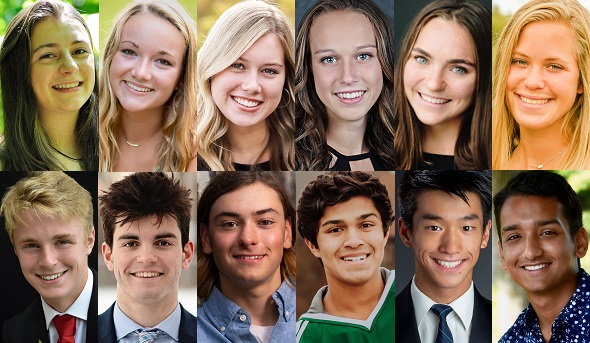
The Class A Scholar-Athlete Award honorees are: Ericka Asmus, Marquette; Lucy Borski, Holland West Ottawa; Morgan Cooper, Hartland; Kylie Ray, Pinckney; Elizabeth Saunders, Traverse City Central; Kayla Wolma, Hudsonville; Logan Canada, Fenton; DJ Dixon, Bloomfield Hills Brother Rice; Malcolm Gaynor, Portage Northern; Tej Kothari, Jenison; Brandon Liu, Northville; and Anish Middha, Midland Dow.
 Ericka Asmus, Marquette
Ran four seasons of cross country and participated in track & field as a freshman. Finished runner-up at Upper Peninsula Division 1 Cross Country Final twice and as league champion in that sport three seasons. Also is a three-time participant in Nordic skiing Junior Nationals. Served as team captain in cross country and earned academic all-state three years. Participating in third year of National Honor Society and school’s environmental club, serving as co-president of the environmental club for the second year. Spoke on environmental issues at Lake Superior Youth Symposium and Northern Michigan University Climate Strike. Also participates in math club and volunteered two years on local farm. Finalizing her college plans but intends to study materials engineering.
Essay Quote: “Far too often, not just in sports but in life, I see people forgetting the things they have in common with their ‘enemy.’ I’ve heard coaches yell ‘The Marquette girl looks terrible; you can pass her,’ degrading me to lift their runners up. I have learned from my running coach that competing is only worth it when I see my opponents as fellow humans, rather than people to defeat.”
 Lucy Borski, Holland West Ottawa
Playing third season of varsity basketball, played three of varsity golf and will play her fourth of varsity soccer this spring. Earned all-area honors in soccer and golf and was part of academic all-state team honors in all three sports. Captained both golf and basketball teams and serves as member of Student Athlete Leadership Council. Participating in second year of National Honor Society and fourth as part of school’s LINKS mentorship program. Participated three years in Young Life. Serving as coach for youth basketball and soccer and First Tee golf school chapter, and also officiates youth hoops and served two years as site supervisor for Holland Charter Township baseball park. Serving as fundraiser and co-host for school’s “Senior Survivor” program that raises money for students in need. Finalizing her college plans but intends to study biology.
Essay Quote: “Sportsmanship during games is important, but it is more important off the field or the court. … Sometimes while watching/playing sports the only thing that matters at that moment is whether you win or lose. However, it comes down to being just a game.”
 Morgan Cooper, Hartland
Participating in fourth season of competitive cheer and also has participated in four of sideline cheer. Will play third season of varsity lacrosse this spring. Earned all-league and all-region honors in competitive cheer and served as captain of both cheer teams. Helped competitive cheer team to MHSAA Finals in 2019 and lacrosse team to three Regional championships including after joining varsity for postseason as freshman. Earned academic all-state recognition every year of high school and served as part of student leadership group and representative to Kensington Lakes Activities Association Leadership Summit. Participating in third year of National Honor Society and second of student council. Also participated on school Honor Guard for 2019 graduation ceremony and this school year and is part of promotion team for school’s Special Olympics Project Unified program. Previously participated in 4-H, earning awards in animal showmanship, writing and photography, and earned a Bronze Award in Girls Scouts. Will attend University of Michigan and study biochemistry in pursuit of a career in oncology.
Essay Quote: “The concepts of being a good sportsman apply on and off the field, during practices, and ultimately in everyday life. Whether you are the best on the field, or the most energetic on the bench, each person plays a critical role in team success.”
 Kylie Ray, Pinckney
Played three seasons of varsity volleyball and will participate in fourth of track & field this spring. Earned all-region recognition in both sports and qualified for MHSAA Finals in track as a junior. Helped track team to league championship. Earned individual and was part of team academic all-state honors. Served as captain of both teams and selected to attend Southeastern Conference Leadership Conference. Competed at 2017 indoor national meet as part of distance medley relay. Participating in fourth year of class council and this year as treasurer. Participating in second year of National Honor Society and first as part of Link Crew that assists freshmen in transition to high school; previously served on school improvement team. Earned awards as part of duet and full orchestra at state solo and ensemble competitions. Teaching third year of religious education classes. Will attend University of Findlay and study physical therapy.
Essay Quote: “In any competition, there will be a winner and a loser, but the true value is that everyone (is) doing their best, learning through the process, and supporting each other. Regardless of the sport, good teammates are the ones who work hard to help others succeed. They help other athletes reach their goals while striving to reach their own goals.”
 Elizabeth Saunders, Traverse City Central
Competing in fourth season of Alpine skiing and is a three-year varsity rower; also played freshman volleyball. Earned all-state in skiing and has helped team to three top-three MHSAA Finals finishes; also raced as part of winning Michigan team in Eastern Championship. Competed in rowing junior nationals and won USRowing National Regatta inclusive double championship with partner who is blind. Served as captain of rowing club and freshman volleyball team. Won national Congressional App Challenge and Northwestern Michigan Engineering Fair for development of CalcuSaver app, and created her own startup company for app development and tech repair. Founded and serves as president of TechGirls group that helps women and minorities pursue STEM education. Participating in second year with school’s Key Club and as president of school’s SciMaTech accelerated STEM program student council. Participating in fourth year of Model United Nations. Worked with local township and regional land conservancy to create monarch butterfly habitat. Will attend Stanford University and study computer science and business.
Essay Quote: “Sportsmanship reflects the fair(ness) and generosity among competitors in a sport. … Because of equal opportunity, students and athletes are able to pursue their interests and passions.”
 Kayla Wolma, Hudsonville
Played varsity golf, subvarsity basketball and will play her fourth season of varsity tennis this spring. Earned all-league honors in tennis and played at MHSAA Finals as a junior. Will serve as tennis team captain this upcoming season. Participating in second year of National Honor Society, and selected and participated in three-week geology field study at various national parks as part of Summer Science Institute. Earned $5,000 UGive grand prize and helped raise more than $10,000 total for Wes Leonard Foundation for purchase of AEDs for schools. Participated in mission work in Flint and Detroit. Serves as Sunday School leader and volunteer youth tennis instructor. Will attend Hope College and study business with a minor in exercise science through Hope's professional tennis management program.
Essay Quote: “My goal is to be like Wes Leonard: I want to be that person who brings teams together, who is polite on the court, and is someone who doesn't cheat or thrive on shortcuts. To be a winner on the court is rewarding, but what truly defines a person is living a life full of integrity and selflessness.”
 Logan Canada, Fenton
Ran three seasons of cross country and will participate in third season of track & field this spring. Ran at MHSAA Cross Country Finals and earned all-region and all-league honors; also earned academic all-state twice in that sport. Served two seasons as cross country captain and will serve second as track captain this upcoming season. Received AP Scholar with Distinction and took math classes at University of Michigan as part of non-degree dual enrollment. Participating in second year of National Honor Society and chaired chapter’s local Freedom Festival event. Earned championship in Flint Metro League math/science competition. Founded Fenton Conservative American Student Association and participated in state representative election campaign. Serving as CEO of student-directed clothing company. Serves as soccer official and has refereed Michigan State Cup and received invitations to officiate in Midwest Regional League and National Premier League. Finalizing college plans but intends to study biomedical or chemical engineering.
Essay Quote: “Life is one convoluted competition; hence, just like any competition, demonstrating sportsmanship makes it more fun, more learning-intensive, more malleable. Indisputably, sportsmanship is an essential characteristic that high school athletes learn, apply, and develop through high school athletics.”
 DJ Dixon, Bloomfield Hills Brother Rice
Playing second season of varsity hockey and will play fourth of varsity lacrosse in the spring. Helped lacrosse team to two MHSAA Finals championships and hockey team to Semifinals appearance. Earned all-state in both sports and serving as hockey captain this winter. Serving as student body vice president and participating in second year of National Honor Society. Serving also as Brother Rice Band of Brothers captain and selected by faculty as student leader for Kairos student retreat program. Volunteering for fourth year with Southeast Oakland Shelter, recruiting other student volunteers and organizing athletic activities for homeless children, and Angel’s Place assisting residents with developmental disabilities. Finalizing what he will pursue academically, but will attend Wesleyan University in Connecticut.
Essay Quote: “That night, both teams displayed nothing but respect for each other. Despite our different backgrounds and levels of experience with sport, we were all just high school athletes that wanted to enjoy a meal together. Phone numbers were exchanged, pictures were shared, and a real sense of comradery was felt. I think that’s what sportsmanship is all about — bringing communities together.”
 Malcolm Gaynor, Portage Northern
Played two seasons of varsity soccer, two seasons of subvarsity basketball and will play his third season of varsity baseball this spring. Earned all-state in baseball and helped team to last season’s Division 1 championship while also serving as a captain. Named National Merit Scholarship semifinalist and participating in second year of National Honor Society. Earned various honors for student journalism as part of his school student news website, including an all-state honorable mention for column writing, serving previously as sports editor and currently as editor-in-chief. Volunteering as youth baseball trainer and for the Society for the Prevention of Cruelty to Animals. Previously volunteered as Link Crew and YWCA children’s mentor and for a U.S. Senate election campaign. Finalizing his course of study but will attend Kenyon College in Ohio.
Essay Quote: “I had always been a hard worker and an individually driven person, but I now know these traits aren't what set apart championship teams. Championship teams have a culture where good sportsmanship is expected. We don’t wallow in our mistakes. We support and encourage, elevating each other to bounce back and work even harder when faced with challenges.”
 Tej Kothari, Jenison
Playing fourth season of varsity hockey and played two seasons of varsity tennis. Also played junior varsity soccer and golf. Served as tennis team captain this past fall. Earned AP Scholar designation and a Congressional Award Bronze Medal. Participating in third year of student council, and as vice president, and second year of National Honor Society and on his chapter’s executive board. Participating in third year of DECA and is a past state finalist. Serving fourth year as board member for Jenison Equity Task Force. Volunteering for West Michigan Special Hockey Association, Grand Rapids Junior Sled Wings, and founded and organized annual crayon drive for Women at Risk International. Will attend University of Michigan and major in pre-medical studies.
Essay Quote: “As a younger athlete, sports were all about winning and losing. I was always a good teammate, but I never thought about being a good opponent. It wasn’t until high school that I began to see through the wins and the losses to a bigger picture. … As I am wrapping up my high school athletic career, I now recognize that winning is not the ultimate goal. The ultimate goal is inclusivity, working toward a common goal while respecting the sport, your fellow athlete, and yourself.”
 Brandon Liu, Northville
Competing in fourth season of wrestling, ran four of cross country and will participate in third varsity season of track & field this spring. Also participated in subvarsity soccer and is in third season of varsity rowing. Competed in MHSAA Finals in cross country and track and earned all-state in latter; also qualified for Regionals in wrestling and rowing state competition. Earned academic all-state in cross country and track. Serving second season as wrestling captain and previously served on school’s Mustang Leadership Council. Earned AP Scholar with Distinction award. Serving fourth year as historian of Wayne County Youth Council and participating in second year of National Honor Society. Qualified for state and national competitions as part of DECA and HOSA Future Health Professionals teams. Earned medals in international Wushu Chinese martial arts competitions and instructs locally. Playing third year as part of Michigan Philharmonics Youth Orchestra and is first chair for viola. Received multiple President’s Volunteer Service Awards and Hugh O’Brian Youth Leadership Award. Finalizing post-graduation plans but has received appointments to the U.S. Military Academy and U.S. Naval Academy.
Essay Quote: “To me, sportsmanship is being respectful – no matter win or lose. I strive to exemplify proper sportsmanship despite the outcome. I try to always talk with my opponent about his season. Consequently, I have made friends from all types of teams.”
 Anish Middha, Midland Dow
Played four seasons of varsity tennis, earning all-state all four seasons and helping team to MHSAA Finals championship as a freshman and runner-up finish as a sophomore. Served as team captain last two seasons. Earned AP Scholar with Distinction award and participating in second year of National Honor Society. Serving fourth year on Midland County Youth Action Council and as president, and has managed distribution of more than $100,000 in grants. Served as logistics chair for two years for Midland County Youth Leadership program. Participating in fourth year of DECA and served two years as club president; earned state championship in automotive services marketing and ranked among top 15 percent internationally. Earned Paderewski national gold medal for piano and is four-time state Student Achievement Testing competition semifinalist. Co-founded school safety initiative that integrates bulletproof panels with door-locking mechanisms. Will attend University of Pennsylvania’s Wharton School and study finance and economics.
Essay Quote: “Though initially difficult, I’ve developed a drastically different attitude towards athletics. In lieu of self-criticism during matches, I’ve exhibited fortitude and value of my competitors’ abilities. A simple “Nice shot!” can go a long way in a system that often glorifies wins over efforts.”
Other Class A girls finalists for the Scholar-Athlete Award were: Alexandra Montgomery, Ann Arbor Huron; Lydia Valtadoros, Ann Arbor Pioneer; Lara Janosz, Bloomfield Hills; Madelyn Crandell, Byron Center; Brenna Bailey, Haslett; Kaitlyn Stid, Holland; Mónica Ruiz, Holly; Eliza Alushi, Livonia Stevenson; Sasha Konovalenko, Midland Dow; Maddie Sermak, Okemos; Anusha Tekumulla, Port Huron Northern; Jayne Flynn, Richland Gull Lake; Grace Foster, Richland Gull Lake; Raegan McNamara, Rochester Hills Stoney Creek; Rachel Gamm, Rockford; Erin Middleton, St. Johns; Shaelie McClain, Troy Athens; and Lauren Tarnowsky, Waterford Mott.
Other Class A boys finalists for the Scholar-Athlete Award were: Vaughn Hajra, Ann Arbor Pioneer; Owen Rennich, Ann Arbor Pioneer; Skyler Sebring, Battle Creek Lakeview; Vikram Strander, Battle Creek Lakeview; Jack Spamer, Brighton; Nate Sesti, Clarkston; Caleb White, Detroit Catholic Central; Luke Sayler, Dexter; George Graham, Grosse Pointe North; Nathaniel Holcomb, Haslett; Jonah Gilmore, Holland; Shadrach Cunningham, Lansing Waverly; Sean Anderson, Midland Dow; Saketh Kamaraju, Midland Dow; Ben Boss, Saginaw Heritage; Peter Apostol, St. Johns; Davis DiGiovanni, Troy Athens; and Ethan Price, Warren Cousino.
The Class C and D scholarship award recipients were announced Feb. 4, and the Class B honorees were announced Feb. 11.
Farm Bureau Insurance of Michigan was founded in 1949 by Michigan farmers who wanted an insurance company that worked as hard as they did. Those values still guide the company today and are a big reason why it is known as Michigan’s Insurance Company, dedicated to protecting the farms, families, and businesses of this great state. Farm Bureau Insurance agents across Michigan provide a full range of insurance services—life, home, auto, farm, business, retirement, Lake Estate®, and more—protecting nearly 500,000 Michigan policyholders.
The MHSAA is a private, not-for-profit corporation of voluntary membership by more than 1,500 public and private senior high schools and junior high/middle schools which exists to develop common rules for athletic eligibility and competition. No government funds or tax dollars support the MHSAA, which was the first such association nationally to not accept membership dues or tournament entry fees from schools. Member schools which enforce these rules are permitted to participate in MHSAA tournaments, which attract more than 1.4 million spectators each year.