

MHSAA Building Named for Retiring Director
By
Geoff Kimmerly
MHSAA.com senior editor
June 26, 2018
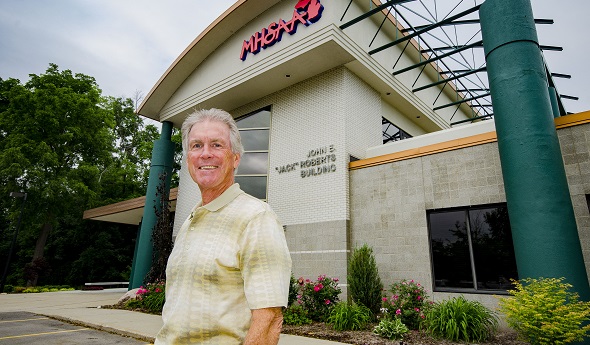
To recognize 32 years of leadership and service to Michigan educational athletics, the MHSAA Representative Council has named its home office in East Lansing after longtime Executive Director John E. “Jack” Roberts, who will retire in August.
The dedication of the “John E. ‘Jack’ Roberts Building” was approved by the Council during its Spring Meeting, May 6-7 in Gaylord, with the fabrication and assembly of the lettering financed by several private donations.
The building, located at 1661 Ramblewood Drive in East Lansing, opened as headquarters for the Association on January 3, 1997. The 20,000-square-foot, two-story facility houses MHSAA staff offices and resources including a publications library, plus multiple conference spaces frequently used to host meetings not only for MHSAA business but by leagues, coaches associations and other groups joining people from across the state.
Roberts, who announced his retirement April 24, will conclude his tenure next month as the second-longest serving full-time executive director during the MHSAA’s 94-year history. He is the fourth person to serve that leadership role full time, following Charles E. Forsythe (1931-42, 1945-68), Allen W. Bush (1968-78) and Vern L. Norris (1978-86). Roberts currently is also the nation’s longest-serving executive director of a state high school athletic association.
“This is an entirely unexpected honor,” Roberts said, “and while I am proud of the building, I’m even prouder of the people who have worked in it.”
The metallic lettering announcing the building’s name was designed by Image360 of Brighton and placed on the façade at the center of the building below the large MHSAA logo facing the property’s parking lot.
John Peckham, then of Martin Property Development of East Lansing, oversaw the original Ramblewood project. The building was designed by Keystone Design and built by Granger Construction.
Prior to the move to its current offices, the MHSAA was housed at 1019 Trowbridge Road in East Lansing from 1976-96. The MHSAA moved to the Trowbridge location from a downtown Lansing office it had leased since 1958.
With his retirement upcoming, Roberts also will leave the National Federation of State High School Associations (NFHS) Board of Directors later this week during the Summer Meeting in Chicago. He also will conclude an extended term as board chairperson of the NFHS Network. Roberts previously served as an assistant director for the National Federation from 1973-80 and came to the MHSAA in the fall of 1986 from the Fellowship of Christian Athletes, which he served as executive vice president.
Assistant Director Mark Uyl was chosen by the Representative Council in May to succeed Roberts as MHSAA executive director.
The MHSAA is a private, not-for-profit corporation of voluntary membership by more than 1,500 public and private senior high schools and junior high/middle schools which exists to develop common rules for athletic eligibility and competition. No government funds or tax dollars support the MHSAA, which was the first such association nationally to not accept membership dues or tournament entry fees from schools. Member schools which enforce these rules are permitted to participate in MHSAA tournaments, which attract more than 1.4 million spectators each year.
Soccer Hall of Famer Seitz, NFL Analyst Pereira Headline Officiate Michigan Day 2026
By
Geoff Kimmerly
MHSAA.com senior editor
July 14, 2026
Officiate Michigan Day 2026 will welcome more than 1,000 Michigan High School Athletic Association-registered game officials July 25 to DeVos Place in Grand Rapids, where they will receive knowledge and instruction from several high-profile voices headlined by recent National Soccer Hall of Fame inductee Kari Seitz – a Brighton High School graduate – and one of television’s most recognizable rules analysts, Mike Pereira.
Officiate Michigan Day is designed to benefit officials with any level of experience, veteran to beginner. High-profile clinicians representing several sports and all levels including the NFL, NBA, MLB, NCAA, FIFA and the National Women’s Soccer League (NWSL) will provide face-to-face training during four sport-specific breakout sessions throughout the conference.
Pereira, a past collegiate and NFL football official who also has served as the NFL’s vice president of officiating, will present the opening address at 9 a.m. He has provided his knowledge during FOX Sports football broadcasts since 2010, explaining rules scenarios on-air as situations unfold in-game.
Seitz, also a graduate of Michigan State University, refereed Women’s World Cups in 1999, 2003, 2007 and 2011 and Olympics tournaments in 2004, 2008 and 2012, and will deliver the conference’s closing message. She’s currently the vice president of refereeing for U.S. Soccer and formerly served as FIFA’s heading of refereeing.
This will be the third Officiate Michigan Day, joining events in 2013 and 2018. OMD 2026 will accompany the annual National Association of Sports Officials (NASO) Summit that will take place July 26-28, also at DeVos Place.
Officials may continue to register on the Officials page. Cost is $50. Additional details, including the full lineup of speakers and clinicians, also is available at that link.