


MHSAA Remembers Late Director Bush
By
Geoff Kimmerly
MHSAA.com senior editor
September 11, 2013
Allen W. Bush was a military man and had a military way about him.
And those traits no doubt were invaluable as the former U.S. Marine became a respected national voice during arguably the most transformative era in high school athletics.
Bush, who served as Executive Director the Michigan High School Athletic Association from the fall of 1968 through the summer of 1978, died Monday in Traverse City. He was 90.
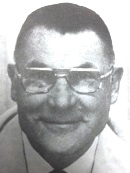 Bush oversaw some of the most significant developments in MHSAA history, chiefly the addition of girls sports – MHSAA tournaments existed for nine girls sports when he retired – plus the addition of football playoffs in 1975 and MHSAA tournaments in baseball, ice hockey and skiing.
“He led the MHSAA during simultaneously one of the most stressful and most exciting times as schools responded to federal legislation promoting opportunities for minorities and females,” current MHSAA Executive Director John E. “Jack” Roberts said. “Al Bush was among leaders who saw the opportunities instead of burdens of those laws.”
He began his tenure at the MHSAA on March 1, 1960, as Assistant State Director of Athletics to Executive Director Charles E. Forsythe. Bush’s designation changed to Associate Director in 1963, and on July 10, 1968 he was appointed to replace the retiring Forsythe as leader of the association.
An award bearing Bush’s name is bestowed by the MHSAA each spring to an administrator, coach, official, trainer, doctor, or member of the media who has at least 15 years of experience in Michigan interscholastic athletics with unusually frequent and significant contributions to the MHSAA.
Prior to joining the MHSAA, Bush taught mathematics, coached four sports and served as athletic director at different times during tenures at Battle Creek Central, Kalamazoo University, Dearborn and Bay City Handy high schools. Bush was a graduate of Kalamazoo University and later earned multiple bachelor’s degrees from Western Michigan University and a master’s in school administration from the University of Michigan. He was captain of the football team at WMU and received its Most Valuable Player and Athletic-Scholarship awards as a senior, and later was named Man of the Year in 1975 by WMU’s Alumni W Club.
Bush also studied at Princeton University and the University of Arizona and served six years of active duty with the U.S. Marine Corps during World War II and the Korean War. He was discharged with a rank of first lieutenant.
While at the MHSAA, Bush was a frequent contributor to the National Federation of State High School Associations. He served as chairperson of the committee that wrote the NFHS’s first swimming and diving rule book and also was a representative to the U.S. Olympic Committee.
A memorial service will take place at 11 a.m. Friday, Sept. 13, at Central United Methodist Church in Traverse City.
A summation written by late MHSAA historian Dick Kishpaugh during 1978 said the following of Bush's service to member schools:
"Through all of these varied and complex changes, the MHSAA has met its commitment to a high standard of excellence," Kishpaugh wrote.
"Al Bush is fallible, as we all are, but he needs to make no apologies. The accomplishments speak for themselves."
2026-27 MHSAA Officials Registration Underway
By
Geoff Kimmerly
MHSAA.com senior editor
June 15, 2026
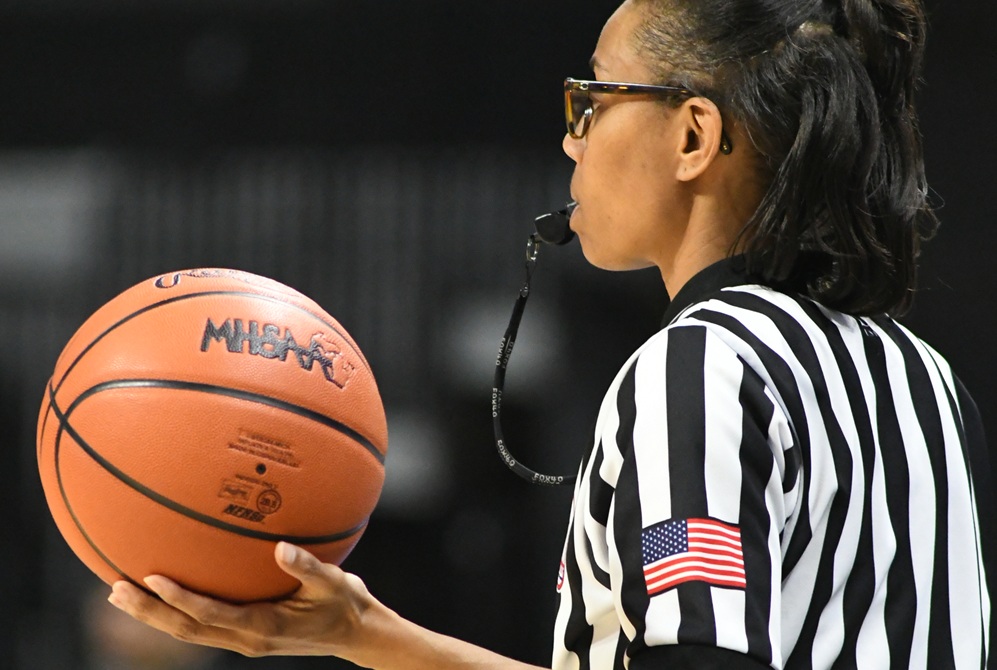
The Michigan High School Athletic Association is accepting registrations online for game officials for the 2026-27 school year.
The MHSAA registered 9,330 officials for the 2025-26 school year, an increase of 4.9 percent from the previous year’s total.
All officials who register may sign up for up to two sports as part of their registration. Officials also will receive membership in the National Association of Sports Officials (NASO), which comes with a variety of educational and training resources and the NASO’s Shield liability insurance that will provide $6 million in coverage for officials while they are working both MHSAA and non-MHSAA events.
For new and returning officials, a $70 fee covers registration for up to two sports. Officials may register for additional sports at $16 per sport.
To avoid a $30 late fee, all fall sport registration applications must be received by Aug. 17, 2026. Winter sports registrations must be received by Nov. 16 to avoid the late fee, and spring sports registrations must be received by March 24, 2027.
Online registration can be accessed on the Officials page. More information about officials registration may be obtained by contacting the MHSAA by phone at (517) 332-5046 or by e-mail at [email protected].
New officials and those who didn’t officiate during 2025-26 must complete an officials' registration test, derived from the MHSAA Officials Guidebook, and the online MHSAA Principles of Officiating course. Additional exams must be taken by those registering for football or basketball for the first time or those who were not registered for those sports during the previous school year. Links to the Officials Guidebook, Principles of Officiating presentation and the football and basketball mechanics manuals can be found by following the “New Officials” link on the Officials page of the MHSAA Website and completing the registration process.
There also are opportunities to officiate for students at least 14 years old and in grades 9-12 through the MHSAA Legacy Program. Juniors and seniors may officiate subvarsity contests, while freshmen and sophomores may officiate contests at the middle school/junior high levels. Mentor officials will work events with Legacy participants to provide guidance and support. Find information on the Legacy Program by clicking “Officials Registration” on the Officials page of the MHSAA Website and reading under “Student Legacy Program Requirements.”
While on MHSAA.com to register for the upcoming school year, officials also can register for Officiate Michigan Day 2026, set for July 25 in Grand Rapids.
Doors open at 7:30 a.m., with the first session at 9 a.m. at DeVos Place. The day-long event will feature dynamic speakers and presenters providing knowledge in several sports and all levels including collegiate and professional.
Cost is $45 if officials register by the end of June, and $50 beginning July 1. More information is on the way; keep posted at MHSAA.com/OMD.