

MHSAA Remembers Late Director Norris
By
Geoff Kimmerly
MHSAA.com senior editor
February 12, 2018
Jack Roberts always was astonished at the amount of detail his predecessor Vern Norris could recall about the people he’d met over many years contributing to high school athletics at the state and national levels.
 When the Michigan High School Athletic Association executive director last spoke with his predecessor, Norris had been in contact with past counterparts from Kansas, Iowa and the National Federation – although Norris had retired from the MHSAA more than three decades ago.
“He was genuinely interested in people and their backgrounds and their families,” Roberts said. “He had good friends. He was good at being a friend, and colleague. I think he genuinely cared about relationships between people.”
And he built many over 23 years at the MHSAA office.
Norris, who led the MHSAA from the fall of 1978 through the summer of 1986, died early Monday morning in Lansing. He was 89.
Norris joined the MHSAA staff on July 15, 1963, as Assistant State Director of Athletics under longtime Executive Director Charles E. Forsythe and then-Associate Director Allen W. Bush. Norris was promoted to Associate Director when Bush was appointed Executive Director in 1968, then took over as Executive Director upon Bush’s retirement in 1978. Forsythe, Bush, Norris and Roberts are the only full-time executive directors to serve during the MHSAA’s 94-year history.
Norris brought to the MHSAA a wealth of experience having coached at Traverse City, Rockford and Hillsdale high schools. He served as Assistant Director of Placement at Western Michigan University for the five years prior to joining the MHSAA staff, and during that time Norris built a reputation as a highly-regarded game official in the Kalamazoo area – and worked as a referee during the 1963 MHSAA Class A Boys Basketball Final.
Norris served on a number of national rules-making bodies during his 23-year tenure with the MHSAA, and as president of the Executive Board of the National Federation of State High School Associations (NFHS) during the 1983-84 school year. But he was best known for his work with Michigan’s coaches and especially officials. An award bearing Norris’ name is presented by the MHSAA each spring to a veteran official who has been active in a local officials association, has mentored other officials, and has been involved in officials’ education. The award has been given since 1992 at the annual Officials’ Awards & Alumni Banquet, which was begun during Norris’ tenure in 1980.
“Vern was respected and admired widely by contest officials, and it was because of that that I asked the Representative Council to approve an award for leaders who were especially involved in mentoring and training officials,” said Roberts, who succeeded Norris in 1986. “A total of 26 officials have received the Norris Award, and more than 10,000 officials have been honored at our annual banquet recognizing a group of contributors especially close to his heart.”
Norris shepherded a number of key advances during his tenures both as associate and executive director. The early 1970s saw the addition of MHSAA tournament events in girls sports, and football playoffs were added in 1975. Membership also grew during his time with the association; the MHSAA had 682 member high schools at the start of 1963-64, and 713 when Norris stepped down.
During his time at the MHSAA, Norris also served as a member of the NFHS Basketball Rules Committee from 1978-82, on the NFHS Constitution Revision Committee in 1979 and as a member of the editorial staff of the NFHS Rules Committee from 1980-82.
He served on the NFHS Executive Board representing Michigan’s section of five Midwestern states during a four-year term that concluded with his year as president, and he also served as chairperson of the NFHS Telecommunications Committee in 1972.
After leaving the MHSAA, Norris served as Commissioner of the Great Lakes Intercollegiate Athletic Conference from fall of 1987 through the close of the 1991-92 school year.
 In retirement, Norris kept in touch with MHSAA staff. He and Roberts spoke every few months throughout the years. And, “he could not have been more gracious when he retired and I was hired. He gave me total support and just the right amount of advice,” Roberts added.
When Norris announced he was leaving the MHSAA early in 1986, then-Lansing State Journal Prep Editor Bob Gross wrote “his integrity is beyond question. He has never shown favoritism to a school, and he has never bent the rules. It’s always been strictly business, exactly what it should be. … That’s why I liked Vern Norris so much. He has always been fair.”
A graduate of Grand Rapids Godwin Heights High School, Norris earned his bachelor’s degree in physical education from Western Michigan University and a master’s in school administration from the University of Michigan.
In addition to his MHSAA and NFHS work, Norris served as a football or basketball rules clinician in various states and multiple provinces of Canada, and served on amateur basketball’s rules-making body at the time – the National Basketball Committee of the United States and Canada – from 1972-76. He contributed during the late 1960s and 1970s on the National Alliance Basketball Advisory and National Alliance Football Rules committees. Norris also served on the United States Olympic Committee’s House of Delegates in 1985.
A Service of Coronation will be held at 11 a.m. Friday at Trinity Lutheran Church in Lansing, with family receiving friends from 2-4 and 6-8 p.m. Thursday at Estes-Leadley Greater Lansing Chapel and at 10 a.m. Friday at the church.
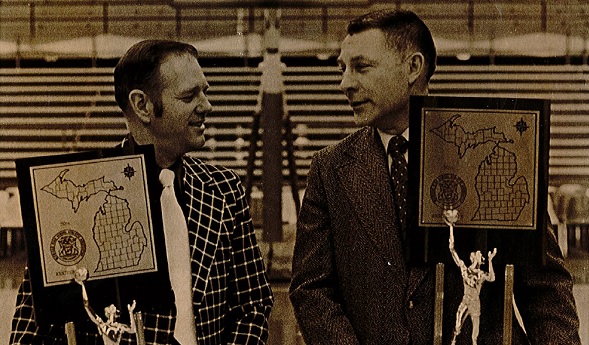
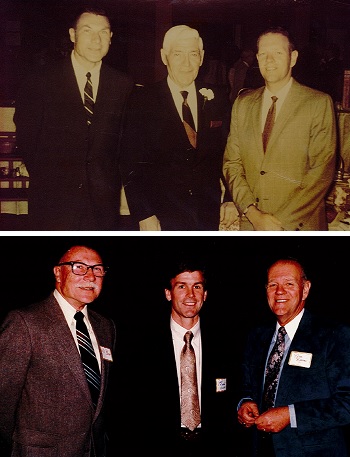
PHOTOS: (Top) Then-Associate Director Vern Norris and Executive Director Al Bush hold up trophies to be awarded at the 1974 Boys Basketball Finals. (Middle) Bush, Charles E. Forsythe and Norris. (Below) Bush, current Executive Director Jack Roberts and Norris in 1988.

2020-21 Classifications Announced
April 20, 2020
By Geoff Kimmerly
Second Half editor
Classifications for MHSAA elections and postseason tournaments for the 2020-21 school year have been announced – including football divisions determined preseason for the first time since 1998 – and with enrollment breaks for postseason tournaments posted to each sport’s page on the MHSAA Website.
Classifications for the upcoming school year are based on a second semester count date, which for MHSAA purposes was Feb. 12. The enrollment figure submitted for athletic classification purposes may be different from the count submitted for school aid purposes, as it does not include students ineligible for athletic competition because they reached their 19th birthday prior to September 1 of the current school year and will not include alternative education students if none are allowed athletic eligibility by the local school district.
All sports’ tournaments are conducted with schools assigned to equal or nearly equal divisions, with lines dependent on how many schools participate in those respective sports.
For 2020-21, there are 752 tournament-qualified member schools. Schools recently were notified of their classification, and sport-by-sport divisions were posted to the MHSAA Website today (April 20). MHSAA Executive Director Mark Uyl said schools may not subsequently lower their enrollment figure. However, if revised enrollment figures are higher and indicate that a school should be playing in a higher division, that school would be moved up.
Football will undergo a significant classification change for the 2020 season, with teams in both 11 and 8-player assigned their divisions before the season for the first time since 1998; from 1999-2019, divisions for the 256-team 11-player field (and later the 8-player tournament) were determined after the regular season. A hard enrollment limit also will take effect this fall for teams to be eligible for the 8-player tournament – all schools with 215 or fewer students are eligible for the 8-player playoffs if they play that format during the regular season.
Two 11-player football champions will play in different divisions in 2020 than those they won a year ago. Grand Rapids Catholic Central will move to Division 5 after winning the Division 4 championship last season, while reigning Division 6 champion Monroe St. Mary Catholic Central will play in Division 7 this upcoming season. Also, 2019 Division 2 runner-up Detroit Martin Luther King will play in Division 3 this fall. In 8-player football, the reigning champions will trade divisions – 2019 Division 1 winner Colon moving into Division 2, and Division 2 champ Pickford moving into Division 1 for this fall.
A number of 2019-20 champions will be playing in different divisions in 2020-21. Grand Rapids Forest Hills Northern’s boys soccer team will move into Division 1 after winning the Division 2 title in 2019. The East Grand Rapids girls swimming & diving team will move back into Lower Peninsula Division 2 – which it won in 2017 – after earning the last two championships in Division 3. Bridgman’s girls cross country team will move into Lower Peninsula Division 3 after winning Division 4 last fall, and Grass Lake’s boys bowling team will move into Division 3 after winning the Division 4 title this winter. The Allegan boys tennis team will move into Lower Peninsula Division 3 after sharing the Division 4 title in the fall, while the Ishpeming Westwood girls tennis team will move into Upper Peninsula Division 1 after winning the Division 2 title the last four seasons. (NOTE: MHSAA Finals in five Winter sports and all Spring sports were canceled in 2019-20 due to COVID-19.)
Visit the respective sport pages on the MHSAA Website to review the divisional alignments for all MHSAA-sponsored tournament sports.
Traditional classes (A, B, C, D) – formerly used to establish tournament classifications – are used only for MHSAA elections. To determine traditional classifications, after all counts are submitted, tournament-qualified member schools are ranked according to enrollment and then split as closely into quarters as possible. For 2020-21, there are 188 member schools in each class.
Effective with the 2020-21 school year, schools with 831 or more students are in Class A. The enrollment limits for Class B are 392-830, Class C is 182-391, and schools with enrollments of 181 and fewer are Class D. The break between Classes A and B decreased 32 students from 2019-20, the break between Classes B and C decreased three students, and the break between Classes C and D is seven students fewer than the 2019-20 school year.
The new classification breaks will see 18 schools move up in Class for 2020-21 while 15 schools will move down:
Moving Up from Class B to Class A
Fowlerville
Harper Woods
Ionia
Moving Down from Class A to Class B
Battle Creek Harper Creek
Eastpointe
Moving Up from Class C to Class B
Blissfield
Canton Prep
Dearborn Riverside Academy West
Detroit Pershing
Detroit Edison
Ecorse
Moving Down from Class B to Class C
Adrian Madison
Detroit Jalen Rose Leadership Academy
Grand Rapids Wellspring Prep
Menominee
Otisville-LakeVille Memorial
Perry
Pinconning
Moving Up from Class D to Class C
Birmingham Roeper
Detroit Academy of the Americas
Detroit Southeastern
Detroit The School at Marygrove
Eau Claire
Genesee
New Buffalo
Painesdale Jeffers
Moving up from Class D to Class B
Detroit Cornerstone Lincoln King Academy
Moving Down from Class C to Class D
Benton Harbor Countryside Academy
Deckerville
Detroit Douglass
Detroit Public Safety Academy
Indian River Inland Lakes
Mayville
New Postseason Eligible Tournament Schools in 2020-21
Bay City Academy
Boyne City Concord Academy
Detroit Cornerstone Lincoln King Academy
Lansing Martin Luther
Detroit Collegiate
Redford Westfield Prep
Enrollment Breaks by Classes – 2020-21
(Number of schools in parentheses)
Class A: 831 and above (188 schools)
Class B: 392 – 830 (188)
Class C: 182 – 391 (188)
Class D: 181 and below (188)
The MHSAA is a private, not-for-profit corporation of voluntary membership by more than 1,500 public and private senior high schools and junior high/middle schools which exists to develop common rules for athletic eligibility and competition. No government funds or tax dollars support the MHSAA, which was the first such association nationally to not accept membership dues or tournament entry fees from schools. Member schools which enforce these rules are permitted to participate in MHSAA tournaments, which attract more than 1.4 million spectators each year.