

MHSAA Remembers Late Director Norris
By
Geoff Kimmerly
MHSAA.com senior editor
February 12, 2018
Jack Roberts always was astonished at the amount of detail his predecessor Vern Norris could recall about the people he’d met over many years contributing to high school athletics at the state and national levels.
 When the Michigan High School Athletic Association executive director last spoke with his predecessor, Norris had been in contact with past counterparts from Kansas, Iowa and the National Federation – although Norris had retired from the MHSAA more than three decades ago.
“He was genuinely interested in people and their backgrounds and their families,” Roberts said. “He had good friends. He was good at being a friend, and colleague. I think he genuinely cared about relationships between people.”
And he built many over 23 years at the MHSAA office.
Norris, who led the MHSAA from the fall of 1978 through the summer of 1986, died early Monday morning in Lansing. He was 89.
Norris joined the MHSAA staff on July 15, 1963, as Assistant State Director of Athletics under longtime Executive Director Charles E. Forsythe and then-Associate Director Allen W. Bush. Norris was promoted to Associate Director when Bush was appointed Executive Director in 1968, then took over as Executive Director upon Bush’s retirement in 1978. Forsythe, Bush, Norris and Roberts are the only full-time executive directors to serve during the MHSAA’s 94-year history.
Norris brought to the MHSAA a wealth of experience having coached at Traverse City, Rockford and Hillsdale high schools. He served as Assistant Director of Placement at Western Michigan University for the five years prior to joining the MHSAA staff, and during that time Norris built a reputation as a highly-regarded game official in the Kalamazoo area – and worked as a referee during the 1963 MHSAA Class A Boys Basketball Final.
Norris served on a number of national rules-making bodies during his 23-year tenure with the MHSAA, and as president of the Executive Board of the National Federation of State High School Associations (NFHS) during the 1983-84 school year. But he was best known for his work with Michigan’s coaches and especially officials. An award bearing Norris’ name is presented by the MHSAA each spring to a veteran official who has been active in a local officials association, has mentored other officials, and has been involved in officials’ education. The award has been given since 1992 at the annual Officials’ Awards & Alumni Banquet, which was begun during Norris’ tenure in 1980.
“Vern was respected and admired widely by contest officials, and it was because of that that I asked the Representative Council to approve an award for leaders who were especially involved in mentoring and training officials,” said Roberts, who succeeded Norris in 1986. “A total of 26 officials have received the Norris Award, and more than 10,000 officials have been honored at our annual banquet recognizing a group of contributors especially close to his heart.”
Norris shepherded a number of key advances during his tenures both as associate and executive director. The early 1970s saw the addition of MHSAA tournament events in girls sports, and football playoffs were added in 1975. Membership also grew during his time with the association; the MHSAA had 682 member high schools at the start of 1963-64, and 713 when Norris stepped down.
During his time at the MHSAA, Norris also served as a member of the NFHS Basketball Rules Committee from 1978-82, on the NFHS Constitution Revision Committee in 1979 and as a member of the editorial staff of the NFHS Rules Committee from 1980-82.
He served on the NFHS Executive Board representing Michigan’s section of five Midwestern states during a four-year term that concluded with his year as president, and he also served as chairperson of the NFHS Telecommunications Committee in 1972.
After leaving the MHSAA, Norris served as Commissioner of the Great Lakes Intercollegiate Athletic Conference from fall of 1987 through the close of the 1991-92 school year.
 In retirement, Norris kept in touch with MHSAA staff. He and Roberts spoke every few months throughout the years. And, “he could not have been more gracious when he retired and I was hired. He gave me total support and just the right amount of advice,” Roberts added.
When Norris announced he was leaving the MHSAA early in 1986, then-Lansing State Journal Prep Editor Bob Gross wrote “his integrity is beyond question. He has never shown favoritism to a school, and he has never bent the rules. It’s always been strictly business, exactly what it should be. … That’s why I liked Vern Norris so much. He has always been fair.”
A graduate of Grand Rapids Godwin Heights High School, Norris earned his bachelor’s degree in physical education from Western Michigan University and a master’s in school administration from the University of Michigan.
In addition to his MHSAA and NFHS work, Norris served as a football or basketball rules clinician in various states and multiple provinces of Canada, and served on amateur basketball’s rules-making body at the time – the National Basketball Committee of the United States and Canada – from 1972-76. He contributed during the late 1960s and 1970s on the National Alliance Basketball Advisory and National Alliance Football Rules committees. Norris also served on the United States Olympic Committee’s House of Delegates in 1985.
A Service of Coronation will be held at 11 a.m. Friday at Trinity Lutheran Church in Lansing, with family receiving friends from 2-4 and 6-8 p.m. Thursday at Estes-Leadley Greater Lansing Chapel and at 10 a.m. Friday at the church.
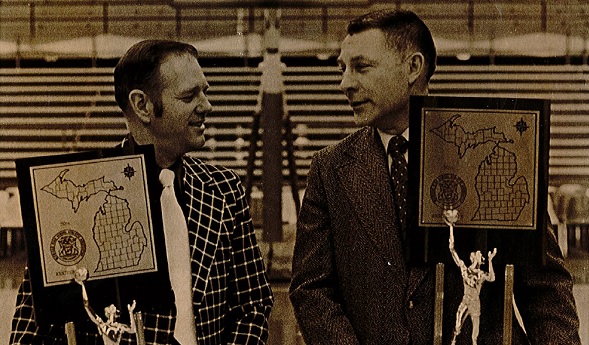
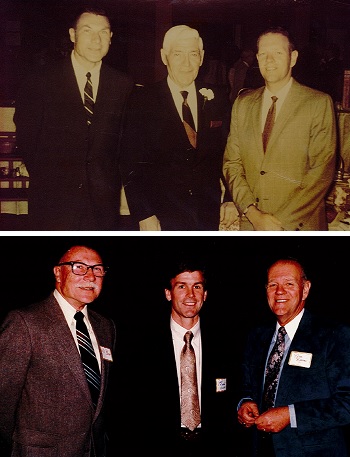
PHOTOS: (Top) Then-Associate Director Vern Norris and Executive Director Al Bush hold up trophies to be awarded at the 1974 Boys Basketball Finals. (Middle) Bush, Charles E. Forsythe and Norris. (Below) Bush, current Executive Director Jack Roberts and Norris in 1988.
Scholars & Athletes 2018: Class B
By
Geoff Kimmerly
MHSAA.com senior editor
February 9, 2018
By Geoff Kimmerly
Second Half editor
The Michigan High School Athletic Association has selected eight student-athletes from Class B member schools to receive scholarships through the MHSAA/Farm Bureau Insurance Scholar-Athlete Award program.
 Farm Bureau Insurance, in its 29th year of sponsoring the award, will give $1,000 college scholarships to 32 individuals who represent their member schools in at least one sport in which the Association sponsors a postseason tournament. The first 30 scholarships are awarded proportionately by school classification and the number of student-athletes involved in those classes; also, there are two at-large honorees who can come from any classification.
Students applying for the Scholar-Athlete Award must be carrying at least a 3.5 (on a 4.0 scale) grade-point average and have previously won a letter in a varsity sport in which the Michigan High School Athletic Association sponsors a postseason tournament. Other requirements for the applicants were to show active participation in other school and community activities and produce an essay on the importance of sportsmanship in educational athletics.
Each of the scholarship recipients will be honored at a halftime ceremony during the Class C Boys Basketball Final game March 24 at the Breslin Student Events Center in East Lansing. Commemorative medallions will be given to the finalists in recognition of their accomplishments.
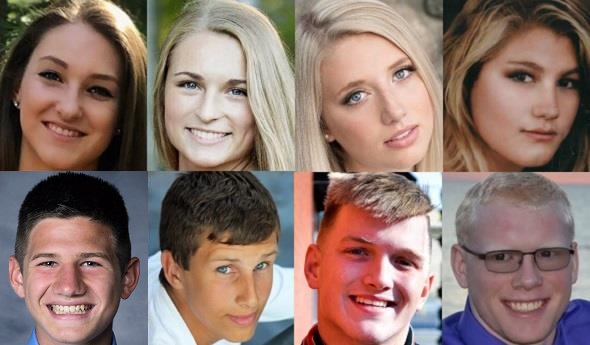
The Class B Scholar-Athlete Award honorees are Emily Buska, Saginaw Swan Valley; Mackenzie M. Kalchik, Sault Ste. Marie; Hannah Shorkey, Essexville Garber; Izabella Marie Taylor, Three Rivers; Troy Joseph Distelrath, St. Clair; Hunter Goldensoph, Saginaw Swan Valley; Anthony Reo, Paw Paw; and Justin A. Lyle, Dowagiac.
Overviews of the scholarship recipients of the Class B Scholar-Athlete Award follow. A quote from each recipient's essay also is included:
 Emily Buska, Saginaw Swan Valley
Playing third year of varsity basketball and played one each of varsity volleyball and varsity soccer; ran varsity cross country for the third time in the fall and will participate in third season of varsity track & field this spring. Served as captain of volleyball, basketball and cross country teams, and earned all-league honors in volleyball, cross country and track. Also earned all-state in track and all-county in cross country. Earned academic all-state in track and carries a 4.0 grade-point average. Participating in second year of National Honor Society, third as student government class representative and second as executive board treasurer. Performed more than 100 hours of community service and earned Habitat for Humanity Appreciation Award. Participating in fourth year of Business Professionals of America and earned Statesman Torch Award and first and third places in regional competition. Participating in fourth year of Students Against Destructive Decisions and school’s Pay It Forward charity organization, and is the head basketball official for Saginaw Township Parks & Recreation. Will attend Saginaw Valley State University and study pre-medical.
Essay Quote: “Sportsmanship keeps the world running smoothly, whether it is in educational athletics, or in life. We need this generosity in the world to help balance the light and dark.”
 Mackenzie M. Kalchik, Sault Ste. Marie
Playing fourth season of varsity basketball, ran four seasons of varsity cross country and played four seasons of varsity soccer; also plans to participate in her first season of varsity track & field this spring. Earned various team awards in cross country, basketball and soccer plus all-conference in cross country and basketball and all-Upper Peninsula recognition in hoops. Captained all three teams. Earned academic all-state in cross country and is participating in her second year of National Honor Society. Serving second year in student government and has served as president and historian; also is serving third year in Students United and has been a group leader. Totaled more than 300 hours of community service and earned a Presidential Service Award. Also participates in her church youth group, Business Professionals of America chapter and is in her third year on Youth Advisory Council. Will attend Lake Superior State University and study pre-medical.
Essay Quote: “My team made history that day, and they did it without me. … I could have pitied myself and not been happy for my team because I didn’t contribute that day of history. But because of my sportsmanship, I made that day what it was really about, my team doing something Sault High had never done before.”
 Hannah Shorkey, Essexville Garber
Playing third season of varsity basketball, played two of varsity volleyball, two of varsity softball and will play her second of varsity soccer this spring. Earned softball all-conference recognition and helped that team to multiple District titles, and earned volleyball academic all-state and helped that team to a District championship. Served as basketball team captain. Participating in fourth years of student council and Students Leading Students, serving as vice president of both. Also participating in second year of National Honor Society and National Technical Honor Society. Participating in second year of Health Occupations Students of America and as parliamentary procedure team vice president, and earned regional awards for HOSA and state recognition for student council as well as a Michigan Student Service Award. Participates in a variety of volunteer efforts and served as a Relay for Life senior captain. Will attend Grand Valley State University and study biomedical sciences and chemistry on a pre-medical track.
Essay Quote: “When people think of sportsmanship, they associate it with the idea of being okay with losing. But that’s not what it is. It’s okay to be hurt when you lose; that shows that what you’re doing is important. Sportsmanship is getting back up after that loss, and doing it with dignity and respect towards your opponent.”
 Izabella Marie Taylor, Three Rivers
Playing second season of varsity basketball, and will compete in fourth varsity seasons of soccer and track & field this spring; also played two seasons of subvarsity volleyball. Earned soccer all-league, all-District and academic all-state honors and all-league, all-state and academic all-state in track. Captained basketball and soccer teams and helped the basketball team to a District title. Placed at MHSAA Track & Field Finals as a sophomore. Participating in fourth year of student council and this year as treasurer after previously serving as class president. Participating in third year of DECA and as chapter president this year; helped team to district and state championships and national finals. Participating in fourth year of marching and symphony band and has earned top ratings for solo and ensemble. Participating in third year of National Honor Society and volunteers for a number of efforts, and has served as a youth sports coach and referee and school tutor and mentor. Has not decided where she will attend college but will study biomedical sciences and pre-dentistry.
Essay Quote: “True sportsmanship is the summit in the evolution of any great player. To evolve as an athlete is to encompass sportsmanship’s many core values. Knowledge. Honor. Integrity. Discipline. Compassion. Respect.”
 Troy Joseph Distelrath, St. Clair
Played four seasons of varsity tennis and two of varsity basketball. Won multiple Regional championships in tennis and helped team to its best Finals finish; earned all-league and all-area honors plus all-league academic honors. Served as captain of both tennis and basketball teams. Participating in third year of National Honor Society and serves on chapter’s executive board; also is serving fourth year on the St. Clair County Youth Advisory Committee and second as executive board member and committee chairperson. Participated in National Youth Leadership Forum’s Law and CSI program in Washington, D.C., and was chosen from 300 students to speak at the closing ceremony. Serving fourth year on student council and second as part of the East China School District Superintendent’s Advisory Council. Will attend Michigan State University and study political theory and constitutional democracy.
Essay Quote: “At its most fundamental level, this is the essence of sportsmanship: the mutual appreciation of one’s dedication and determination, the common understanding that as athletes we make daily sacrifices in order to achieve a similar goal, and the shared mentality that while we strive to reach greatness on our respective fields of play, unspoken boundaries may not be crossed if order and civility are to remain intact.”
 Hunter Goldensoph, Saginaw Swan Valley
Played two seasons of varsity soccer, two of varsity basketball and will play his second of varsity baseball and participate in second of varsity track & field this spring. Earned all-league and all-District soccer awards, and served as team captain. Helped soccer team to a league title and soccer and baseball teams to District championships. Participating in second year of National Honor Society and third in Business Professionals of America; helped BPA team to regional title and state placing. Participated three years with church youth group and vacation Bible school; also has served as youth coach and official. Served on Michigan Humanities Council’s “Great Michigan Read” selection committee as a junior and has volunteered two years with Special Olympics. Will attend Eastern Michigan University and study chemistry, biology and business.
Essay Quote: “Sportsmanship is so much more than what everyone believes. It isn’t just shaking the other team’s hands after the game; true sportsmanship is knowing that you need your opponent because without him or her, there is no game. It is acknowledging that your opponent holds the same passion as you, that they have the same drive and determination that brings you back to practice every single day.”
 Justin A. Lyle, Dowagiac
Played two seasons of varsity football after moving up as a sophomore, wrestled four seasons and will participate in his third of track & field this spring. Served as captain of the football and wrestling teams, and helped the wrestling team to multiple District championships. Earned all-league honors in both football and wrestling. Participating in fourth year of student government and third of student senate, and has served as class president all four years. Serving as National Honor Society chapter president and president as well of Rotary Interact Club. Also is serving his second term as treasurer of the school’s Chieftain Heart sportsmanship club. Volunteers with his church and has taught three years of Sunday School. Earned the Presidential Bronze Volunteer Service Award and Daughters of the American Revolution scholarship. Will attend Central Michigan University and study broadcasting and cinematic arts.
Essay Quote: “Accountability is an exceptional virtue to those who display sportsmanship. Displaying sportsmanship teaches young athletes that every action they make will directly affect themselves and their peers. Accepting the responsibility for the mistakes one makes can be much tougher than accepting the admiration for the successes achieved; however, facing the mistakes often reveals the athlete’s true character.
 Anthony Reo, Paw Paw
Played three seasons of varsity football and wrestled four seasons on varsity. Served as multiple-season captain in both sports and earned all-state honors in wrestling and all-conference in both sports. Placed fifth in his weight class at last season’s MHSAA Individual Finals. Named National Merit Commended Scholar and earned National Honor Society recognition and Daughters of the American Revolution Good Citizen Award. Serving fourth year on student council and has held offices of president and executive secretary, and assisted in the drafting of a new constitution. Also participating in fourth year of Key Club and has served as editor and president while helping form the school’s largest club ever. Served as youth coach and official. Co-founded Pillars student-led support group and participating in fourth year of Peer Assistance Leaders. Served as an intern with Servicemembers Civil Relief Act Foundation. Will attend Princeton University and study entrepreneurship.
Essay Quote: “I know that, whether I want it or not, youth in my community are guided by my example and strive to imitate my actions. This is what motivates me to perform both on and off the field. As a student-athlete, I know my actions set a standard for behavior in my community, and I want that behavior to be grounded in excellence.”
Other Class B girls finalists for the Scholar-Athlete Award were: Megan Brooks, Saginaw Swan Valley; Katelyn Brown, Jonesville; Kate Cao, Bloomfield Hills Cranbrook Kingswood; MacKenzie Desloover, Yale; Valeta A. Gage, Sault Ste. Marie; Celia C. Gaynor, Pontiac Notre Dame Prep; Caroline Hirth, Chelsea; Mackenzie Horn, Marshall; Jordyn Kriegl, Kingsford; Mackenzie Luce, Ludington; Lauren Neiheisel, Pontiac Notre Dame Prep; and Grace VerHage, Otsego.
Other Class B boys finalists for the Scholar-Athlete Award were: David Ameriguian, Grosse Ile; Patrick J. Bertoni, Chelsea; Vincent Goyette, Flint Powers Catholic; Anthony Harris, Frankenmuth; Jacob Keener, Ferndale; Jackson Lund, Big Rapids; Lucas Misra, Bloomfield Hills Cranbrook Kingswood; Thomas Otten, Paw Paw; Sawyer Perpich, Kingsford; William Rayner, Marshall; Caleb Schoon, Ludington; and John Stellard, Ferndale.
The Class A scholarship award recipients will be announced Feb. 20. Class C and D honorees were announced Feb. 6.
Farm Bureau Insurance of Michigan was founded in 1949 by Michigan farmers who wanted an insurance company that worked as hard as they did. Those values still guide the company today and are a big reason why it is known as Michigan’s Insurance Company, dedicated to protecting the farms, families, and businesses of this great state. Farm Bureau Insurance agents across Michigan provide a full range of insurance services — life, home, auto, farm, business, retirement, Lake Estate®, and more — protecting nearly 500,000 Michigan policyholders.
The MHSAA is a private, not-for-profit corporation of voluntary membership by more than 1,500 public and private senior high schools and junior high/middle schools which exists to develop common rules for athletic eligibility and competition. No government funds or tax dollars support the MHSAA, which was the first such association nationally to not accept membership dues or tournament entry fees from schools. Member schools which enforce these rules are permitted to participate in MHSAA tournaments, which attract more than 1.4 million spectators each year.