MHSAA Tickets Go Digital with GoFan
November 2, 2020
By John Johnson
MHSAA Director of Broadcast Properties
The MHSAA, in partnership with GoFan and high schools across the state, have kicked off the 2020 Football Playoffs with a new touchless, digital ticket offering.
Sporting events across the country are looking a little different this year with limited capacity in stadiums, social distancing and other statewide regulations that are challenging state associations and schools to think creatively on how to get fans in the stands safely. Digital ticketing is a faster and more expedient way to attend events and now a safer way as well.
“GoFan will make it easier on our spectators to purchase tickets for our tournament events and easier for our tournament sites from a management standpoint." said Mark Uyl, Executive Director of the MHSAA. “During this pandemic, GoFan is making it more convenient – and safer – for everyone.”
With limited capacity in mind, a select number of tickets are distributed to each team in advance of the game. Priority ticket purchasing is available first to parents and family members through a VIP link. Public sale of tickets may not be offered at all sites, based on availability, but purchasing may be done on the participating school GoFan pages beginning at 6 p.m. Wednesday each week.
“GoFan is proud to partner with the MHSAA and play a key role in their digital ticketing implementation across the (state),” said B.J. Pilling, Chief Executive Officer of GoFan. “Digital ticketing is being adopted as the primary choice for many high schools and state associations."
MHSAA and GoFan also are implementing touchless ticketing across the state of Michigan during soccer, volleyball and cross country championships.
For a full list of championship events and how to get your tickets, click here.
About GoFan: GoFan is the leading digital ticketing solution for high school events. Led by innovative technology and unmatched support, GoFan provides schools with a turnkey platform to manage season, online, and at-event ticket sales. GoFan is a product of Huddle Tickets, which has provided over 2 billion event tickets to schools since 2001. Serving over 2,000 high schools and 37 state associations, GoFan provides fans frictionless access to high school events across the country (click link for more). You can also follow the company on Twitter @GoFanHS and LinkedIn, and like GoFan on Facebook.
About Michigan High School Athletic Association: The MHSAA is a private, not-for-profit corporation of voluntary membership by more than 1,500 public and private senior high schools and junior high/middle schools which exists to develop common rules for athletic eligibility and competition. No government funds or tax dollars support the MHSAA, which was the first such association nationally to not accept membership dues or tournament entry fees from schools. Member schools which enforce these rules are permitted to participate in MHSAA tournaments, which attract more than 1.4 million spectators each year.
'Check-in Champ' App Rewards Fans
January 10, 2017
By Geoff Kimmerly
Second Half editor
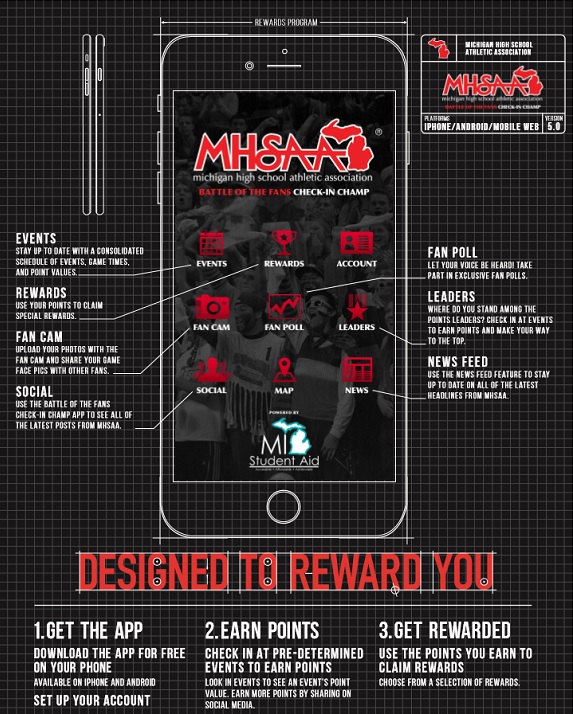
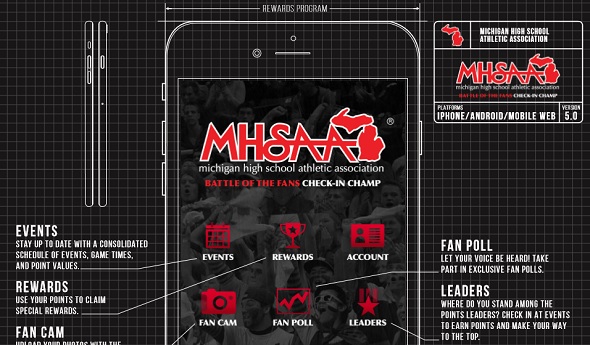
The Michigan High School Athletic Association and SuperFanHigh, a leading fan loyalty and engagement company, have launched a mobile app that will allow students, faculty, alumni, community members and all fans to earn prizes and college scholarships by showing support for high school basketball teams.
To participate, fans simply need to download the “Check-in Champ” app for free from the Apple iTunes or Google Play online stores and then check in at high school girls and boys basketball games they are attending this season. SuperFanHigh will track these check-ins and provide standings of fans who attend the most events statewide beginning Tuesday, Jan. 10. Fans “checking in” accrue points toward prizes including a total of $5,000 in college scholarships sponsored by MI Student Aid.
“The ‘Check-in Champ’ contest provides an exciting opportunity for our schools to promote their regular-season girls and boys basketball games,” MHSAA Executive Director John E. “Jack” Roberts said. “We’re eager to see how this will build more excitement at games, both during the regular season and the MHSAA tournament, and we’re appreciative of MI Student Aid for adding significant incentive for students and their families who support their classmates and communities.”
For the remainder of this Michigan high school boys and girls basketball season, fans who attend games will earn points. When registering on the app, fans must select their favorite school. Schools will be divided by Class: A, B, C and D. A $3,000 scholarship will be awarded to the fan who earns the most points overall across all four classes, and $500 scholarships will be awarded to fans who earn the most points in each class.
Only student fans will be eligible to use the college scholarships; however, fans who are not students may still compete for the scholarships and designate them for specific students should they win the contest. All fans, including those who are not students, will be able to earn app “badges” as they accrue points, and the top 100 point-getters will receive shirts printed to celebrate their accomplishment in the contest.
“We are excited about partnering with the MHSAA to launch this new app,” said Anne Wohlfert, Director of the Student Financial Services Bureau at the Michigan Department of Treasury. “We are pleased to offer $5,000 in scholarship dollars to the students who attend the most games. This joint venture aligns with our goals to provide high school students and their families with student financial resources and information.”
The app provides other information for students and fans including their selected schools’ boys and girls basketball team schedules, MHSAA news and an opportunity to share photos through a ‘fan cam.’ Participants may accrue bonus points by answering MHSAA basketball trivia questions and promoting their “check-ins” on social media.
SuperFanHigh is a division of its parent company, SuperFanU and provides fan experiences for more than 300 high schools and colleges/universities across the country. The company is leading the market in developing innovative platforms that allow the communication and marketing between students/fans and schools to be more engaging and efficient.
“We know that our partnership with MHSAA will yield lots of excitement this year across the state of Michigan,” says Kayla Mount, co-founder and COO of SuperFanU.