


MHSAA Ups Awareness with 'Heat Ways'
August 6, 2013
With the beginning of a new year for high school sports just a week away, members of the Michigan High School Athletic Association have been preparing to follow a new model policy for hot weather activity, guided by a new publication and a rules meeting emphasis on heat and hydration.
The MHSAA Representative Council adopted a Model Policy for Managing Heat & Humidity earlier this year, a plan many schools have since adopted at the local level. The plan directs schools to begin monitoring the heat index at the activity site once the air temperature reaches 80 degrees, and provides recommendations when the heat index reaches certain points, including ceasing activities when it rises above 104 degrees.
The model policy is outlined in a number of places, including a new publication called Heat Ways, which is available for download from the MHSAA Website. Heat Ways not only provides the model policy, but addresses the need for proper acclimatization in hot weather.
The topic of heat-related injuries receives a lot of attention at this time of year, especially when deaths at the professional, collegiate and interscholastic levels of sport occur, and especially since they are preventable in most cases with the proper precautions. In football, data from the National Federation of State High School Associations shows that 41 high school players have died from heat stroke between 1995 and 2012.
Even before the days of the Internet, the MHSAA held a leadership role in providing resources each Spring to assist schools in their preparation for hot preseason practices. In addition to the information now contained in Heat Ways, the Association is making dealing with heat, hydration and acclimatization the topic for its required preseason rules meetings for coaches and officials. The 15-minute online presentation spends a fair amount of time talking about the need for good hydration in sports, regardless of the activity or time of year.
The Health & Safety Resources page of the MHSAA Website has a set a number of links to different publications and information, and a free online presentation from the National Federation of State High School Associations. Visit MHSAA.com, click on Schools, and then on Health & Safety Resources to find the information.
“We know now more than we ever have about when the risk is high and who is most at risk, and we’re fortunate to be able to communicate that information better than ever before to administrators, coaches, athletes and parents," said John E. “Jack” Roberts, executive director of the MHSAA. “Heat stroke is almost always preventable, and we encourage everyone to avail themselves of the information on our website.”
Roberts added that the first days of formal practices in hot weather should be more for heat acclimatization than the conditioning of athletes, and that practices in such conditions need planning to become longer and more strenuous over a gradual progression of time.
“Then, schools need to be vigilant about providing water during practices, making sure that youngsters are partaking of water and educating their teams about the need for good hydration practices away from the practice and competition fields,” Roberts said.
'Yard Squad' Enjoys Unexpected Response
May 20, 2017
By Geoff Kimmerly
Second Half editor
The task itself was a simple one, and the reasons for doing it simple at first.
 An elderly woman called Colon High School – on the advice of her daughter, who teaches in the Upper Peninsula – looking for a student group that might be interested in assisting with some yard work.
Sophomore Andrew Smolarz, meanwhile, always is looking for community service hours to go toward membership in his school’s Varsity Club and National Honor Society chapter.
So he and four track & field teammates volunteered and spent a few hours picking up sticks, raking around her house and cleaning up brush. But they never anticipated the response.
“After the first time we did it, the reaction we got from people – it was more than just doing work for them,” Smolarz said. “When she saw us, the first lady said we’d restored her faith in the youth in the community. She got pretty teary-eyed, so it meant a lot to us, and she wanted a hug from all of us too.”
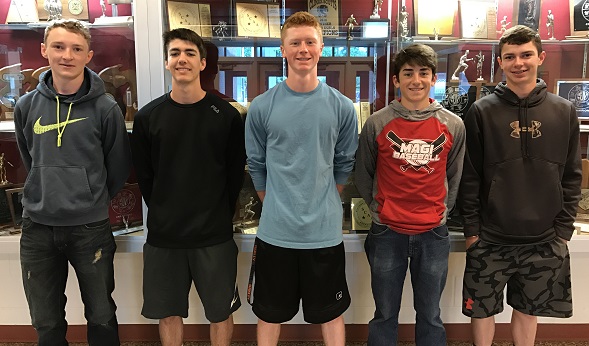
Since, Smolarz and his “Yard Squad” – sophomores Isaiah Fellers and Andy Stoll and freshmen Philip Alva and Austin Stoll – have taken their cleaning talents to two more homes, with three more and a restaurant also on the schedule.
Colon’s Yard Squad is a recipient of an inaugural MHSAA/Lake Trust Credit Union “Community Service Award” recognizing contributions by Michigan’s high school student-athletes away from the field. The Yard Squad will receive $1,000, which will go toward Colon’s athletic department and equipment for the track & field and baseball teams. Six honorees total are receiving awards this spring; Second Half will feature one a day this week.
While there are a multitude of ways to serve one’s community – over the next few days we will feature some incredibly impressive campaigns to raise money, awareness and donate goods to those in need – Colon’s Yard Squad found a way to help that students at any school can replicate, and to the same unexpected benefits.
That first call ended up on the ear of Colon athletic director Paige Smolarz – also Andrew’s mother and the school’s boys track & field coach – and when she offered the opportunity, these five underclassmen stepped up. It’s not that they don’t have other things going on; all five are dual sport athletes also playing baseball or golf, so clean-ups so far have come on Sundays adding up to about 15 hours total by each student with many more yet to be worked this spring.
Among others they’ve helped were a second elderly woman and her disabled husband, and a young couple where the wife is fighting cancer and the husband is working long shifts to support the family.
The village of Colon, tucked south of Kalamazoo and north of Sturgis, has roughly 1,200 residents, and word quickly gets around. The first woman helped by the Yard Squad told her friends, and there was some Facebook buzz as well. Smolarz said he and the “squad” are just a bunch of friends (and the Stolls are cousins) having fun working together to do something good.
“People think so much more of the little things you do for them than I actually thought (they would),” Andrew Smolarz said. “I just thought we’d go clean up, say thanks, and leave. But they thought so much more over it.
“It’s gotten a lot more fun in my opinion. The reaction is really cool to see on people’s faces. People just can’t believe we’d come out and do that for them.”
The Community Service Awards are sponsored by the Michigan High School Athletic Association and Lake Trust Credit Union to recognize student-athletes' efforts to improve the lives of others in their communities. In addition to the $1,000 award, the Lake Trust Foundation is awarding an additional $500 to each honoree, to be donated to a non-profit, 501 (c)(3) organization of the awardee’s choice.
PHOTO: Colon High School's "Yard Squad" from left: Isaiah Fellers, Andy Stoll, Andrew Smolarz, Phillip Alva and Austin Stoll. (Photo courtesy of the Colon athletic department.)