


MHSAA's Roberts Elected to NFHS Board
July 12, 2016
By Geoff Kimmerly
Second Half editor
MHSAA Executive Director John E. “Jack” Roberts has been elected to serve a four-year term on the Board of Directors for the National Federation of State High School Associations, the national governing body for high school athletics and activities.
Roberts has served as executive director since 1986 and is the longest-tenured active state association executive director among NFHS members. The MHSAA is one of the nation’s largest state associations with more than 1,400 high schools and junior high/middle schools. The NFHS, in its press release on new officers and board members, called Roberts "one of the nation’s most articulate advocates for education-based activity programs."
 After graduating from P. J. Jacobs High School in Stevens Point, Wis., and Dartmouth College and attending graduate school at the University of Wisconsin, Roberts taught English and coached football at high schools in Milwaukee and Denver until 1973, when he joined the staff of the NFHS, which at that time was located in Elgin, Illinois.
From 1973 to 1980, Roberts developed the NFHS’ volleyball, swimming & diving and ice hockey rules programs, and re-codified the Soccer Rules Book. Later, as assistant director, he was in charge of public, legislative and judicial affairs for the NFHS.
Roberts joined the staff of the Fellowship of Christian Athletes (FCA) in 1981 and was named executive vice president of the FCA in 1984. He served in that capacity until 1986, when he was named executive director of the MHSAA.
Roberts served a previous term on the NFHS Board of Directors from 1996 to 2000 and has been chairman of the NFHS Network Board of Directors since 2013. He also has served on two previous NFHS Strategic Planning Committees and is past chair of the board of directors of the Michigan Society of Association Executives.
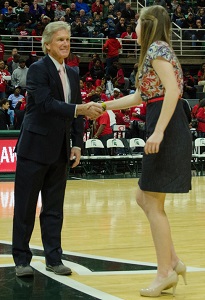
PHOTO: MHSAA Executive Director Jack Roberts congratulates an MHSAA/Farm Bureau Scholar-Athlete Award winner at the Breslin Center.

Participation Remains Steady in 2018-19
July 18, 2019
By Geoff Kimmerly
Second Half editor
Michigan High School Athletic Association member schools continued to experience a decade-long decline in enrollment in 2018-19, and participation across 28 sports for which the MHSAA sponsors postseason tournaments also decreased slightly. However, while the drop in enrollment was 1.28 percent from the previous school year, participation fell only 1.03 percent as four sports repeated in setting records.
A total of 281,992 participants competed in MHSAA-sponsored sports this past school year. The overall MHSAA participation totals count students once for each sport in which they participate, meaning students who are multiple-sport athletes are counted more than once.
Boys participation fell 1.2 percent to 161,614, and for the first time in four years girls participation also decreased, by eight tenths of a percent to 120,378. However, both reductions were smaller than losses in enrollment of 1.36 percent for boys and 1.19 for girls. Since the 2008-09 school year, overall enrollment in MHSAA member high schools is down 12.8 percent. But during that time, overall participation in MHSAA-sponsored sports is down only 7.3 percent.
Girls lacrosse continued its run of setting a participation record every season since becoming a sponsored tournament sport in 2005, this spring with 3,180 participants – a 9.7-percent increase from a year ago. Boys lacrosse set a record for the third consecutive year, up 5.2 percent with 5,438 participants. Both boys and girls bowling also repeated in breaking participation records – boys bowling participation increased 4.7 percent over 2017-18 with 4,329 participants, while girls bowling was up 1.1 percent with 3,093 athletes. Boys cross country, with 9,588 athletes, just missed last year’s record-setting total but still saw its second-largest group of participants since totals first were tracked year-to-year in 1991-92.
Seven more sports saw increases in participation in 2018-19, boys skiing leading the way with 11.2-percent growth – its 6,284 athletes were the sport’s most since 2014-15 thanks with an increase of three tenths of a percent over a year ago. Girls and boys tennis both saw increases; girls 1.8 percent to 9,286 athletes, its most since 2011-12, and boys up 1.6 percent to 6,261 athletes, its most since 2014-15.
Girls swimming & diving was up 1.1 percent to 5,794 athletes, its most since 2013-14. Girls track & field had its highest number of participants since 2009-10 with 17,406, with an increase of seven tenths of a percent from last year. Wrestling increased a percent from 2017-18, to 9,494 athletes, ending two years of declines. Boys Golf was up three tenths of a percent to 6,284 athletes, ending three straight years of decreases.
While 17 sports saw decreases in participation, eight saw decreases by smaller percentages than the loss of enrollment: boys basketball (-1.2 percent), girls competitive cheer (-0.6), boys cross country (-0.7), girls gymnastics (-1.1), girls skiing (-0.5), boys soccer (-0.9), girls soccer (-0.1) and boys track & field (-0.1). Football, despite a decrease in participation of 4.3 percent, remains the most played sport by far with 35,412 participants. Boys track & field is second with 23,548, followed by boys basketball with 21,125. Girls volleyball, despite a 1.8-percent decline from a year ago, remains the most popular girls sport with 19,072 athletes.
The participation figures are gathered annually from MHSAA member schools to submit to the National Federation of State High School Associations for compiling of its national participation survey. Results of Michigan surveys from the 2000-01 school year to present may be viewed on the MHSAA Website.
The following chart shows participation figures for the 2018-19 school year from MHSAA member schools for sports in which the Association sponsors a postseason tournament:
|
BOYS |
GIRLS |
|||
|
Sport |
Schools (A) |
Participants |
Schools (A) |
Participants (B) |
|
Baseball |
639/9 |
17,211 |
- |
0/23 |
|
Basketball |
731/2 |
21,119 |
693 |
15,376/6 |
|
Bowling |
398/13 |
4,302 |
370 |
3,093/27 |
|
Competitive Cheer |
- |
- |
347 |
6,672 |
|
Cross Country |
634/0 |
9,588 |
619 |
8,144 |
|
Football - 11 player |
572/82 |
33,868 |
- |
0/94 |
|
8-player |
79/10 |
1,432 |
- |
0/18 |
|
Golf |
504/74 |
6,136 |
337 |
3,587/148 |
|
Gymnastics |
- |
- |
86 |
694 |
|
Ice Hockey |
242/10 |
3,282 |
- |
-/12 |
|
Lacrosse |
163/8 |
5,423 |
120 |
3,180/15 |
|
Skiing |
102/0 |
924 |
95 |
763 |
|
Soccer |
492/16 |
14,425 |
476 |
13,209/67 |
|
Softball |
- |
- |
628 |
13,290 |
|
Swimming & Diving |
248/18 |
4,968 |
262 |
5,794/35 |
|
Tennis |
290/17 |
6,221 |
330 |
9,286/40 |
|
Track & Field |
679/0 |
23,548 |
673 |
17,406 |
|
Volleyball |
- |
- |
713 |
19,072 |
|
Wrestling |
466/186 |
9,167 |
- |
-/327 |
(A) The first number is the number of schools reporting sponsorship on the Sports Participation Survey, including primary and secondary schools in cooperative programs as of May 15, 2019. The second number indicates the number of schools that had girls playing on teams consisting primarily of boys.
(B) The second number indicates the number of additional girls playing on teams consisting primarily of boys and entered in boys competition.
The MHSAA is a private, not-for-profit corporation of voluntary membership by more than 1,500 public and private senior high schools and junior high/middle schools which exists to develop common rules for athletic eligibility and competition. No government funds or tax dollars support the MHSAA, which was the first such association nationally to not accept membership dues or tournament entry fees from schools. Member schools which enforce these rules are permitted to participate in MHSAA tournaments, which attract more than 1.4 million spectators each year.