


Multi-Sport Participation Holds Steady in 2023-24, Continuing Increases Found Over Entirety of Study
By
Geoff Kimmerly
MHSAA.com senior editor
January 16, 2025
The MHSAA’s sixth Multi-Sport Participation Survey, conducted last spring for the 2023-24 school year, showed for the third-consecutive year that nearly 45 percent of athletes at member high schools participated in more than one sport, while the entirety of the study continues to show that percentages of multi-sport athletes for all four Classes (A-B-C-D) have grown during the six years this topic has been studied in this way.
Early and intense sport specialization has become one of the most serious issues related to health and safety at all levels of youth sports, as overuse injuries and burnout among athletes have been tied to chronic injuries and health-related problems later in life. In early 2016, the MHSAA appointed a Task Force on Multi-Sport Participation as part of a continued effort to promote and protect participant health and address the issues leading to early sport specialization. The annual Multi-Sport Participation Survey was among results of the task force’s work.
The 2023-24 Multi-Sport Participation Survey received responses from 63.7 percent of member high schools and showed 44.8 percent of athletes at those MHSAA member high schools participating in two or more sports, a tenth of a percent increase from survey results in 2022-23 and half a percent increase from two years prior.
For 2023-24, 47.6 percent of male athletes and 41.4 percent of female athletes played multiple sports. Class D has enjoyed the highest percentage of multi-sport athletes over all six years of surveys, this time at 63.1 percent, followed by Class C (59.4), Class B (48.0) and Class A (38.2).
Over the six years of this survey, data also has shown slight increases in multi-sport participation in all four classes. Class A has risen from 35.9 percent in 2017-18 to 38.2 in 2023-24. Class B has risen from 46.7 to 48.0, Class C from 55.2 to 59.4 and Class D from 58.1 to 63.1 over those six years.
The MHSAA Task Force also recommended measuring multi-sport participation in MHSAA member schools to recognize “achievers” – that is, schools that surpass the norm given their enrollment and other factors that affect school sports participation.
Battle Creek Harper Creek, Detroit Cody and Grand Rapids Northview have appeared among the top 10 percent of their respective Classes five of the six years the survey has been conducted. Five more schools have appeared among the top 10 percent of their Classes four of the six years: Decatur, East Grand Rapids, Manton, Parma Western and Warren Michigan Collegiate.
In Class A, Macomb L’Anse Creuse North (94.7 percent) and Battle Creek Harper Creek (72.4) posted the highest percentages of multi-sport athletes for 2023-24, with Grand Rapids Northview (68.1), Berkley (65.0) and Kalamazoo Loy Norrix (64.3) also reporting reaching at least 60 percent. In Class B, four schools reached at least 65 percent multi-sport participation – Parma Western (78.0), Constantine (75.4), Clare (65.7) and Reed City (65.4).
Class C saw six schools reach 80 percent this past school year – Warren Michigan Collegiate (91.7 percent), Flint Beecher (91.3), LeRoy Pine River (89.5), Cass City (84.3), Decatur (83.3) and Manton (81.4). Four Class D schools responded at higher than 90 percent multi-sport participation – Gaylord St. Mary (92.9), Lake Leelanau St. Mary (91.7), Wyoming West Michigan Lutheran (90.9) and Deckerville (90.7) – followed by Marcellus Howardsville Christian (88.9), Morrice (86.8), Ewen-Trout Creek (85.7), Vestaburg (85.5) and Alanson (85.0).
Click for the full summary report on the Multi-Sport Participation Survey.
2016-17 Classifications Announced
By
Geoff Kimmerly
MHSAA.com senior editor
March 29, 2016
Classifications for Michigan High School Athletic Association elections and postseason tournaments in traditionally classified sports (A, B, C, D) for the 2016-17 school year have been announced, with enrollment breaks for postseason tournaments set up by divisions posted to each sport’s page on the MHSAA Website.
Classifications for the upcoming school year are based on a second semester count date, which for MHSAA purposes was Feb. 10. The enrollment figure submitted for athletic classification purposes may be different from the count submitted for school aid purposes, as it does not include students ineligible for athletic competition because they reached their 19th birthday prior to September 1 of the current school year and will not include alternative education students if none are allowed athletic eligibility by the local school district.
After all the counts are submitted, tournament-qualified member schools are ranked according to enrollment, and then split as closely into quarters as possible. For 2016-17, there are 751 tournament-qualified member schools with 187 schools in Class A, and 188 schools in Class B, Class C and Class D.
Effective with the 2016-17 school year, schools with 881 or more students are in Class A in MHSAA postseason tournament competition. The enrollment limits for Class B are 412-880; Class C is 207-411; and schools with enrollments of 206 and fewer are Class D. The break between Classes A and B increased six students from 2015-16, the break between Classes B and C decreased eight students, and the break between Classes C and D is six students fewer than the current school year.
The new classification breaks will see 22 schools move up in class for 2016-17, while 17 schools will move down.
Schools recently were notified of their classification. MHSAA Executive Director John E. "Jack" Roberts said schools may not subsequently lower their enrollment figure. However, if revised enrollment figures should be higher and indicate that a school should be playing in a higher class, that school would be moved up.
Schools have the option to play at any higher classification for a minimum of two years, but must exercise the option by April 15 for fall sports, August 15 for winter sports and October 15 for spring sports.
MHSAA tournament sports that will be conducted in traditional classifications for 2016-17 are Basketball and Girls Volleyball. Football will use traditional classifications to determine playoff points.
Sports which will compete in nearly equal divisions are: Baseball, Bowling, Girls Competitive Cheer, Lower Peninsula Cross Country, Lower Peninsula Golf, Ice Hockey, Lacrosse, Lower Peninsula Soccer, Skiing, Softball, Lower Peninsula Swimming and Diving, Lower Peninsula Tennis, Lower Peninsula Track and Field and Wrestling.
Visit the respective sport pages on the MHSAA Website to review the divisional alignments.
The divisions and qualifiers for the MHSAA Football Playoffs will be announced on Selection Sunday, Oct. 23, 2016.
A complete list of school enrollments used to determine classifications for the 2016-17 school year can be found on the Enrollment & Classification page of the MHSAA Website.
Here is a complete list of schools changing classification for 2016-17. (Note: This list does not include schools opting up in class/division for tournaments, which can be found on the Administrators page of the MHSAA Website, under Enrollment and Classification):
Moving Up From Class B to Class A
Coldwater
Detroit International Academy
Melvindale
New Boston Huron
Warren Fitzgerald
Moving Down From Class A to Class B
Haslett
Jackson Northwest
Lansing Eastern
Saginaw Arthur Hill
Moving Up From Class C to Class B
Canton Preparatory
Ferndale University
Flint Academy West
Grand Rapids Wellspring Preparatory
Ithaca
Montague
Sanford Meridian Early College
Tawas
Ypsilanti Arbor Preparatory
Moving Down From Class B to Class C
Allen Park Cabrini
Detroit Central Collegiate
Detroit Benjamin Carson Science & Medicine
Harrison
Jackson Lumen Christi
Jonesville
Warren Michigan Collegiate
Moving Up From Class D to Class C
Detroit Randolph Technical
Detroit Universal Academy
Kimball Landmark Academy
Kingston
Munising
Newberry
Potterville
Rudyard
Moving Down From Class C to Class D
Auburn Hills Oakland Christian
Burton Madison Academy
Lutheran Westland
Mayville
Merrill
Saginaw Michigan Lutheran Seminary
New Postseason Eligible Tournament Schools in 2016-17
Brimley Ojibwe Charter
Center Line Michigan Math & Science
Detroit Cornerstone Leadership & Business
Detroit Delta Prep
Jackson Prep & Early College
Petoskey St. Michael Academy
Southfield Arts & Technology
Enrollment Breaks by Classes – 2016-17
(Number of schools in parentheses)
Class A: 881 and above (187 schools)
Class B: 412 – 880 (188)
Class C: 207 – 411 (188)
Class D: 206 and below (188)
The MHSAA is a private, not-for-profit corporation of voluntary membership by more than 1,400 public and private senior high schools and junior high/middle schools which exists to develop common rules for athletic eligibility and competition. No government funds or tax dollars support the MHSAA, which was the first such association nationally to not accept membership dues or tournament entry fees from schools. Member schools which enforce these rules are permitted to participate in MHSAA tournaments, which attract more than 1.4 million spectators each year.
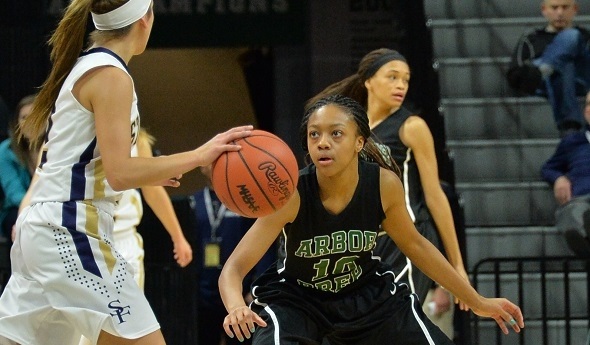
PHOTO: Ypsilanti Arbor Prep won the Class C girls basketball championship earlier this month, but will compete in Class B next season.