


Multi-Sport Survey Helps Set Benchmark
July 31, 2018
By Geoff Kimmerly
Second Half editor
NOTE: This report includes a revision Aug. 3 to account for incorrect data for Jenison, which previously was listed with the second-highest percentage of multi-sport athletes in Class A. The updated data changed only two percentages updated below (*), and both by only one tenth of a percent.
Nearly 43 percent of athletes at Michigan High School Athletic Association member high schools participated in more than one sport during the 2017-18 school year, according to the first-ever Multi-Sport Participation Survey conducted this spring and inspired by the work of the MHSAA’s Task Force on Multi-Sport Participation.
Early and intense sport specialization has become one of the most serious issues related to health and safety at all levels of youth sports, as overuse injuries and burnout among athletes have been tied to chronic injuries and health-related problems later in life. In early 2016, the MHSAA appointed the Task Force on Multi-Sport Participation as part of a continued effort to promote and protect participant health and address the issues leading to early sport specialization.
While there is a growing amount of research detailing the negative effects of early sport specialization, there is little research on the prevalence of sport specialization, including at the high school level. This MHSAA survey received responses from 79.9 percent of member high schools and will be conducted annually to measure how multi-sport participation exists at schools of different sizes and also the progress being made to increase it at all schools.
“It’s now well-known that students who specialize in one sport year-round are prone to all kinds of health hazards. This is serious business; we have to find out the ways and means to promote the multi-sport experience,” MHSAA Executive Director John E. “Jack” Roberts said. “This survey will help us identify best practices. If I’m an administrator, and another school of the same size and same demographics has twice the multi-sport participation as my school, I want to know why. What are they doing to encourage that culture?”
From schools that responded to this year’s survey, 42.5 percent of students participated in athletics in 2017-18 – 46.3 percent of boys and 38.7 percent of girls. As anticipated, Class D schools enjoyed the highest percentage of athletes among the entire student body, at 55.2 percent, followed by Class C (50.1), Class B (45.1) and Class A (39.1*).
Of those athletes counted by responding schools, 42.8 percent participated in more than one sport – including 44.6 percent of boys and 40.6 percent of girls. Class D again enjoyed the highest percentage of multi-sport athletes, 58.1 percent, followed by Class C (55.2), Class B (46.7) and Class A (35.9*).
Similar results for overall sport participation and multi-sport participation relative to enrollment size were seen by further breaking down Class A into schools of fewer than 1,000 students, 1,000-1,500 students, 1,501-2,000 students and more than 2,000 students. For both sport participation as a whole and multi-sport participation specifically, the smallest Class A schools enjoyed the highest percentages, while percentages then decreased for every larger size group of schools.
The MHSAA Task Force on Multi-Sport Participation also recommended measuring multi-sport participation in MHSAA member schools to recognize “achievers” – that is, schools that surpass the norm given their enrollment and other factors that affect school sports participation. An achievement program is being developed for future years, and this year’s survey results will assist in setting a benchmark for that recognition.
In Class A, Marquette (82.6 percent), Grand Rapids Union (74.1) and Holland West Ottawa (74.0) posted the highest percentages of multi-sport athletes. In Class B, four schools achieved at least 80 percent multi-sport participation – Birch Run (87.1), Gladstone (83.8), Clawson (81.0) and Shepherd (80).
Class C saw 13 schools with more than 80 percent of its athletes taking part in more than one sport, led by Ubly (90.2 percent) and Detroit Southeastern (89.2). Four Class D schools responded at higher than 90 percent multi-sport participation – Brethren (95.4), DeTour (94.3), Jackson Christian (91.7) and Waterford Our Lady (90.8).
The full summary report on the Multi-Sport Participation Survey is available on the “Health & Safety” page of the MHSAA Website.
2020 Class Honored Together, from Afar
By
Geoff Kimmerly
MHSAA.com senior editor
May 15, 2020
Ishpeming Westwood’s girls basketball team was two hours into a three-hour trip to its Division 3 Regional Final on March 12 when the Patriots were told to turn the bus around and come home.
In an instant, the 2019-20 school year – and with it all MHSAA sports across the state – had come to a halt. And two months later, the high school world and its sports community continue to wait for bits of normalcy to return.
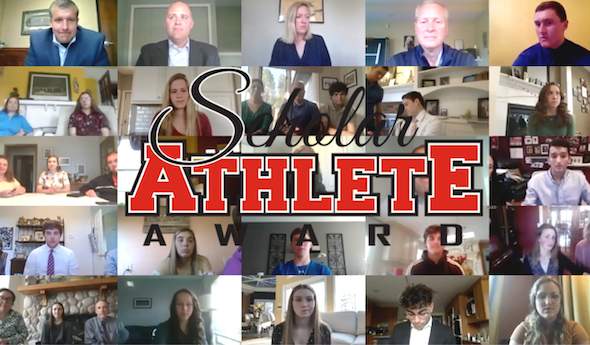
On Wednesday, we were able to enjoy a little bit of normal that’s been part of the annual MHSAA calendar for three decades. A Zoom call brought together 31 families from all over the state along with MHSAA staff and Farm Bureau Insurance CEO Don Simon to celebrate this year’s MHSAA/Farm Bureau Insurance Scholar-Athlete Award winners.
Living rooms, kitchens and home offices replaced Breslin Center as settings for this “virtual” ceremony. And yet, this ceremony may be remembered more than any other because of its necessity – due to the COVID-19 pandemic – and because of how it brought so many together, remotely, while the coronavirus has forced all of us to remain apart.
Below is the ceremony, in full, including words from Simon, MHSAA Executive Director Mark Uyl and Assistant Director Andy Frushour and, for the first time, a student speaker from the class – Ishpeming Westwood senior Madelyn Koski, who was part of that basketball team destined for Sault Ste. Marie. A brief Q&A with Koski follows.
Koski was an all-stater on the court who would’ve finished her high school career with four varsity letters each for hoops, tennis and softball. She will continue at Ferris State University, where she’ll pursue a degree in pharmacy and continue her basketball career.
Second Half: How did you decide what you wanted to say? Was there a message you wanted to get across?
It was easy to write the sad part, because I know what happened – I was there. But it was hard for me to make a positive spin at the end because I don’t think anyone’s over it yet. I was glad to be able to turn it into something that was bigger than sports … more about our whole lives and less about our time in high school.
Second Half: It’s been two months. How have you been navigating the disappointment, the sadness? And is there advice you’d give to other people your age trying to do it?
As time went on, it got a little bit better. The day after was pretty sad; that’s all I could think about. Now there’s so many other things to do – the weather’s nicer, we can go outside. And I’m playing college basketball – not everyone has that chance – but at least I have that to practice for, look forward to.
I guess, it’s just … time heals.
Second Half: Even though you can’t be with them and hang out with them, I’m sure you’re talking a lot of your friends and teammates. What kind of conversations are you having? Is it looking ahead? Is it still thinking about, “We’d be playing softball right now?"
I think we kinda tried to leave the basketball stuff in the past because it was too sad to talk about. We made sure we do talk, obviously not in person, but on social media or FaceTime, we just talk about our memories and everything. That helped. It didn’t close the chapter, but it was nice to talk to them when we were all alone. And now we just don’t talk about that anymore. Nobody really wants to talk about it. We see memories popping up on Facebook and all these other things about, “Oh, we had a softball game last year at this time.” And it’s pretty sad. But no one else is playing. So it’s like we’re all in the same boat.
 Second Half: You can turn on the news and you can see what every adult has to say about what’s going on right now. … You’re 17, you’re finishing your last year of high school, you’re going through something no one has gone through in more than 100 years. How do you see everything that’s happening in the world right now, as you look at it from a 17-year-old’s point of view and see seasons end and school end?
I know we can’t help what happened. But obviously I think it’s unfair that it happened to our class. It stinks for every grade, but (as seniors) we’re missing out on our best parts of high school right now and it’s pretty horrible. We’ve been waiting years for our senior proms and graduations, banquets and award ceremonies, like the MHSAA one. So that kinda stinks.
Ever since March 12, I’ve been staying optimistic. But I’m proved wrong every time because things just keep getting canceled and canceled. … (But) I’m a pretty optimistic person, so I still have some left.
Second Half: What happens next? What does your summer look like? What happens for people who are in your shoes?
I’ll keep working out, and one of the girls on my high school basketball team is going to play at Michigan Tech so (eventually) we can work out together. … I think the biggest thing to do this summer, that I think I’ll do, is appreciate time with my family. I have gotten to spend a lot of time with them. And then maybe once summer rolls around and we’re allowed to be in bigger groups, I’ll be able to be with people other than my mom and dad, like my grandparents and cousins and my aunts and uncles. … (My sister Jillian and I) have been playing the same varsity sports for the last couple of years, and she’s been really successful. It’s been fun to win all these championships and stuff with her.
Second Half: What do you think you’re going to remember from this in five years, 10 years, when people ask you what your experience was like?
I’m probably going to say it’s a pretty bad experience. I guess it was an eye-opener that life can change at any moment. That’s kind’ve it. It didn’t change in a good way.
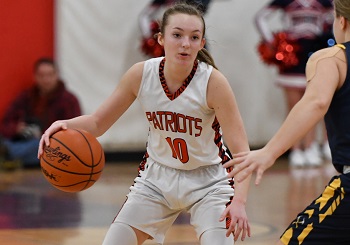
PHOTO: Westwood's Madelyn Koski sets up a play as Negaunee's Breanne Giotto defends her during their Jan. 24 game. (Photo by Cara Kamps.)