


Multi-Sport Survey Helps Set Benchmark
July 31, 2018
By Geoff Kimmerly
Second Half editor
NOTE: This report includes a revision Aug. 3 to account for incorrect data for Jenison, which previously was listed with the second-highest percentage of multi-sport athletes in Class A. The updated data changed only two percentages updated below (*), and both by only one tenth of a percent.
Nearly 43 percent of athletes at Michigan High School Athletic Association member high schools participated in more than one sport during the 2017-18 school year, according to the first-ever Multi-Sport Participation Survey conducted this spring and inspired by the work of the MHSAA’s Task Force on Multi-Sport Participation.
Early and intense sport specialization has become one of the most serious issues related to health and safety at all levels of youth sports, as overuse injuries and burnout among athletes have been tied to chronic injuries and health-related problems later in life. In early 2016, the MHSAA appointed the Task Force on Multi-Sport Participation as part of a continued effort to promote and protect participant health and address the issues leading to early sport specialization.
While there is a growing amount of research detailing the negative effects of early sport specialization, there is little research on the prevalence of sport specialization, including at the high school level. This MHSAA survey received responses from 79.9 percent of member high schools and will be conducted annually to measure how multi-sport participation exists at schools of different sizes and also the progress being made to increase it at all schools.
“It’s now well-known that students who specialize in one sport year-round are prone to all kinds of health hazards. This is serious business; we have to find out the ways and means to promote the multi-sport experience,” MHSAA Executive Director John E. “Jack” Roberts said. “This survey will help us identify best practices. If I’m an administrator, and another school of the same size and same demographics has twice the multi-sport participation as my school, I want to know why. What are they doing to encourage that culture?”
From schools that responded to this year’s survey, 42.5 percent of students participated in athletics in 2017-18 – 46.3 percent of boys and 38.7 percent of girls. As anticipated, Class D schools enjoyed the highest percentage of athletes among the entire student body, at 55.2 percent, followed by Class C (50.1), Class B (45.1) and Class A (39.1*).
Of those athletes counted by responding schools, 42.8 percent participated in more than one sport – including 44.6 percent of boys and 40.6 percent of girls. Class D again enjoyed the highest percentage of multi-sport athletes, 58.1 percent, followed by Class C (55.2), Class B (46.7) and Class A (35.9*).
Similar results for overall sport participation and multi-sport participation relative to enrollment size were seen by further breaking down Class A into schools of fewer than 1,000 students, 1,000-1,500 students, 1,501-2,000 students and more than 2,000 students. For both sport participation as a whole and multi-sport participation specifically, the smallest Class A schools enjoyed the highest percentages, while percentages then decreased for every larger size group of schools.
The MHSAA Task Force on Multi-Sport Participation also recommended measuring multi-sport participation in MHSAA member schools to recognize “achievers” – that is, schools that surpass the norm given their enrollment and other factors that affect school sports participation. An achievement program is being developed for future years, and this year’s survey results will assist in setting a benchmark for that recognition.
In Class A, Marquette (82.6 percent), Grand Rapids Union (74.1) and Holland West Ottawa (74.0) posted the highest percentages of multi-sport athletes. In Class B, four schools achieved at least 80 percent multi-sport participation – Birch Run (87.1), Gladstone (83.8), Clawson (81.0) and Shepherd (80).
Class C saw 13 schools with more than 80 percent of its athletes taking part in more than one sport, led by Ubly (90.2 percent) and Detroit Southeastern (89.2). Four Class D schools responded at higher than 90 percent multi-sport participation – Brethren (95.4), DeTour (94.3), Jackson Christian (91.7) and Waterford Our Lady (90.8).
The full summary report on the Multi-Sport Participation Survey is available on the “Health & Safety” page of the MHSAA Website.
Records Set Despite Overall Participation Dip
July 9, 2014
By Geoff Kimmerly
Second Half editor
Participation in high school sports in which postseason tournaments are sponsored by the Michigan High School Athletic Association decreased slightly for the third straight school year in 2013-14, following a continuing trend of declining member school enrollments.
However, nine MHSAA sports saw increases in participation from 2012-13, and four sports set records for the second straight school year.
A total of 288,230 participants took part in the 28 tournament sports offered by the MHSAA during the past year – a 1.9-percent decrease from the 2012-13 figure of 293,810. However, enrollments at member schools also decreased 0.7 percent from 2012-13 and have fallen 10 percent since the 2006-07 school year – while MHSAA participation has fallen only 7.9 percent during that time. This year’s dip was slightly larger than the 1.2-percent decrease from 2011-12 to 2012-13.
Overall boys participation fell 1.7 percent from 2012-13 to 2013-14, while girls participation fell 2.2 percent. The overall MHSAA totals count students once for each sport in which they participate, meaning students who are multiple-sport athletes are counted more than once.
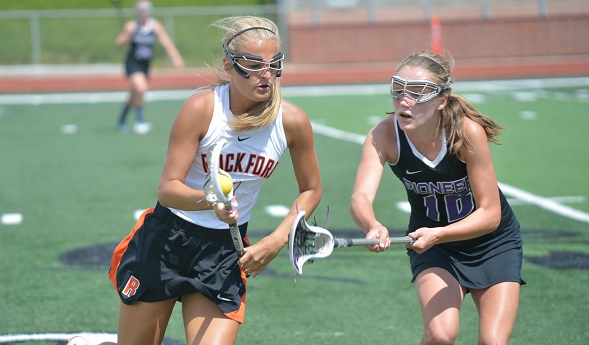
For the second straight school year, both boys and girls lacrosse (5,089 and 2,540, respectively) and boys and girls cross country (8,882 and 8,703) set participation records. Both lacrosse totals have increased annually during their 10 years as MHSAA tournament sports; the girls saw an increase of 1.6 percent from 2012-13. Participation in both boys and girls cross country increased for the fifth straight seasons – the girls this time by 3.9 percent.
Three girls sports rebounded from recent declines. Girls swimming and diving (6,604) broke a two-year downturn in participation with its highest total since 2010-11, while girls golf (3,427) increased by 2.8 percent and girls soccer (13,619) increased one percent after also falling from 2011-12 to 2012-13. Girls track and field (17,259) posted its second straight increase and highest participation total since 2009-10.
However, troubling trends continued in two of the most popular girls sports. Girls basketball participation fell for the eighth straight season to 16,329 participants, the sport’s fewest since records first were kept in 1991-92. The girls basketball total has decreased 14.7 percent since a U.S. District Court decision led to the switching of girls basketball season from fall to winter beginning in 2007-08. Comparatively, girls enrollment at MHSAA schools during that time has fallen 10.4 percent.
The sport that swapped seasons with girls basketball and moved to fall, volleyball, saw a 6.5-percent drop in participation this school year to 18,607 athletes, its fewest since 1993-94 and a decrease of 13.6 percent since its final season as a winter sport.
Also of note in this year’s survey:
- Total, nine sports saw increases in participation in 2013-14 (three boys, six girls), while 19 had decreases (11 boys, eight girls).
- Football participation, 11 and 8-player teams combined, dropped for the sixth straight season but this time by only 2 percent to 40,673 athletes. The drop from 2011-12 to 2012-13 was 3.7 percent.
- Wrestling saw a decrease for the fifth straight year, but also by a smaller percentage than the year before – 2.2 percent versus a 4.8-percent drop from 2011-12 to 2012-13.
- Baseball participation increased for the second straight year, up 0.7 percent to 18,227 participants. But softball saw the third-largest dip in 2013-14, 7.2 percent to 13,443 participants.
- Gymnastics (600) saw a decrease for the second straight year, this time by 11 percent – the largest percentage decrease of any sport this school year. Boys skiing (745) saw the second-largest drop, 9.7 percent.
The participation figures are gathered annually from MHSAA member schools to submit to the National Federation of State High School Associations for compiling of its national participation survey. Results of Michigan surveys from the 2000-01 school year to present may be viewed on the MHSAA Website.
The following chart shows participation figures for the 2013-14 school year from MHSAA member schools for sports in which the Association sponsors a postseason tournament:
BOYS GIRLS
SPORT |
SCHOOLS (A) |
PARTICIPANTS |
SCHOOLS (A) |
PARTICIPANTS (B) |
|
Baseball |
630/646/2 |
18,220 |
- |
-/7 |
|
Basketball |
727/732/2 |
21,504 |
676/723 |
16,321/8 |
|
Bowling |
341/359/1 |
3,573 |
326/357 |
2,939/7 |
|
Competitive Cheer |
- |
- |
311/337 |
7,120 |
|
Cross Country |
591/626/0 |
8,882 |
577/622 |
8,703/0 |
|
Football – 11 player |
596/660/3 |
39,963 |
- |
-/43 |
|
8-player |
36/39/0 |
667 |
- |
- |
|
Golf |
515/542/12 |
6,768 |
317/327 |
3,365/62 |
|
Gymnastics |
- |
- |
56/74 |
600 |
|
Ice Hockey |
219/268/2 |
3,564 |
- |
-/19 |
|
Lacrosse |
125/130/0 |
5,089 |
86/88 |
2,540/0 |
|
Skiing |
81/104/0 |
745 |
78/104 |
662/0 |
|
Soccer |
475/496/12 |
14,242 |
466/478 |
13,619/48 |
|
Softball |
- |
- |
569 |
13,443 |
|
Swimming & Diving |
242/266/1 |
5,243 |
260/274 |
6,064/8 |
|
Tennis |
312/318/2 |
6,464 |
338/347 |
8,856/6 |
|
Track & Field |
648/679/0 |
22,716 |
634/673 |
17,259/0 |
|
Volleyball |
- |
- |
662 |
18,607 |
|
Wrestling |