

NFHS Introduces Updated Logo
July 17, 2019
Special from NFHS
As the National Federation of State High School Associations (NFHS) heads into the next 100 years of leading high school sports and other activity programs nationwide, it will be doing so with a new logo.
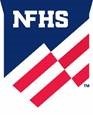 The new logo was unveiled to the membership earlier this month at the close of the NFHS Centennial Celebration. The NFHS and its 51-member state high school associations celebrated the organization’s accomplishments at the 100th Annual Meeting at the JW Marriott in downtown Indianapolis.
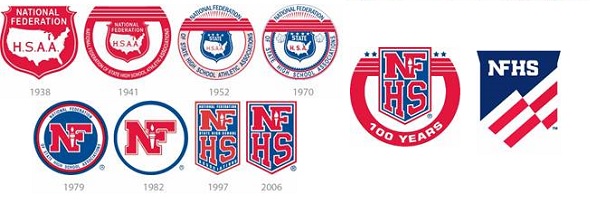
The organization will continue to be branded as the NFHS in the new logo, and the N and F are connected as has been the case since 1979. However, the entire acronym is together on one line as opposed to the previous logo with the NF and HS on separate lines. While red and blue will continue to be the predominant colors, the new logo mixes white with red and blue to suggest a flag waving in the wind. The direction of the flag is pointing upward to symbolize forward-thinking and advancement.
The new design maintains a resemblance to the shield that has been a part of the NFHS logo since 1997. However, the logo is flared at the top, and the bottom of the logo does not have definitive borders, which suggests the organization has moved past its first 100 years and is expanding its reach as the national leadership organization for high school sports and performing arts programs in the United States.
While the organization’s logo from 1952 had four stars to signify the four charter members of the NFHS, the four stripes within the new logo represent the four homes of the organization during the first 100 years.
“We wanted to retain NFHS as the central component of the new logo because the organization’s national presence has continued to spiral upward in the 22 years since the NFHS acronym was adopted,” said Dr. Karissa Niehoff, NFHS executive director. “However, as we celebrated our first 100 years, we felt it was important to establish a new look that would signify our ever-increasing role as the national leader in high school sports and performing arts programs.”
Counting the Centennial logo that was used during the 2018-19 school year, the new logo will be 10th used by the organization since the first one was adopted in the 1930s. The new logo was created by Section 127, an Indianapolis-based design company.
The NFHS was started in 1920 and had offices in Chicago until 1971, when it moved to Elgin, Illinois. The organization moved to Kansas City, Missouri, in 1979, and then in 2000 to Indianapolis, where it remains today.
The Michigan High School Athletic Association is a member of the NFHS, and Michigan is one of the four founding states of the national association.

MHSAA Network Receives MAB Awards
March 5, 2020
By Geoff Kimmerly
Second Half editor
The MHSAA Network was honored Wednesday night with three awards from the Michigan Association of Broadcasters at its annual Broadcast Excellence Awards presentation for 2019 at the conclusion of the Great Lakes Media Show at the Lansing Center.
This Week In High School Sports, the network’s five-minute weekly flagship program – powered by Michigan Student Aid – which is heard on more than 100 over-the-air and internet audio outlets across the state during the Fall and Winter sports seasons, won the Best of category for Sports Program for Statewide Radio Networks. The program also received a Merit Award in the category.
The MHSAA Network origination of the 2019 Division 1 Boys Basketball Final – presented by Sparrow Health – also took a Merit Award in the Sports Play-by-Play category. The 64-62 win for Ypsilanti Lincoln, decided on a putback at the buzzer by Jalen Fisher, had Topher Goggin and Jeff Sommerville of MHSAA Network affiliate WQBX in Alma on the call, John Kreger as the host and Mike Stump as the sideline reporter.
“We’ve always felt that we were providing quality coverage of high school sports and had never entered the MAB awards program prior to this past year,” said John Johnson, MHSAA Director of Sports Broadcast Properties, who also hosts This Week in High School Sports. “It’s humbling to receive such an honor from those in the broadcasting community that we serve.”
The MHSAA Network produces audio coverage of the Association’s championships in Boys Soccer, Girls Volleyball and Football in the Fall; Ice Hockey and Basketball in the Winter; and Lacrosse, Girls Soccer, Baseball and Softball in the Spring – 90 games in all. All games can be heard on the MHSAANetwork.com website, and the Basketball Finals in March are broadcast by 20 to 40 over-the-air radio stations. In addition to This Week In High School Sports, the Network also produces the weekly 60-second vignette – Be The Referee – which takes a look into the fine art of officiating. Those programs are also available at MHSAANetwork.com and the MHSAA Website.