

NFHS Introduces Updated Logo
July 17, 2019
Special from NFHS
As the National Federation of State High School Associations (NFHS) heads into the next 100 years of leading high school sports and other activity programs nationwide, it will be doing so with a new logo.
 The new logo was unveiled to the membership earlier this month at the close of the NFHS Centennial Celebration. The NFHS and its 51-member state high school associations celebrated the organization’s accomplishments at the 100th Annual Meeting at the JW Marriott in downtown Indianapolis.
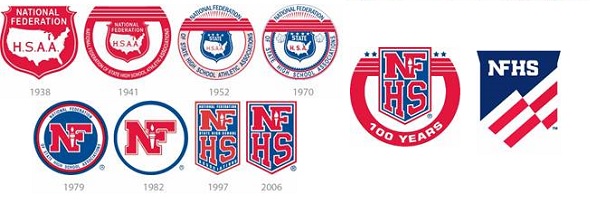
The organization will continue to be branded as the NFHS in the new logo, and the N and F are connected as has been the case since 1979. However, the entire acronym is together on one line as opposed to the previous logo with the NF and HS on separate lines. While red and blue will continue to be the predominant colors, the new logo mixes white with red and blue to suggest a flag waving in the wind. The direction of the flag is pointing upward to symbolize forward-thinking and advancement.
The new design maintains a resemblance to the shield that has been a part of the NFHS logo since 1997. However, the logo is flared at the top, and the bottom of the logo does not have definitive borders, which suggests the organization has moved past its first 100 years and is expanding its reach as the national leadership organization for high school sports and performing arts programs in the United States.
While the organization’s logo from 1952 had four stars to signify the four charter members of the NFHS, the four stripes within the new logo represent the four homes of the organization during the first 100 years.
“We wanted to retain NFHS as the central component of the new logo because the organization’s national presence has continued to spiral upward in the 22 years since the NFHS acronym was adopted,” said Dr. Karissa Niehoff, NFHS executive director. “However, as we celebrated our first 100 years, we felt it was important to establish a new look that would signify our ever-increasing role as the national leader in high school sports and performing arts programs.”
Counting the Centennial logo that was used during the 2018-19 school year, the new logo will be 10th used by the organization since the first one was adopted in the 1930s. The new logo was created by Section 127, an Indianapolis-based design company.
The NFHS was started in 1920 and had offices in Chicago until 1971, when it moved to Elgin, Illinois. The organization moved to Kansas City, Missouri, in 1979, and then in 2000 to Indianapolis, where it remains today.
The Michigan High School Athletic Association is a member of the NFHS, and Michigan is one of the four founding states of the national association.

Rep Council Wrap-Up: Winter 2017
April 1, 2017
By Geoff Kimmerly
Second Half editor
To accommodate an increasing number of member schools moving to 8-player football, while continuing to provide a championship opportunity for schools with the smallest enrollments, the Representative Council of the Michigan High School Athletic Association approved the addition of a second division to the 8-Player Football Playoffs among multiple actions taken during its annual Winter Meeting on March 24 in East Lansing.
A total of 60 Class D schools have declared so far they will sponsor 8-player varsity football teams this fall, a 20-percent increase in tournament-eligible teams from last season (only Class D schools currently are eligible for the MHSAA tournament in this sport). The Council voted to expand the 8-player tournament to two four-week, 16-team brackets, with schools divided based on enrollment. Since its first season of MHSAA tournament sponsorship in 2011, 8-player football has finished with one 16-team playoff.
The two-division, four-week format provides the smallest MHSAA member schools a shorter tournament involving schools with a smaller difference in enrollment, both of which may enhance participant health and safety. The championships games will occur the weekend before Thanksgiving. Qualification criteria, enrollment limits and MHSAA Finals venues will be discussed at the Council’s Spring Meeting, May 7-8.
The Council also discussed venue possibilities for future wrestling and basketball Finals rounds, with sites for the 2017-18 school year to be selected not later than the Spring Meeting. The Basketball Finals, played the last many seasons at Michigan State University’s Breslin Center for both girls and boys, would have with their currently-scheduled dates one or the other in conflict in future seasons with Breslin’s potential opportunity to host NCAA Tournament first and second-round games for MSU’s women’s basketball team. The Council will review proposals for hosting the Basketball Finals at the Spring Meeting, and also consider the possibility of altering schedules for the tournaments to accommodate venue availability.
The MHSAA Wrestling Finals have been conducted for the team tournament the last two years at Central Michigan University’s McGuirk Arena, while the individual tournament has finished the last 15 seasons at The Palace of Auburn Hills. The contract with McGuirk Arena ended with this winter’s tournament, and with the future of The Palace uncertain, the MHSAA is considering options for moving that event as well.
The Council also approved a recommendation from the MHSAA Baseball/Softball Committee to classify those two sports independently beginning with the 2017-18 school year. Currently, schools are placed in the same divisions for both sports, and also play in the same tournament groupings for both. This action allows for the sports to be organized separately, and came in response to fewer schools sponsoring both baseball and softball teams, which has led to Districts with uneven numbers of teams (more for softball at a particular site than for baseball, or vice versa).
Also in football, the Council approved a Football Committee recommendation that the MHSAA seek permission from the National Federation of State High School Associations (NFHS) to continue to experiment with a 40-second clock for use between plays. Teams taking part in the experiment will have 40 seconds from the end of the previous play to snap the ball to begin the next, unless there is an administrative stoppage (for penalty, measurement, etc.). MHSAA schools began experimenting with the 40-second clock during the 2016 season.
In addition to sport matters, the Council discussed a paper prepared by the Michigan State University Institute for the Study of Youth Sports entitled “Gender Differences in Youth Sport Concussion.” The paper delved into findings by the MHSAA during its 2015-16 concussion reporting that showed a greater number of reports of concussions for females than males in the same sport (for example, basketball and soccer). The MHSAA’s findings, and the Institute’s comparisons with findings of other organizations and researchers, will be used to help shape MHSAA services and support to school sports.
The Representative Council is the legislative body of the MHSAA. All but five members are elected by member schools. Four members are appointed by the Council to facilitate representation of females and minorities, and the 19th position is occupied by the Superintendent of Public Instruction or designee.
The MHSAA is a private, not-for-profit corporation of voluntary membership by more than 1,400 public and private senior high schools and junior high/middle schools which exists to develop common rules for athletic eligibility and competition. No government funds or tax dollars support the MHSAA, which was the first such association nationally to not accept membership dues or tournament entry fees from schools. Member schools which enforce these rules are permitted to participate in MHSAA tournaments, which attract more than 1.4 million spectators each year.