

NFHS's Gardner Announces Retirement
January 9, 2018
Special from NFHS
Bob Gardner, executive director of the National Federation of State High School Associations (NFHS) since May 2010, has announced his retirement, effective Aug. 1, 2018. Gardner notified the NFHS Board of Directors of his retirement plans at the NFHS Winter Meeting on Jan. 3 in Scottsdale, Arizona.
 Gardner is the fifth full-time executive director of the NFHS, following H.V. Porter (1940-58), Cliff Fagan (1958-77), Brice Durbin (1977-93) and Bob Kanaby (1993-2010).
Gardner’s eight-year run as head of the national organization for high school athletics and performing arts activities will conclude a 48-year career in secondary education, including the final 18 years on the NFHS staff in Indianapolis.
Since assuming duties as NFHS executive director in 2010, Gardner has vigorously promoted the values of high school activity programs and expanded opportunities for participation by boys and girls nationwide. During his eight years as executive director, participation in high school sports has increased by almost 400,000, including the expanded opportunity for students with disabilities in high school sports.
Gardner has led the organization’s focus on risk minimization in high school sports, with particular emphasis on concussion awareness, and has brought a heightened national presence to the work of the NFHS and its member state associations. In addition to the continual expansion of the NFHS Learning Center during his tenure, Gardner is credited with starting the NFHS Network, the first-of-its-kind digital coverage of high school sports with more than 25,000 events covered during the 2016-17 school year.
In addition, during his eight years as chief executive of the organization, operating revenue for the NFHS increased by $4 million.
Ironically, Gardner’s entire 48-year career was spent in the state of Indiana. He was a teacher and coach at three schools for eight years and also served as an athletic director for a period of time. In 1978, Gardner became principal of Milan Junior-Senior High School, followed by a stint as superintendent of the Milan Community Schools.
After serving on the Indiana High School Athletic Association (IHSAA) Board of Directors during his time at Milan, Gardner joined the IHSAA staff in 1985 as assistant commissioner. He served 10 years in that role prior to becoming commissioner in 1995.
During his five years as IHSAA commissioner, Gardner led the change in the IHSAA football playoffs to permit participation by all schools, negotiated the association’s largest corporate sponsorship agreement in history with Indiana Farm Bureau Insurance and led the transition to multiple classes in team sports.
Gardner joined the NFHS staff in 2000 as chief operating officer and served in that position for 10 years prior to becoming executive director. During this time, he chaired the NFHS Rules Review Committee and was responsible for day-to-day operations of the organization.
Gardner earned his bachelor’s degree from the University of Evansville (Indiana) and his master’s and education specialist degrees from Ball State University in Muncie, Indiana. He has served on the Board of Directors for USA Football, USA Basketball and the Indiana Sports Corporation. He is a member of the Indiana High School Wrestling Hall of Fame.
Following the March 1 application deadline, finalists for the position will be interviewed by the NFHS Board of Directors April 17-18 in Indianapolis, with the new executive director expected to begin duties Aug. 1.
Ottinger's 'Organ Game' a Slam Dunk
May 23, 2017
By Geoff Kimmerly
Second Half editor
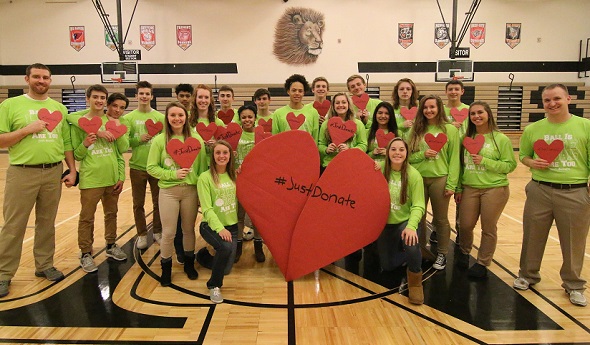
Every time Justice Ottinger sees one of the neon green T-shirts he designed on a student in the hallways at Newaygo High, he remembers fondly the “Ball Is Life, Organs Are Too” basketball game he planned this winter as an intern in the school’s athletic office.
 Much more frequently, the Lions’ senior gives thanks for the family friend who inspired the event by giving Ottinger a kidney last June.
Ottinger is a recipient of an MHSAA/Lake Trust Credit Union “Community Service Award” for his creation of the “Ball Is Life, Organs Are Too” event on Jan. 20 that raised more than $4,000 for Gift of Life Michigan and provided an opportunity for 13 people to register as organ donors.
As noted, the event started as an assignment from Newaygo athletic director Kristen Melvin to create and organize some sort of benefit game. It turned into an opportunity for Ottinger to not only spread the word about something that’s given him a better life, but also a chance to honor donor “Uncle” Tom Linsley for doing so.
“As soon as she said it, I said ‘organ game.’ There was nothing else. Organs mean so much,” Ottinger said. “There are a lot of people waiting for organs, and I don’t think people know the seriousness of this as much as they should. (I did it) just to get people to be aware of that, that organ transplants are a big deal, organ donation is a big deal, and I’m a believer everyone should be signed up to be organ donors.”
The Community Service Awards recognize contributions by Michigan’s high school student-athletes away from the field. Ottinger, a three-sport athlete, will user the $1,000 award as a scholarship toward his education at Cornerstone University, where he’ll begin studies toward his goal of becoming a doctor. Six honorees total are receiving awards this spring; Second Half is featuring one a day this week.
Just last weekend, Ottinger won Lower Peninsula Division 3 Regional championships in the 110 and 300-meter hurdles, advancing to next week’s MHSAA Track & Field Finals in both events. It was a performance that showed how much the kidney has affected him physically. His 15.43 time in the 110 race was a personal record and 1.4 seconds faster than his best all of last year. His 300 time of 41.38 was his second-fastest this spring and more than three seconds faster than his best in 2016. He’s undefeated in the 300 this season.
Compare that to a year ago, when Ottinger “was doing it, but not doing it very good. I was still putting forth my best effort, and stuff like that, but the closer I got to the transplant date, in basketball and track more I could tell. I’d fall asleep all the time,” he said.
“Once I had a transplant, it was the total opposite.”
Ottinger’s family knew he’s need a kidney transplant eventually since he was 2 years old. Although it was a slow process, his kidneys gradually lost their ability to function over the next 15 years; by last summer, they were down to functioning at only six perfect effectiveness.
 He was set to begin dialysis last summer when a donor was found – Linsley, who Justice affectionately calls “Uncle,” his dad’s best friend from when they attended Newaygo a generation ago.
Ottinger returned to play soccer in the fall and basketball in the winter, and set up his event for the Lions’ home game against Grant. Local businesses sponsored the event, and players and coaches wore the neon green shirts Ottinger designed. So did plenty of other people.
With Justice on the court, his mother Julie Long took over running the fundraiser during the game. But she had to get her son’s OK during warm-ups to order an additional 300 shirts – the first batch had sold out.
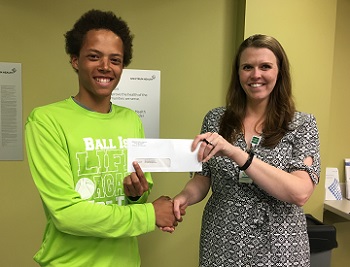
Gift of Life also sent a representative to sign up new donors on the spot, and Ottinger said the monetary donation will be used to help people who have had transplants pay hospital bills and for other costs that come with receiving a new organ.
He’s hopeful Newaygo will put on the event again next season, and Ottinger would like to do something similar at Cornerstone, where he’s set to join the track & field team.
His desire to become a doctor is boosted by what he’s experienced medically. But it’s rooted in something he’s already begun to fulfill.
“I’ve been in the hospital a lot, so I’d say that’s partially (the motivation),” Ottinger said. “But partially, I always have this urge to help people, make life better for people, and that’s driven me to do it too.”
The Community Service Awards are sponsored by the Michigan High School Athletic Association and Lake Trust Credit Union to recognize student-athletes' efforts to improve the lives of others in their communities. In addition to the $1,000 award, the Lake Trust Foundation is awarding an additional $500 to each honoree, to be donated to a non-profit, 501 (c)(3) organization of the awardee’s choice.
PHOTOS: (Top) Justice Ottinger (center of photo) and some of his many Newaygo supporters hold up #JustDonate hearts while wearing T-shirts he designed for his “Ball Is Life, Organs Are Too” event. (Middle) Ottinger presents a check to Gift of Life Michigan. (Photos courtesy of Justice Ottinger.)
2017 Community Service Awards
Sunday: Colon "Yard Squad" - Read
Monday: Bailey Brown, Brighton - Read