

Ottinger's 'Organ Game' a Slam Dunk
May 23, 2017
By Geoff Kimmerly
Second Half editor
Every time Justice Ottinger sees one of the neon green T-shirts he designed on a student in the hallways at Newaygo High, he remembers fondly the “Ball Is Life, Organs Are Too” basketball game he planned this winter as an intern in the school’s athletic office.
 Much more frequently, the Lions’ senior gives thanks for the family friend who inspired the event by giving Ottinger a kidney last June.
Ottinger is a recipient of an MHSAA/Lake Trust Credit Union “Community Service Award” for his creation of the “Ball Is Life, Organs Are Too” event on Jan. 20 that raised more than $4,000 for Gift of Life Michigan and provided an opportunity for 13 people to register as organ donors.
As noted, the event started as an assignment from Newaygo athletic director Kristen Melvin to create and organize some sort of benefit game. It turned into an opportunity for Ottinger to not only spread the word about something that’s given him a better life, but also a chance to honor donor “Uncle” Tom Linsley for doing so.
“As soon as she said it, I said ‘organ game.’ There was nothing else. Organs mean so much,” Ottinger said. “There are a lot of people waiting for organs, and I don’t think people know the seriousness of this as much as they should. (I did it) just to get people to be aware of that, that organ transplants are a big deal, organ donation is a big deal, and I’m a believer everyone should be signed up to be organ donors.”
The Community Service Awards recognize contributions by Michigan’s high school student-athletes away from the field. Ottinger, a three-sport athlete, will user the $1,000 award as a scholarship toward his education at Cornerstone University, where he’ll begin studies toward his goal of becoming a doctor. Six honorees total are receiving awards this spring; Second Half is featuring one a day this week.
Just last weekend, Ottinger won Lower Peninsula Division 3 Regional championships in the 110 and 300-meter hurdles, advancing to next week’s MHSAA Track & Field Finals in both events. It was a performance that showed how much the kidney has affected him physically. His 15.43 time in the 110 race was a personal record and 1.4 seconds faster than his best all of last year. His 300 time of 41.38 was his second-fastest this spring and more than three seconds faster than his best in 2016. He’s undefeated in the 300 this season.
Compare that to a year ago, when Ottinger “was doing it, but not doing it very good. I was still putting forth my best effort, and stuff like that, but the closer I got to the transplant date, in basketball and track more I could tell. I’d fall asleep all the time,” he said.
“Once I had a transplant, it was the total opposite.”
Ottinger’s family knew he’s need a kidney transplant eventually since he was 2 years old. Although it was a slow process, his kidneys gradually lost their ability to function over the next 15 years; by last summer, they were down to functioning at only six perfect effectiveness.
 He was set to begin dialysis last summer when a donor was found – Linsley, who Justice affectionately calls “Uncle,” his dad’s best friend from when they attended Newaygo a generation ago.
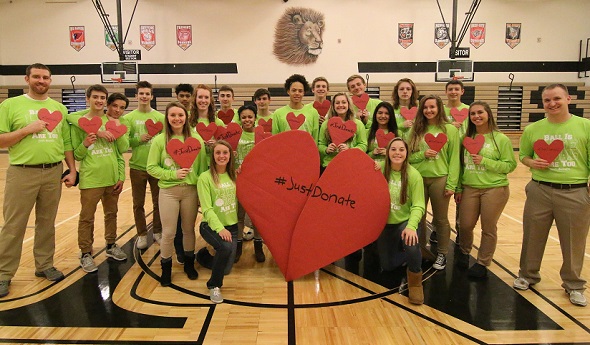
Ottinger returned to play soccer in the fall and basketball in the winter, and set up his event for the Lions’ home game against Grant. Local businesses sponsored the event, and players and coaches wore the neon green shirts Ottinger designed. So did plenty of other people.
With Justice on the court, his mother Julie Long took over running the fundraiser during the game. But she had to get her son’s OK during warm-ups to order an additional 300 shirts – the first batch had sold out.
Gift of Life also sent a representative to sign up new donors on the spot, and Ottinger said the monetary donation will be used to help people who have had transplants pay hospital bills and for other costs that come with receiving a new organ.
He’s hopeful Newaygo will put on the event again next season, and Ottinger would like to do something similar at Cornerstone, where he’s set to join the track & field team.
His desire to become a doctor is boosted by what he’s experienced medically. But it’s rooted in something he’s already begun to fulfill.
“I’ve been in the hospital a lot, so I’d say that’s partially (the motivation),” Ottinger said. “But partially, I always have this urge to help people, make life better for people, and that’s driven me to do it too.”
The Community Service Awards are sponsored by the Michigan High School Athletic Association and Lake Trust Credit Union to recognize student-athletes' efforts to improve the lives of others in their communities. In addition to the $1,000 award, the Lake Trust Foundation is awarding an additional $500 to each honoree, to be donated to a non-profit, 501 (c)(3) organization of the awardee’s choice.
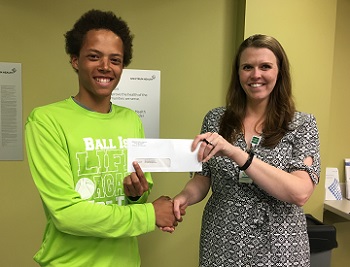
PHOTOS: (Top) Justice Ottinger (center of photo) and some of his many Newaygo supporters hold up #JustDonate hearts while wearing T-shirts he designed for his “Ball Is Life, Organs Are Too” event. (Middle) Ottinger presents a check to Gift of Life Michigan. (Photos courtesy of Justice Ottinger.)
2017 Community Service Awards
Sunday: Colon "Yard Squad" - Read
Monday: Bailey Brown, Brighton - Read

Ford Field Parking, Protocols Announced
November 24, 2014
By Geoff Kimmerly
Second Half editor
To provide for the convenience and safety of spectators attending the Michigan High School Athletic Association 11-Player Football Finals at Ford Field in Detroit, Nov. 28 and 29, attendees are being advised of a variety of items related to transportation and security – including policies regulating types of bags allowed into the stadium.
Parking will be available in Ford Field facilities and lots to the east and north of the stadium and cost $6. A map identifying the designated Ford Field lot (4) and parking deck can be found on the Football page of the MHSAA Website. (There also are a number of privately-operated parking facilities close to Ford Field, but their pricing may differ.)
Fans also are advised that tailgating, including the setting up and use of grilling equipment, and the consumption of alcohol, is prohibited in Ford Field parking facilities and lots.
Gates A, B and G will be available for public entrance during the event. Ticket sales will begin near Gates A and G at 8 a.m. each day, and the building will open its doors to spectators at 9 a.m.
Tickets are priced at $10 and allow a fan to see all four games in a single day. Spectators leaving the stadium will be required to purchase another ticket for re-entry. Children under the age of 2 will be admitted without charge for this event. There will not be a public Will Call window.
Upon arrival in the building, fans will find their designated seating areas on the South side of the field if their team is the designated home team for their contest and on the North side for the designated visiting team. Home teams this weekend are Clarkston, Muskegon Mona Shores, Muskegon, Grand Rapids South Christian, Grand Rapids West Catholic, Ithaca, Ishpeming and Munising. Brightly lit video boards above the seating areas will display the names of the participating teams each day, and fans should sit on the side of the stadium where they see their school’s name. For general fans, the entire lower bowl of Ford Field will be open for the event.
Security measures also will be in place to help assure spectator safety. Fans will be subject to a visual search, and Ford Field personnel reserve the right to request patrons open their coats, bags and other item-carrying vessels for visual inspection and deny entrance to individuals who do not cooperate. Items which fans will be prohibited from bringing into the building include, but are not limited to, the following:
- Purses larger than a clutch bag, coolers, briefcases, backpacks, cinch bags, grocery & paper bags, duffle bags, luggage of any kind, computer and camera bags and large camera cases.
- Aerosol cans (hairspray, mace, pepper spray, etc.)
- Animals (except service animals to aid guests with disabilities)
- Balloons (air or helium)
- Balls (beach balls, footballs, etc.)
- Banners or large flags
- Cameras with lenses longer than five inches
- Decals, stickers, confetti or glitter
- Electronic equipment including laptop computers, video recorders and video cameras, and tripods (hand-held video cameras are allowed)
- Fireworks
- Food, beverages or liquids (cans, bottles, boxes, flasks, etc.)
- Illegal substances
- Knives, pocket knives, box cutters, scissors, etc.
- Laser pointers
- Markers (permanent) and/or paint
- Noisemaking devices (bells, horns, kazoos, whistles, etc.)
- Objects that can be used as missiles or projectiles (sticks, bats, clubs, Frisbees, etc.)
- Seat cushions
- Strollers and infant car seats or carriers
- Umbrellas
Weapons
The following items will be permitted after inspection:
- Small bags, purses and fanny packs that do not exceed 8½ inches by 14 inches by 10 inches. An exception will be made for medically necessary items after proper inspection at a gate designated for this purpose.
- Diaper bags (only if accompanied by a child)
- Binoculars and binoculars cases
- Cameras and small camera cases (lenses may not measure longer than five inches)
- Small radios (no larger than the size of a football and used with an earpiece)
- Small hand-held video cameras (but no tripods or extension cords)
- Small, compact umbrellas (must be placed securely under seat)
- Posters and signs without poles or sticks, or larger than what one person can hold.
The complete list of prohibited items can be found on the Ford Field Web site under Policies & Info. Prohibited items that are discovered during security inspections at stadium entrances must either be returned to the owner's vehicle or discarded. Items will not be held for later pickup.
Fans are reminded that all image taking (still and video) may be only for personal, non-commercial use.