


Participation Again Outpaces Population
August 9, 2017
By Geoff Kimmerly
Second Half editor
Michigan had the eighth-most participants in high school sports nationally in 2016-17 according to statistics released this week by the National Federation of State High School Associations, after ranking seventh in participation the last eight school years.
However, this year’s level of participation again bested Michigan’s national ranking for total number of residents of high school age, which fell from ninth to 10th according to U.S. Census Bureau figures.
Michigan’s participation ranking was based on a number of 295,647, with 127,277 girls and 168,370 boys taking part in high school athletics, and included sports in which the MHSAA does not conduct postseason tournaments. The totals count students once for each sport in which he or she participates, meaning students who are multiple-sport athletes are counted more than once.
The state’s girls participation ranked eighth nationally, down one spot from 2015-16, while the boys participation figure also ranked eighth, down from sixth the year before. However, as with overall population, Michigan ranks 10th for both females and males ages 14-17 according to the latest U.S. Census Bureau estimates from 2016.
A total of 19 sports bested the state’s overall national participation ranking of eighth by placing seventh or higher on their respective lists. Three Michigan sports improved in national ranking during 2016-17, while five sports dropped one position and a sixth sport dropped two spots.
Michigan girls and boys golf both improved from sixth to fifth in national participation ranking, while girls basketball – with its first increase in participation after 10 straight years of decline – rose from seventh to sixth nationally. Michigan also moved up to seventh, from eighth, for 8-player football participation – significant because the state’s 11-player football participation ranking didn’t fall with that increase, remaining at sixth nationally for the fourth straight year.
Of the five sports that fell in national participation rankings in 2016-17, three stayed above population rank – boys basketball fell from sixth to seventh nationally, girls bowling from third to fourth and volleyball from fourth to sixth. Girls gymnastics (11th to 12th) and boys lacrosse (eighth to ninth) fell only one spot on their respective national lists.
The other Michigan sports that ranked eighth or higher all equaled their national rankings from 2015-16 and included baseball (eighth), boys bowling (third), competitive cheer (sixth), boys and girls cross country (both seventh), boys ice hockey (fourth), boys and girls skiing (both third), softball (seventh), boys tennis (fifth), girls tennis (third), boys track & field (seventh), girls track & field (eighth) and wrestling (seventh). Girls lacrosse (13th), boys and girls soccer (both ninth), boys swimming & diving (ninth) and girls swimming & diving (10th) all also held to their national rankings from the previous year.
National participation in high school sports in 2016-17 set a record for the 28th consecutive year with 7,963,535 participants – an increase of 94,635 from the year before. Girls participation increased for the 28th consecutive year with an additional 75,971 participants – the largest one-year jump since 2000-01 – and set an all-time high of 3,400,297. Boys participation also set another all-time high with 4,563,238, an increase of 18,664 participants from 2015-16.
Girls saw increases in all of their top-10 participatory sports, with competitive spirit (competitive cheer in Michigan) showing the largest increase of 18,712 participants nationally. Track & field, volleyball, soccer and lacrosse showed the next greatest increases among girls sports. Seven of the top 10 boys sports registered increases from 2015-16, led by soccer, track & field and cross country.
Football (1,086,748), while down two percent from 2015-16, again remained the most-played high school sport overall, followed by boys track & field (600,136), boys basketball (550,305), girls track & field (494,477) and baseball (492,935).
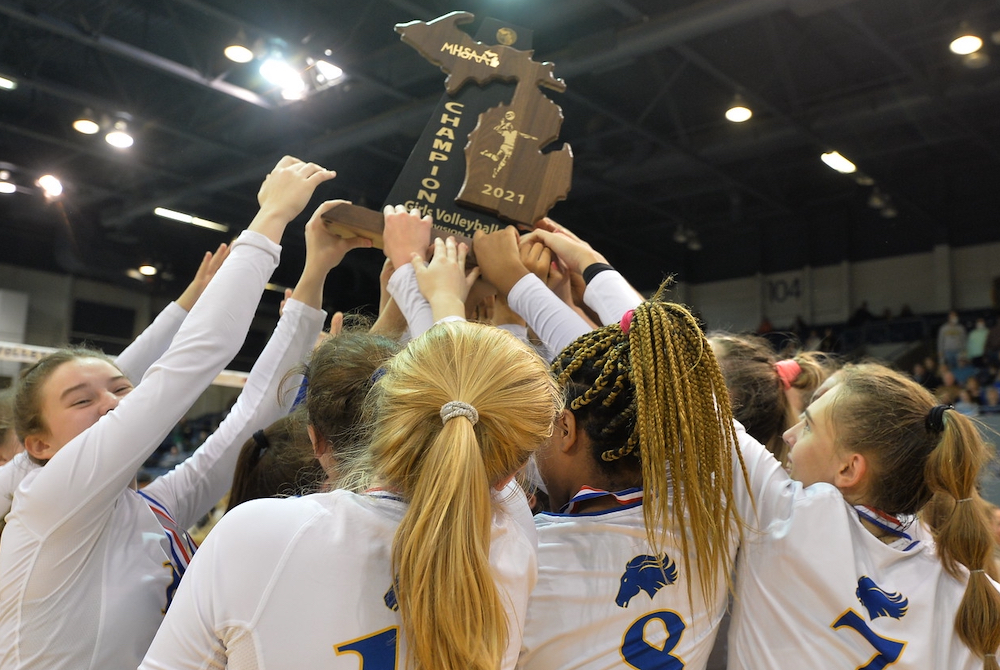
2021-22 Parade of Champions Features 98 Schools, Multiple 1st-Time Title Winners
By
Geoff Kimmerly
MHSAA.com senior editor
June 27, 2022
A total of 98 schools won one or more of the 128 Michigan High School Athletic Association team championships awarded during the 2021-22 school sports year, with two teams earning the first Finals championship in any sport in their schools’ histories.
Hillsdale Academy celebrated its first MHSAA Finals championship by winning the Lower Peninsula Division 4 boys cross country title Nov. 6. That same day, Wyoming Potter’s House Christian claimed its first Finals title by winning the Division 4 boys soccer championship.
A total of 21 schools won two or more championships this school year, paced by East Grand Rapids’ five won in girls cross country, girls lacrosse, girls track & field and both girls and boys swimming & diving. Ann Arbor Pioneer and Marquette were next with four Finals championships. Pioneer won in girls cross country, girls tennis and both girls and boys swimming & diving. Marquette won in boys cross country, boys track & field and both girls and boys swimming & diving.
Bloomfield Hills Cranbrook Kingswood and Hudson both won three Finals championships. Winning two titles in 2021-22 were Allen Park, Ann Arbor Greenhills, Brighton, Detroit Catholic Central, Escanaba, Grand Rapids Forest Hills Central, Hart, Hartland, Houghton, Ishpeming Westwood, Lansing Catholic, Munising, Muskegon Western Michigan Christian, Powers North Central, Warren De La Salle Collegiate and Williamston.
A total of 29 teams won first MHSAA titles in their respective sports. A total of 45 champions were repeat winners from 2020-21. A total of 20 teams won championships for at least the third-straight season, while six teams extended title streaks to at least four consecutive seasons. The Lowell wrestling program owns the longest title streak at nine seasons.
Sixteen of the MHSAA's 28 team championship tournaments are unified, involving teams from the Upper and Lower Peninsulas, while separate competition to determine titlists in both Peninsulas is conducted in remaining sports.
Click Here for a sport-by-sport listing of MHSAA champions for 2021-22.