


Pay-to-Play Use Hovers at 50 percent
By
Geoff Kimmerly
MHSAA.com senior editor
July 30, 2019
By Geoff Kimmerly
Second Half editor
Half of MHSAA member high schools continued to assess sports participation fees during the 2018-19 school year, according to a survey that has measured the prevalence of charging students to help fund interscholastic athletics annually over the last 15 years.
Of the 604 schools which responded to the 2018-19 survey, exactly half – 302 – assessed a participation fee, while 302 did not during the past school year. This year’s survey results are in line with those of the last two schools years, which saw 49.7 percent of schools charging participation fees for 2016-17 and 49 percent in 2017-18. For the purposes of the survey, a participation fee was anything $20 or more regardless of what the school called the charge (registration fee, insurance fee, transportation fee, etc.).
The MHSAA conducted its first participation fee survey during the 2003-04 school year, when 24 percent of responding schools reported they charged fees. The percentage of member schools charging fees crossed 50 percent in 2010-11 and reached a high of 56.6 percent in 2013-14 before falling back below 50 percent in 2016-17.
A record number of member high schools responded to the survey for the second straight year – 81 percent of the MHSAA’s 750 member schools provided data for 2018-19. Class A schools again remained the largest group charging fees, with 69 percent of respondents doing so. Class B and Class C schools followed, both with 48 percent charging fees, and Class D schools also remained in line with the previous year with 35 percent charging for participation.
Charging a standardized fee for each team on which a student-athlete participates – regardless of the number of teams – remains the most popular method among schools assessing fees, with that rate at 45 percent of schools. Schools charging a one-time standardized fee per student-athlete remained constant at 28 percent. A slight uptick was seen in the percentage of schools assessing fees based on tiers of the number of sports a student-athlete plays (for example, charging a larger fee for the first team and less for additional sports), with 20 percent of responding schools charging in this way compared to 15 percent a year ago.
The amounts of most fees remained consistent or similar as well during 2018-19. The median annual maximum fee per student of $150 and the median annual maximum family fee of $300 both remained constant for at least the fifth straight year, while the median fee assessed by schools that charge student-athletes once per year held steady at $125 for the third straight school year. The median per-team fee increased slightly, $5, to $80 for 2018-19.
The survey for 2018-19 and surveys from previous years can be found on the MHSAA Website.
The MHSAA is a private, not-for-profit corporation of voluntary membership by more than 1,500 public and private senior high schools and junior high/middle schools which exists to develop common rules for athletic eligibility and competition. No government funds or tax dollars support the MHSAA, which was the first such association nationally to not accept membership dues or tournament entry fees from schools. Member schools which enforce these rules are permitted to participate in MHSAA tournaments, which attract more than 1.4 million spectators each year.
2026-27 MHSAA Officials Registration Underway
By
Geoff Kimmerly
MHSAA.com senior editor
June 15, 2026
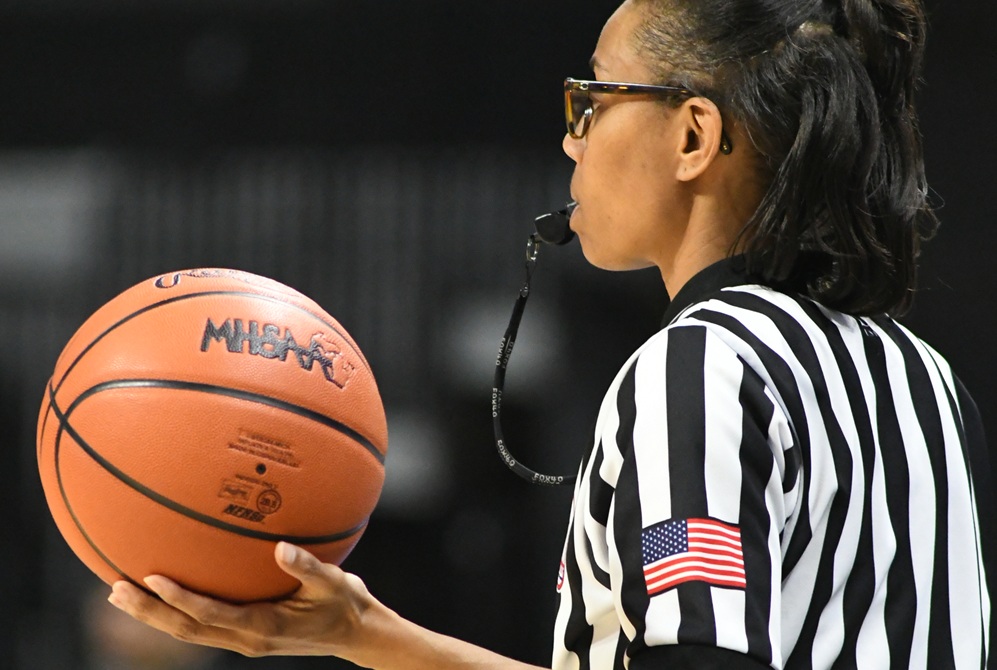
The Michigan High School Athletic Association is accepting registrations online for game officials for the 2026-27 school year.
The MHSAA registered 9,330 officials for the 2025-26 school year, an increase of 4.9 percent from the previous year’s total.
All officials who register may sign up for up to two sports as part of their registration. Officials also will receive membership in the National Association of Sports Officials (NASO), which comes with a variety of educational and training resources and the NASO’s Shield liability insurance that will provide $6 million in coverage for officials while they are working both MHSAA and non-MHSAA events.
For new and returning officials, a $70 fee covers registration for up to two sports. Officials may register for additional sports at $16 per sport.
To avoid a $30 late fee, all fall sport registration applications must be received by Aug. 17, 2026. Winter sports registrations must be received by Nov. 16 to avoid the late fee, and spring sports registrations must be received by March 24, 2027.
Online registration can be accessed on the Officials page. More information about officials registration may be obtained by contacting the MHSAA by phone at (517) 332-5046 or by e-mail at [email protected].
New officials and those who didn’t officiate during 2025-26 must complete an officials' registration test, derived from the MHSAA Officials Guidebook, and the online MHSAA Principles of Officiating course. Additional exams must be taken by those registering for football or basketball for the first time or those who were not registered for those sports during the previous school year. Links to the Officials Guidebook, Principles of Officiating presentation and the football and basketball mechanics manuals can be found by following the “New Officials” link on the Officials page of the MHSAA Website and completing the registration process.
There also are opportunities to officiate for students at least 14 years old and in grades 9-12 through the MHSAA Legacy Program. Juniors and seniors may officiate subvarsity contests, while freshmen and sophomores may officiate contests at the middle school/junior high levels. Mentor officials will work events with Legacy participants to provide guidance and support. Find information on the Legacy Program by clicking “Officials Registration” on the Officials page of the MHSAA Website and reading under “Student Legacy Program Requirements.”
While on MHSAA.com to register for the upcoming school year, officials also can register for Officiate Michigan Day 2026, set for July 25 in Grand Rapids.
Doors open at 7:30 a.m., with the first session at 9 a.m. at DeVos Place. The day-long event will feature dynamic speakers and presenters providing knowledge in several sports and all levels including collegiate and professional.
Cost is $45 if officials register by the end of June, and $50 beginning July 1. More information is on the way; keep posted at MHSAA.com/OMD.