


Pay-to-Play's Extent Unchanged in 15-16
July 21, 2016
By Geoff Kimmerly
Second Half editor
The percentage of Michigan High School Athletic Association high schools that assessed participation fees to help fund interscholastic athletics held steady at 51.5 percent in 2015-16 for the second straight school year after reaching a high of nearly 57 percent two years ago.
A total of 557 high schools – or 74 percent of the MHSAA membership – responded to the 2015-16 survey for a five percent increase from the year before and the highest feedback rate since 2010-11, when 74 percent of member high schools also responded. A total of 287 high schools, or 51.5 percent that took the survey, charged fees this school year, compared to the same percentage of 522 respondents in 2014-15.
There were 755 senior high schools in the MHSAA membership in 2015-16. This was the 12th survey of schools since the 2003-04 school year, when members reported fees were being charged by 24 percent of schools. The percentage of member schools charging fees crossed 50 percent in 2010-11 and reached 56.6 percent in 2013-14 before decreasing the following school year.
Class B schools continued to see a decline in fees in 2015-16, with 48 percent of respondents from that class assessing fees compared to 52 percent in 2014-15 and 62 percent of Class B schools in 2013-14. Class C and D saw minimal increases in the percentages of schools assessing fees this year, and for the second straight school year 70 percent of Class A respondents assessed fees.
Charging a standardized fee for each team on which a student-athlete participates – regardless of the number of teams – remains the most popular method among schools assessing fees, with that rate rising five percent to 44 percent total of schools that assessed fees in 2015-16. Schools charging a one-time standardized fee per student-athlete remained nearly constant, falling only from 28 to 27 percent over the last year. The survey showed a slight decrease in schools assessing fees based on tiers of the number of sports a student-athlete plays (for example, charging a larger fee for the first team and less for additional sports) and also a slight decrease in fees being assessed based on the specific sport being played.
The amounts of most fees also remained consistent from 2014-15 to 2015-16: the median annual maximum fee per student at $150, the median annual maximum family fee at $300 and the median per-team fee at $75. The median fee assessed by schools that charge student-athletes once per year did increase $20 to $120.
The survey for 2015-16 and surveys from previous years can be found on the MHSAA Website.
The MHSAA is a private, not-for-profit corporation of voluntary membership by more than 1,400 public and private senior high schools and junior high/middle schools which exists to develop common rules for athletic eligibility and competition. No government funds or tax dollars support the MHSAA, which was the first such association nationally to not accept membership dues or tournament entry fees from schools. Member schools which enforce these rules are permitted to participate in MHSAA tournaments, which attract more than 1.4 million spectators each year.
Awards Honor Those Lending a Hand
April 12, 2017
By Geoff Kimmerly
Second Half editor
Sports often make up a significant, although singular part of the lives of Michigan’s high school student-athletes and coaches.
 Many also find ways to have significant impacts on the lives of others – and we’d like to tell the rest of our state how they’re making a difference.
The Michigan High School Athletic Association, together with Lake Trust Credit Union, will award this spring the inaugural Community Service Awards to recognize individuals and teams that have worked to benefit their communities.
Each winner will receive a $1,000 award to be applied toward an individual college scholarship, credited to a team’s account with its athletic department or even gifted to the group helped by our honoree.
Please help us get the word out. Encourage a student, coach or administrator to tell us about a completed or ongoing community service project. Any student, team or coach currently participating in interscholastic athletics at an MHSAA member high school can apply. Applications should be e-mailed both to the school’s athletic director and MHSAA’s Kurt Tiesman at [email protected].
The deadline for applications is May 1, and multiple winners will be selected and notified by May 12. Click for more information.
We hear and read about these contributions and successes throughout the school year. Thank you in advance for your help in allowing us to honor some of this great work in the community by those who also shine on the field.
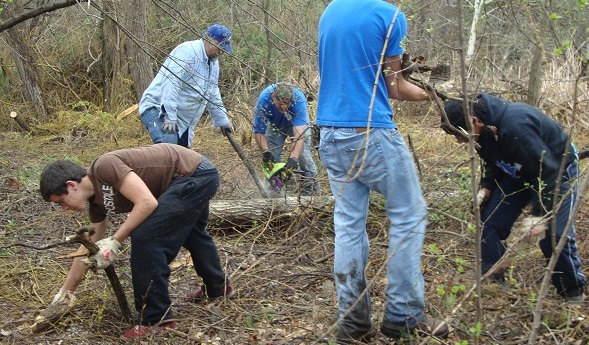
PHOTO: Members of the Adrian boys track & field team help clean up after a tornado in Dexter in 2012.