


Preliminary Concussion Data Announced
December 9, 2015
By Geoff Kimmerly
Second Half editor
The Michigan High School Athletic Association this school year requested for the first time that member schools report possible concussions by their student-athletes during both practice and competition. Preliminary data from the fall season shows two percent of more than 100,000 high school athletes experienced concussions, and 27 percent of high schools responding reported that none of their athletes experienced concussions while participating in MHSAA sports.
The MHSAA received data from 744 – or 99 percent – of its member high schools at the end of the fall season. The average number of concussions reported by member high schools through Dec. 4, 2015, was 3.2 concussions per school. Fifty-two percent of reporting schools stated they had two or fewer concussions by athletes this fall.
Football, the fall season’s most-played sport with 39 percent of all fall participants, revealed 79 percent of all concussions reported for the season. Boys soccer, with nearly 14 percent of fall sport participants, revealed 11 percent of all concussions reported.
Data collected by the MHSAA remains preliminary, in part, because results noted include pending reports that have not been verified. After completion of these follow-up reports, the final number of concussions that actually occurred this past season may be lower than the preliminary numbers being reported at this time. The data analyzed to date is for high schools only, although middle schools also have the opportunity to report possible concussions. A full breakdown of the data including concussions by gender, sport, team level (varsity through junior high) and setting (practice or event) will be reported after the conclusion of the spring 2016 season.
The reporting of possible concussions is part of a three-pronged advance by the MHSAA in concussion care during the 2015-16 school year, all of which are producing data related to the frequency and severity of head injuries. The MHSAA this fall became the first state association to offer pilot sideline concussion testing, with 62 schools taking part in one of two programs. One of the objectives of the pilot programs was to increase awareness of concussions and improve sideline detection; and preliminary results indicate that the average number of possible concussions reported by pilot schools exceeds the average reported by schools outside the pilot group.
Of 36 schools reporting the most concussions this fall, 11 are part of the MHSAA’s pilot sideline detection programs. Those programs – King-Devick Test and XLNTbrain Sport – utilize technology to provide on-site testing of athletes who have sustained possible concussions, with results of those examinations then compared against baseline tests taken by athletes previously.
The MHSAA also is the first state association to provide all participants at every member high school and junior high/middle school with insurance intended to pay accident medical expense benefits – covering deductibles and co-pays left unpaid by other policies – resulting from head injuries sustained during school practices or competitions and at no cost to either schools or families. The program will produce additional data about the frequency and severity of head injuries. While it is still early, only 34 claims have been made on the insurance policy designed to assist in payment for concussion care. Twenty of the claims are for football, 11 for soccer.
“These three efforts combined are part of making our good programs better,” MHSAA Executive Director John E. “Jack” Roberts said. “We’re pleased to provide these services to our schools, and we anticipate having a comprehensive report after the end of the school year, with that data then used by the National Federation of State High School Associations and research institutions to continue to make our games safer.”
Schools report possible concussions online via the MHSAA Website. Reports are then examined by members of the MHSAA staff, who follow up with school administrators as those student-athletes continue to receive care and eventually return to play. Student privacy is protected.
Previously, the MHSAA also was among the first state associations to adopt a return-to-play protocol that keeps an athlete out of activity until at least the next day after a suspected concussion, and allows that athlete to return to play only after he or she has been cleared for activity by a doctor (M.D. or D.O.), physician’s assistant or nurse practitioner.
“These pilot programs, and the reporting of potential concussions by all of our schools, have made administrators, coaches and athletes more aware of the possibility of concussions and the importance of immediate detection and care,” Roberts said. “Many of our schools have long had programs in place to detect concussions and provide care. The opportunities to test, report and receive financial assistance in the event of a concussion have encouraged all of our schools to consider additional ways to better care for their student-athletes.
“These latest in a long line of health and safety initiatives will establish a baseline, and eventually allow us to determine if we are making progress year-to-year in Michigan school sports in this critical area of health and safety.”
The MHSAA is a private, not-for-profit corporation of voluntary membership by more than 1,400 public and private senior high schools and junior high/middle schools which exists to develop common rules for athletic eligibility and competition. No government funds or tax dollars support the MHSAA, which was the first such association nationally to not accept membership dues or tournament entry fees from schools. Member schools which enforce these rules are permitted to participate in MHSAA tournaments, which attract more than 1.4 million spectators each year.
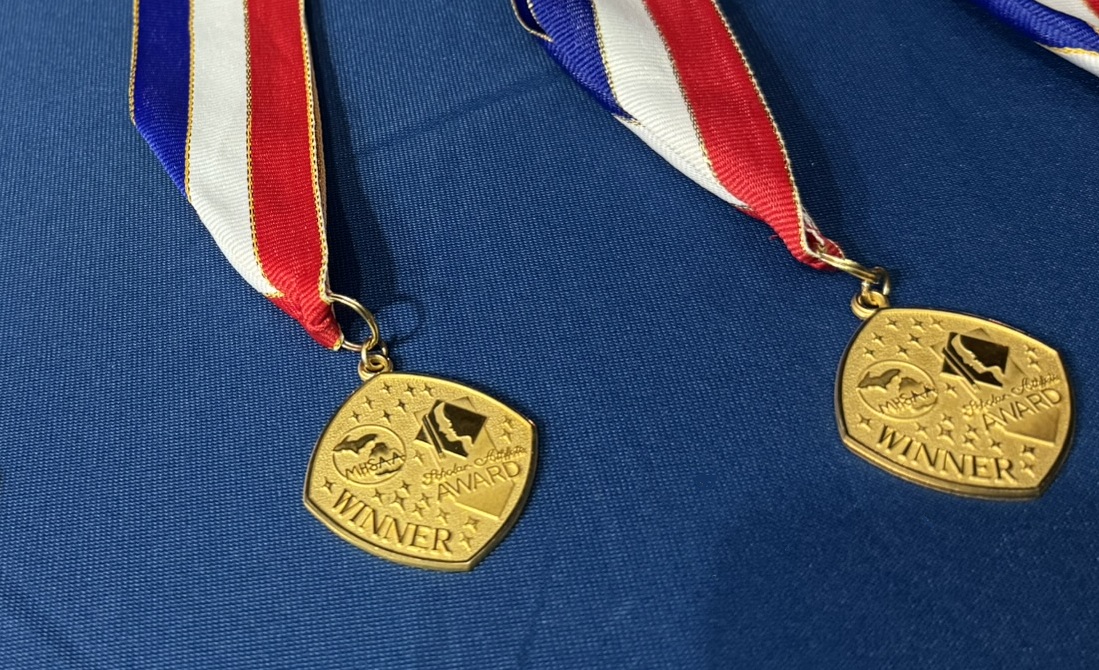
Applications Available for 2026-27 MHSAA/Farm Bureau Insurance Scholar-Athlete Awards
By
Geoff Kimmerly
MHSAA.com senior editor
October 6, 2026
One of the Michigan High School Athletic Association’s most popular programs, the Scholar-Athlete Award, will again with Farm Bureau Insurance present 32 $2,000 scholarships to top student-athletes at member high schools during the 2026-27 school year.

The MHSAA/Farm Bureau Insurance Scholar-Athlete Award highlights the value extracurricular activities play in the total education of high school students, often improving their academic achievements in the process. The Scholar-Athlete Award is in its 38th year. Since the award’s inception in 1988-89, Farm Bureau Insurance has presented more than $1 million in scholarships through this program.
The first 30 scholarships will be presented on a graduated basis across the MHSAA’s traditional class structure. From Class A schools, six boys and six girls will receive scholarships; from Class B schools, four boys and four girls; from Class C schools, three boys and three girls; and from Class D schools, two boys and two girls will be honored. The final two scholarships will be awarded at-large to minority recipients, regardless of school size. The scholarships may be used at the institution of higher learning the recipients attend during the first year at those colleges.
Applications from individual schools will be limited to the number of available scholarships in their enrollment class. Class A schools may submit the names of six boys and six girls, Class B schools may submit four boys and four girls, Class C may submit three boys and three girls and Class D may submit two boys and two girls.
Students applying for Scholar-Athlete Awards must be graduating during the 2026-27 school year, carrying an unrounded 3.5 (on a 4.0 scale) grade-point average and have won a varsity letter in a sport in which the MHSAA sponsors a postseason tournament: baseball, girls and boys basketball, girls and boys bowling, competitive cheer, girls and boys cross country, field hockey, football, girls and boys golf, gymnastics, ice hockey, girls and boys lacrosse, girls and boys skiing, girls and boys soccer, softball, girls and boys swimming & diving, girls and boys tennis, girls and boys track & field, girls and boys volleyball and girls and boys wrestling.
Applicants will be required to show involvement in other school and community activities and submit an essay on the importance of sportsmanship in educational athletics.
Information – including answers to a number of frequently asked questions – and links to the application are available online on the Scholar-Athlete Award page. Applications are available in digital format only and must be submitted online by 4 p.m. Dec. 4.
A committee composed of school administrators from across the state will select finalists and winners in late January, with the winners to be announced throughout February. All applicants, finalists and scholarship recipients will be announced on the MHSAA Website. The 32 scholarship recipients will be recognized during the 2027 MHSAA Boys Basketball Finals at the Breslin Student Events Center in East Lansing.
Farm Bureau Insurance of Michigan was founded in 1949 by Michigan farmers who wanted an insurance company that worked as hard as they did. Those values still guide the company today and are a big reason why it is known as Michigan’s Insurance Company, dedicated to protecting the farms, families, and businesses of this great state. Farm Bureau Insurance agents across Michigan provide a full range of insurance services – life, home, auto, farm, business, retirement, Lake Estate®, and more – protecting more than 660,000 Michigan residents.
The MHSAA is a private, not-for-profit corporation of voluntary membership by more than 1,500 public and private senior high schools and junior high/middle schools which exists to develop common rules for athletic eligibility and competition. No government funds or tax dollars support the MHSAA, which was the first such association nationally to not accept membership dues or tournament entry fees from schools. Member schools which enforce these rules are permitted to participate in MHSAA tournaments, which attract more than 1.4 million spectators each year.