


Rate of MHSAA High Schools Charging Participation Fees Falls to Lowest in 22 Years
By
Geoff Kimmerly
MHSAA.com senior editor
August 5, 2026
The annual Michigan High School Athletic Association participation fee survey completed for the 2025-26 school year continued to confirm the positive direction that has emerged this decade as the rate of member high schools charging student-athletes to play sports fell to its lowest in more than two decades.
Of the 703 MHSAA member schools (93 percent of membership) which responded to the most recent survey, only 38 percent (270 schools) charged participation fees in 2025-26 – a drop of two percent from the year prior and the lowest percentage since 34.5 percent of member schools reported charging a fee for the 2004-05 school year. Over the two decades between, the rate of high schools charging participation fees reached a high of 57 percent in 2013-14. Rates consistently have measured in the low 40s after the COVID-19 pandemic.
The MHSAA began conducting the participation fee survey with the 2003-04 school year. For the purposes of the survey, a participation fee is anything $20 or more regardless of what the school called the charge – registration fee, athletic fee, etc.
All four school-size classifications also saw rate decreases, with Class A schools leading the way with 46 percent charging fees – which was still a reduction of seven percent from 2024-25. Class B was down slightly to 39 percent charging for participation, while Class C schools were down six points to 28 percent charging and Class D schools were down four points also to 28 percent.
A standardized fee for each team on which a student-athlete participates – regardless of the number of teams – has remained the norm over the history of the MHSAA’s survey, and for the second-straight year 43 percent of schools charging a fee did so in this way during 2025-26. That was followed by 33 percent of responding schools charging a one-time standardized fee and 13 percent assessing fees based on tiers of the number of sports a student-athlete plays (for example, charging a larger fee for the first team and less for additional sports).
For 2025-26, the median maximum amount a school charged per student-athlete for the school year was $150, and the median annual maximum charged per family was $350. For schools charging student-athletes a one-time fee to cover all sports played, the median was $125. For schools charging a fee per sport, the median was $80 for each team.
The survey for 2025-26 and surveys from previous years can be found on the Pay-To-Play Survey page (direct link to this year’s results).
The MHSAA is a private, not-for-profit corporation of voluntary membership by more than 1,500 public and private senior high schools and junior high/middle schools which exists to develop common rules for athletic eligibility and competition. No government funds or tax dollars support the MHSAA, which was the first such association nationally to not accept membership dues or tournament entry fees from schools. Member schools which enforce these rules are permitted to participate in MHSAA tournaments, which attract more than 1.3 million spectators each year.
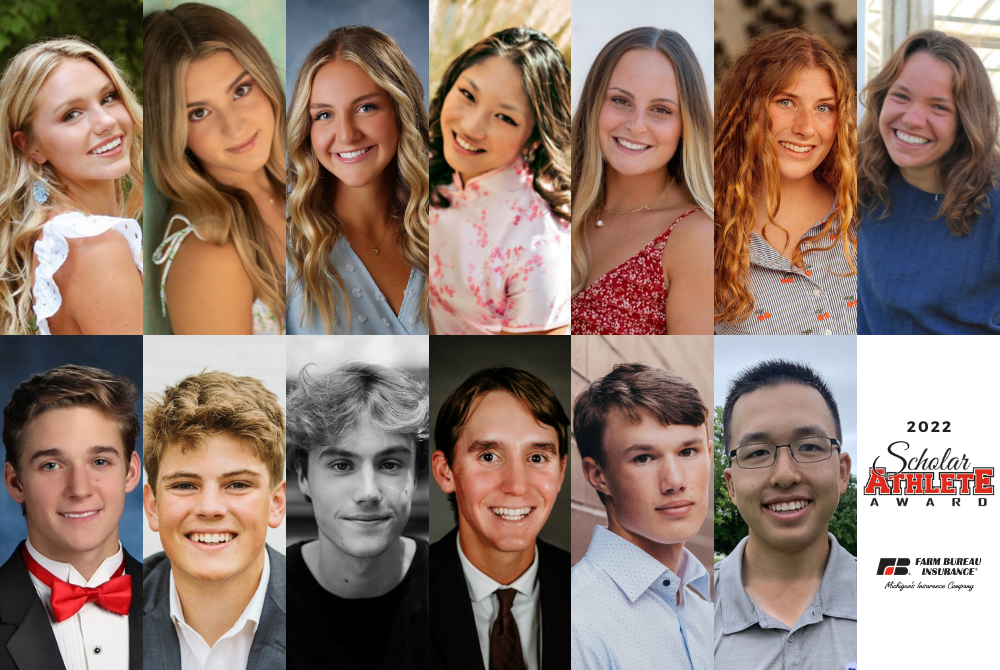
Scholars & Athletes 2022: Class A
By
Geoff Kimmerly
MHSAA.com senior editor
February 22, 2022
The Michigan High School Athletic Association has selected 13 student-athletes from Class A member schools to receive scholarships through the MHSAA/Farm Bureau Insurance Scholar-Athlete Award program.

Farm Bureau Insurance, in its 33rd year of sponsoring the award, will give $2,000 college scholarships to 32 individuals who represent their member schools in at least one sport in which the Association sponsors a postseason tournament. The first 30 scholarships are awarded proportionately by school classification and the number of student-athletes involved in those classes; also, there are two at-large honorees who can come from any classification.
Students applying for the Scholar-Athlete Award must be carrying at least a 3.5 (on a 4.0 scale) grade-point average and have previously won a letter in a varsity sport in which the Michigan High School Athletic Association sponsors a postseason tournament. Other requirements for the applicants were to show active participation in other school and community activities and produce an essay on the importance of sportsmanship in educational athletics.
The 32 scholarship recipients will be recognized March 26 during the MHSAA Boys Basketball Finals at the Breslin Student Events Center in East Lansing.
The Class A Scholar-Athlete Award honorees are: Cookie Estelleh Baugh, Ann Arbor Pioneer; Ella DeGraw, Rochester Hills Stoney Creek; Alexis Maloney, St. Johns; Maeve Spicer, White Lake Lakeland; Ella Spooner, Holland West Ottawa; Greta VanZetten, Holland; Elzien Zomer, Holland; John Bungart, Orchard Lake St Mary's; William Goelz, Petoskey; Klay Grant, Muskegon Reeths-Puffer; Colin Koot, Mason; Brady Wright, Birmingham Seaholm; and Neil Zhu, Detroit Catholic Central.
Overviews of the scholarship recipients of the Class A Scholar-Athlete Award follow. A quote from each recipient's essay also is included:
(NOTE: If an athlete intended to play and was part of a spring sports team in 2020, that sport is counted among the athlete’s total although the season was canceled due to COVID-19.)
 Cookie Estelleh Baugh, Ann Arbor Pioneer
Ran four years of varsity cross country and will participate in her fourth of track & field this spring. Helped cross country team to three straight Lower Peninsula Division 1 championships and finished fifth and 12th, respectively, in the individual standings her final two seasons. Also ran on LPD1 champion 3,200-meter relay last spring. Earned all-state academic honors seven times across her two sports and served as captain of both teams. Participating in fourth year of student council and third of National Honor Society. Serving first year as Ann Arbor Area Community Foundation board member trustee and also fourth year on foundation’s Youth Council. Participated for three years as part of school’s Positive Peer Influencer program and is participating in third year of Pioneer’s Restorative Justice Program. Will attend Michigan State University and study kinesiology.
Essay Quote: “Having begun playing competitive sports at age 3, I have experienced wins and losses, successes and failures. I have felt like the queen of the world, and I have wept like a baby into my pillow. With each experience I learned my why. … To demonstrate good sportsmanship is as much for myself, teammates, coaches, parents, and family; I owe it to them to lead by a positive example.”
 Ella DeGraw, Rochester Hills Stoney Creek
Participating in fourth season of competitive cheer and will play varsity tennis this spring after previously playing on junior varsity; also cheered four years with football sideline team. Helped competitive cheer team to Division 1 Finals championship as a freshman and is a four-year starter in all three rounds. Earned all-state recognition and twice made academic all-state team for cheer, and twice served as team captain for competitive and sideline teams. Participating in second year of National Honor Society and has served as officer and cabinet member. Also participating in third year of Spanish National Honor Society and as a senior officer. Serving fourth year and as leader of school’s Athletic Leadership Council, and serving fourth year in key club. Named Clinical Observer of the Year by Ascension St. John Children’s Hospital department of pediatrics. Will attend University of Michigan and study biology on a pre-medical track.
Essay Quote: “Sports have provided me with some of the best life skills I have ever learned. … Life is not always kind, bad outcomes happen regardless of effort and preparation, and all I can control is how I respond to those moments of adversity. Part of sportsmanship is dealing with adversity and not making excuses when the outcome doesn’t go your way.”
 Alexis Maloney, St. Johns
Playing third season of varsity basketball and will play fourth of varsity tennis this spring; also played junior varsity volleyball as a freshman and sophomore. Earned all-conference and all-academic honors in basketball and tennis, helping tennis team to league championship and Regional runner-up finish. Served as captain for both varsity teams. Playing fourth year in marching band and third with symphonic band and has served as tenor drum and drumline section leader. Earned “1” competition ratings as part of both bands. Participating in fourth year on school’s Student Athletic Leadership Committee, and serving as social media director, and participating in second year of National Honor Society. Also participating in fourth years of school’s Compassion Club (serving on leadership board), Renaissance Club, Garden Club and church youth group. Will attend Trine University and study mechanical engineering.
Essay Quote: “When given the chance to congratulate, help, or support your opponent, do it. There will never be any negative backlash from the positivity you give to them, and know that makes you a better person. Sportsmanship is much like the golden rule; treat others the way you want to be treated. Take these lessons from the game and make them a part of your every day.”
 Maeve Spicer, White Lake Lakeland
Competing in fourth season of varsity gymnastics and third of varsity competitive cheer. Also ran junior varsity cross country and participated in track & field as a freshman. Earned all-state in gymnastics finishing sixth on vault at MHSAA Finals as a junior and was conference all-around champion; also earned academic all-state recognition. Helped her Huron Valley United co-op gymnastics team to Regional title as a sophomore. Served as captain of gymnastics and cheer teams. Participating in second years of National Honor Society, Math Honor Society and Spanish Honor Society. Earned Individual Project Completion of Middle Years Programme as part of International Baccalaureate studies. Participating in second year of Peer Corps, and has organized three clothing drives for foster children as part of work for local center. Is undecided where she will attend college but intends to study international relations.
Essay Quote: “Sportsmanship is important because sports themselves are not simply about who is the best, rather what you can learn from them. I have learned valuable life lessons from my sports that I will carry with me throughout the rest of my life such as determination, perseverance, teamwork, integrity, and respect, along with so many others that have built up my character.”
 Ella Spooner, Holland West Ottawa
Playing second season of varsity basketball and will play her fourth of varsity lacrosse this spring. Earned all-conference and individual academic all-state in lacrosse and helped basketball team to academic all-state honor. Named Michigan Youth Female Athlete of the Year at 2021 Meijer State Games. Will serve third season as lacrosse captain. Ranked first academically in class of 512 with 4.16 GPA, and participating in National Honor Society. Participating in third year of LINKS and second of Peer-to-Peer mentorship programs. Served as writer and editor of school’s newspaper and earned awards from Michigan Interscholastic Press Association and Scholastic. Served as assistant director for West Ottawa Broadcasting Network. Coached youth basketball and lacrosse, and volunteered in multiple other service efforts. Will attend Kalamazoo College and study biology on a pre-medical track.
Essay Quote: “Character is so important in life and can either drag you down or take you far. By teaching sportsmanship, it allows young athletes who are still growing and developing to build their character. Each part of being an excellent sportsman relates directly to more than just a sports game, but to the game of life itself.”
 Greta VanZetten, Holland
Participated in four seasons of varsity swimming and will participate in fourth of track & field this spring. Earned all-conference in both sports and qualified 17 times for MHSAA Finals in swimming over four seasons. Served as co-captain of swim team as both junior and senior. Participating in second year of National Honor Society and voted head of school’s leadership pillar. Participating in second year of student senate and third year as part of school’s delegation to Youth in Government; also serving second year as part of Holland Youth Advisory Council’s environmental committee and as chairperson. Participating in third year of school choirs Vocal Dimensions and as president. Initiated Michigan Green School certification for Holland High and participating in third year with Students Helping Our Remarkable Earth club. Participating in second year of Academic WorldQuest and won regional competition and qualified for nationals as a junior. Is undecided where she will attend college but intends to double major in mathematics and gender and sexuality studies.
Essay Quote: “Sportsmanship is about wanting the best for your competitors, as well as yourself. When everyone competes at the best of their ability, sports become truly fun. Educational athletics expand beyond winning and achievement. Learning about humility, equity, confidence, and collaboration are all lessons found in sportsmanship and encouraged though high school sports.”
 Elzien Zomer, Holland
Playing third season of varsity basketball, swam three seasons on varsity and will play second season of varsity soccer this spring; also played junior varsity volleyball as a freshman. Earned all-area honors in basketball and served as team captain for basketball (varsity and JV), co-captain for swimming & diving team and captain for junior varsity volleyball. Participating in second year of National Honor Society and as part of leadership pillar, and serving third year as class representative in student government. Serving as school representative to county’s Student Leaders Initiating Change coalition. Participating in fourth year in school’s be nice. club. Served as youth soccer official for three years and community pool lifeguard. Will attend University of Michigan-Dearborn and study either biomedical engineering or physical therapy.
Essay Quote: “Attitude and respect are always a choice, every day, every play. A positive mindset and an encouraging attitude build strong athletes, but also build good role models for life. … We don’t all have the same intensity for sportsmanship, but we each have the tools to build character on and off the court. For me, this is the importance of sportsmanship in educational athletics. The goal is to teach growth and understanding so that we can choose to put them into practice in our own lives.”
 John Bungart, Orchard Lake St. Mary’s
Wrestling fourth varsity season and will play fourth season of varsity lacrosse in the spring. Also will compete in fourth season on rowing team. Served as captain of both wrestling and lacrosse teams. Earned all-state in lacrosse and all-league and all-country in wrestling. Carrying 4.07 GPA and participating in second year of National Honor Society. Summited second and third-highest peaks in United States as part of Boy Scouts. Has volunteered in multiple volunteer community service efforts including as part of Forgotten Harvest throughout high school. Has served as lifeguard throughout high school. Also has participated in church youth group all four years. Will attend Kalamazoo College and study biochemistry.
Essay Quote: “We speak with our mouths, and we hear with our ears. We also talk with our hands and listen with our eyes. We share with our faces and understand it in our hearts. When any of these cogs in the wheel fail, it can lead to confusion, knee-jerk responses, and chaos in its wake. Communication and mutual respect are the (epitomes) of sportsmanship in educational athletics.”
 William Goelz, Petoskey
Competing in fourth season of varsity skiing and played two seasons of varsity tennis. Also played two subvarsity seasons of lacrosse and ran cross country as a freshman. Helped ski team to two Division 2 Finals championships and a runner-up finish, and earned multiple all-state honors. Earned academic all-state in skiing and tennis, and served as ski team captain. Earned AP Scholar with Distinction and National Merit Scholarship commended scholar designations. Participating in second year of National Honor Society and third on district’s Student Advisory Council. Has served all four years as part of Petoskey-Harbor Springs Area Community Foundation Youth Advisory Committee, including as foundation officer and board liaison, and is serving as PHSACF director as a senior. Participating in third year of key club and as vice president. Completed University of Pennsylvania’s Wharton Global Youth Program Business Leadership Academy. Is undecided on where he will attend college and his future course of study.
Essay Quote: “Decades from now, what I will remember are great times spent with great teammates, a sentiment held impossible if not for the utmost sportsmanship within myself and amongst athletes. Not only does sportsmanship in educational athletics spark lifelong memories, it also establishes a careful precedent for sociability and professionalism beyond high school.”
 Klay Grant, Muskegon Reeths-Puffer
Ran four seasons of cross country and will participate in fourth of track & field this spring; also played varsity soccer as a freshman. Earned three Greater Muskegon cross country championships and finished eighth in Lower Peninsula Division 1 Final this past fall. Qualified for MHSAA Track & Field Finals in four events as a junior and earned all-conference. Served as captain of cross country and track teams. Served as student council freshman president and as trustee as a sophomore. Participating in third year of church’s children’s ministry and as student leader, and second year as church intern. Serving as student leader in third year participating on school’s IMPACT leadership team, and served as ambassador for Straight Talk About Tough Stuff coalition. Will attend Colorado Christian University and major in Biblical studies with an emphasis in languages.
Essay Quote: “I believe the integrity of sportsmanship is often downplayed. It is not only the heroic acts of sportsmanship in front of a big crowd, or when the cameras are on, but in the day-in-day-out monotony of relationships. I viewed this highly by encouraging each teammate after practices, telling them: "Nice job today, I'll see you tomorrow."
 Colin Koot, Mason
Playing second season of varsity basketball and will play second of varsity baseball this spring, and played four seasons of varsity tennis. Helped tennis team qualify for MHSAA Finals all four seasons and earned all-conference in tennis and baseball. Helped baseball team to academic all-state award. Served as tennis team captain for three seasons. Participating in fourth year of Youth in Government and second as delegation leader, and received servant leadership award as sophomore. Participating in second year of National Honor Society. Participated in Future Farmers of America as a freshman and sophomore and won state championship in Greenhand Conduct of Meetings as a freshman and National Silver Award as a sophomore. Served as school newspaper sports editor-in-chief as a freshman and has umpired baseball throughout high school. Is undecided where he will attend college but intends to study biomedical engineering.
Essay Quote: “Overall, competitive sportsmanship is the most important facet of educational athletics. The ability for an individual to compete at a high level while maintaining good sportsmanship is crucial in transforming from a person who wins to a person who succeeds. Success is measured in many different ways, but a successful athlete understands that there is more to athletics than just the scoreboard.”
 Brady Wright, Birmingham Seaholm
Competing in fourth season on varsity ski team and played four seasons of varsity tennis; also played junior varsity lacrosse as a freshman and sophomore. Reached MHSAA Finals flight semifinals as sophomore and junior. Earned all-state and all-state academic for tennis and all-region for ski, and earned multiple league Scholar-Athlete Awards for both sports. Served as team captain for both. Earned AP Scholar with Distinction and named National Merit Scholarship semifinalist. Earned perfect score on ACT. Participating in second year of National Honor Society and third of National Science Honor Society. Participated in Science Olympiad as competitor and coach and founded high school team, and earned county and state placings. Playing fourth years in school marching and concert bands and served as clarinet section leader. Is undecided where he will attend college but intends to study chemical engineering.
Essay Quote: “Ultimately, what I learned is that the game and the competition is more important than winning a match at any cost. I have seen kids who struggle with losing and will do anything to win. Honor and integrity get thrown out the window to avoid a loss. … It is important to me that I am honest with myself – I play sports to push myself in ways that academics cannot. Cheating the game does not help you improve or build character.”
 Neil Zhu, Detroit Catholic Central
Will play fourth season of varsity golf this spring and has helped team to runner-up and fourth-place finishes at Lower Peninsula Division 1 Finals. Earned all-state and is ranked among top players for his class in Michigan by American Junior Golf Association. Advanced to match play at Golf Association of Michigan 2021 Amateur Championship. Earned AP Scholar with Honor and National Merit Scholarship commended student designations. Participating in second year of National Honor Society tutoring program. Participating in fourth year of finance club and as vice president. Reached highest level of Michigan Music Teachers Association for piano and earned first and second-place finishes in state competition. Completed University of Michigan summer coding program. Volunteered in multiple community service efforts throughout high school. Served as youth leadership member for church as junior and senior. Will attend Swarthmore College (Pa.) and study computer science.
Essay Quote: “The sport of golf is a medium through which my accountability to my decisions and more importantly my accountability to my competitors and values is tested. Therefore, my integrity plays into the principle of accountability. Moreover, golf offers opportunities to meditate on choices which plays into the skill of decision making.”
Other Class A girls finalists for the Scholar-Athlete Award were: Amelia Weyhing, Ann Arbor Pioneer; Piper Barnhart, Brownstown Woodhaven; Sophia Lustig, Brownstown Woodhaven; Madison Hissong, Fraser; Brooke Myers, Grand Rapids Forest Hills Northern; Ana Todesco, Grosse Pointe North; Sonya Konon, Harrison Township L'Anse Creuse; Natalie Blake, Holland West Ottawa; Abigail Lueck, Livonia Churchill; Samantha Provenzano, Livonia Franklin; Erica Molnar, Livonia Stevenson; Laura Leiti, Midland Dow; Alexandria Stacy French, Richland Gull Lake; Kiera Hall, Rochester Hills Stoney Creek; Kate Meinecke, Royal Oak; Sara Schermerhorn, Traverse City West; and Hannah DiGiovanni, Troy Athens.
Other Class A boys finalists for the Scholar-Athlete Award were: Nathan Pawlowicz, Battle Creek Lakeview; Nathan Jerore, Brownstown Woodhaven; Colin Pearson, Caledonia; Joseph Marano, Dearborn Edsel Ford; Conner Bell, Detroit Catholic Central; Chase Gibson, Fenton; Nick Temple, Fenton; Ben Taylor, Grand Rapids Forest Hills Central; Ross VanBlois, Grandville; Owen Swisher, Livonia Churchill; James Oberman, Livonia Franklin; Thomas Randall, Orchard Lake St Mary's; Blake Coy, Saline; Amod Talekar, Saline; Kaden Keller, St. Johns; Jake Lasceski, St. Johns; Ethan Tennant, Temperance Bedford; Michael T. Schermerhorn, Traverse City West; and Caiden Carlson, White Lake Lakeland.
The Class C and D scholarship award recipients were announced Feb. 8, and the Class B honorees were announced Feb. 15.
Farm Bureau Insurance of Michigan was founded in 1949 by Michigan farmers who wanted an insurance company that worked as hard as they did. Those values still guide the company today and are a big reason why it is known as Michigan’s Insurance Company, dedicated to protecting the farms, families, and businesses of this great state. Farm Bureau Insurance agents across Michigan provide a full range of insurance services—life, home, auto, farm, business, retirement, Lake Estate®, and more—protecting nearly 500,000 Michigan policyholders.
The MHSAA is a private, not-for-profit corporation of voluntary membership by more than 1,500 public and private senior high schools and junior high/middle schools which exists to develop common rules for athletic eligibility and competition. No government funds or tax dollars support the MHSAA, which was the first such association nationally to not accept membership dues or tournament entry fees from schools. Member schools which enforce these rules are permitted to participate in MHSAA tournaments, which attract more than 1.4 million spectators each year.