

Rep Council Approves Expanded Basketball Schedules, Classification Changes at Winter Meeting
By
Geoff Kimmerly
MHSAA.com senior editor
March 29, 2022
An increase in the number of regular-season games high school basketball teams are allowed to play may be the most visible action taken by the Representative Council of the Michigan High School Athletic Association during its annual Winter Meeting on March 25 in East Lansing. However, a change in classification procedure expected to bring more equity to tournament groupings should have the most far-reaching effects across all sports.
The Winter Meeting frequently serves as an opportunity for the Council to discuss items expected to come up for action at its final meeting of the school year, scheduled for May 1-2. However, the Council took a number of actions at this meeting as they relate to scheduling currently underway for the 2022-23 school year, or Spring tournaments this May.
The Council approved a Basketball Committee proposal that will allow, beginning with the 2022-23 season, high school basketball teams to play up to 22 regular-season games at every level (varsity, junior varsity and freshman). Teams previously played a maximum of 20 games during the regular season; this adjustment brings MHSAA school schedules in line with what is allowed in most other Midwest states. Additionally as part of that proposal, mandatory preseason practice was reduced by one week, allowing teams to begin playing games after 14 days instead of 21.
The Council also approved a proposal by the Classification Committee that will result in postseason divisions more reflective of the number of schools actively sponsoring teams for that season. Divisions are assigned by taking the number of teams playing a sport and dividing equally by the number of team championships awarded in that sport (for example, four in baseball and softball). Previously, by the time seasons started the smallest-school divisions in many sports ended up with fewer teams than larger-school divisions because several small schools would declare they would be sponsoring a team during the classification process in March but then be unable to do so because of lack of participation or other reasons.
With this change, schools that have indicated they will sponsor a sport but haven’t participated in that sport as a team or with individual qualifiers over the previous two years will be removed from the classification process before divisions are determined. Those schools that have been removed must then notify the MHSAA they have an active team before being added back into the tournament.
A number of other actions will affect competition as quickly as this spring’s MHSAA Tournaments, and into the 2022-23 school year.
The Council approved a Cross Country/Track & Field proposal to allow for more MHSAA Tournament opportunities for wheelchair athletes. Starting with this Spring 2022 season, Regional and Final meets will include four events for wheelchair participants – 100, 200 and 400-meter races and shot put. These events will be open to wheelchair track & field athletes at MHSAA member schools. Additionally, the Council approved the expansion of postseason Paralympic opportunities in swimming, adding a 100-yard freestyle heat to the 50-yard freestyle heat that has been offered at Finals since 2020.
In baseball and softball, the Council approved committee proposals in those sports to allow District first-round games to be played during the week before Memorial Day. Baseball may play first-round games that previous Thursday, Friday or Saturday, and softball may play that previous Thursday and Friday, beginning this upcoming season. Previously, all first-round games were played the Tuesday after Memorial Day. This change is expected to alleviate pitch count concerns in baseball and provide scheduling flexibility for later District rounds that could allow athletes – especially at small schools where baseball and softball players frequently participate in track & field – opportunities to compete in both sports during the week following Memorial Day.
Another change proposed by the Classification Committee and approved by the Council will raise the enrollment cap for cooperative hockey programs, potentially allowing for more opportunities for schools to contribute athletes who wish to play the sport. Nearly 50 percent of hockey teams playing in the MHSAA Tournament are cooperatives made up of students from multiple schools, and for hockey those schools’ enrollments now may total up to 5,500 students, an increase of 2,000 students for hockey only. Schools participating in a cooperative hockey program must continue to receive Executive Committee approval and show a demonstrated lack of participation in hockey.
The Council also approved a Classification Committee proposal that will allow football teams to opt up in division after the annual release of classifications for the upcoming season in late March/early April. Football teams may opt up one division, with Executive Committee approval, and must show reason and rationale for their request. All football opt ups will be for a minimum of two years, and the Executive Committee will consider those opt-up requests at only its April and May meetings each year.
The Council approved a number of increased benefits for MHSAA-registered game officials, including raises in postseason game fees paid to officials across all sports. Also moving forward, MHSAA officials will be provided membership in the National Association of Sports Officials (NASO), which will provide expanded liability insurance plus additional resources and professional services for all MHSAA registered officials. The Council also approved a change to the registration process and fees that will automatically provide each official registration in two sports. All three changes were proposed by the Audit & Finance Committee.
The Council also approved a rule change allowing the use of school transportation during summer, but it must be funded from school-approved activities of booster clubs, school teams, student groups and community, civic or service groups. This includes the use of busses, vans and other vehicles owned or leased by the school district or operated by any entity with which the district contracts to provide transportation services.
The Representative Council is the legislative body of the MHSAA. All but five members are elected by member schools. Four members are appointed by the Council to facilitate representation of females and minorities, and the 19th position is occupied by the Superintendent of Public Instruction or designee.
The MHSAA is a private, not-for-profit corporation of voluntary membership by more than 1,500 public and private senior high schools and junior high/middle schools which exists to develop common rules for athletic eligibility and competition. No government funds or tax dollars support the MHSAA, which was the first such association nationally to not accept membership dues or tournament entry fees from schools. Member schools which enforce these rules are permitted to participate in MHSAA tournaments, which attract more than 1.4 million spectators each year.
6 Schools Win First Titles in 2012-13
By
Geoff Kimmerly
MHSAA.com senior editor
June 24, 2013
A total of 101 schools won one or more of the 127 team Finals championships awarded by the Michigan High School Athletic Association during the 2012-13 school year – with six programs winning the first MHSAA team titles in any sport for their respective schools.
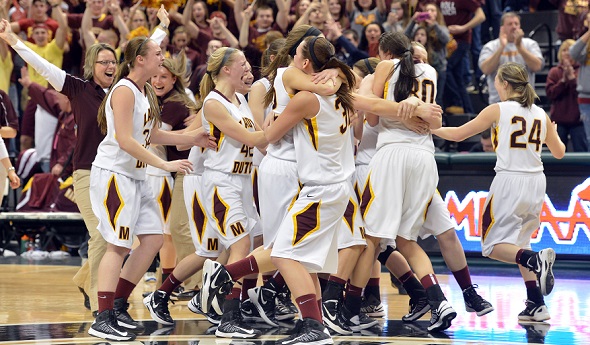
The Manchester girls basketball, Jackson Northwest girls bowling, Portland football, Harbor Beach football, Deckerville football and Hamtramck Frontier International boys soccer teams brought home the first MHSAA team championships in their schools’ histories.
A total of 33 teams won their first MHSAA titles. A total of 46 champions were repeat winners from 2011-12 – and 23 of those won for at least the third straight season. The Bloomfield Hills Brother Rice boys lacrosse team has the longest title streak of nine seasons, while the Battle Creek St. Philip volleyball team has won six straight titles for the second-longest streak overall and longest among girls programs.
Bloomfield Hills Cranbrook-Kingswood claimed the most championships, four, winning in Division 2 boys lacrosse, Lower Peninsula Division 3 girls swimming and diving, Lower Peninsula Division 3 girls tennis and Division 3 ice hockey. Four schools won three titles apiece: Grand Rapids Christian, Grand Rapids South Christian, Marquette and St. Ignace LaSalle.
Sixteen of the MHSAA's 28 championship tournaments are unified, involving teams from the Upper and Lower Peninsulas, while separate competition to determine titlists in both Peninsulas is conducted in remaining sports.
For a sport-by-sport listing of MHSAA champions for 2012-13 - Click Here (PDF)
The MHSAA is a private, not-for-profit corporation of voluntary membership by more than 1,500 public and private senior high schools and junior high/middle schools which exists to develop common rules for athletic eligibility and competition. No government funds or tax dollars support the MHSAA, which was the first such association nationally to not accept membership dues or tournament entry fees from schools. Member schools which enforce these rules are permitted to participate in MHSAA tournaments, which attract approximately 1.6 million spectators each year.
PHOTO: Manchester's girls basketball team celebrates the school's first MHSAA team championship in any sport this March at the Breslin Center. (Click to see more at HighSchoolsSportsScene.com.)