


Rep Council Wrap-up: Fall 2012
December 7, 2012
A change in format for the Boys Basketball Finals highlighted actions taken by the Representative Council of the Michigan High School Athletic Association during its annual Fall Meeting, Nov. 30 in East Lansing.
Mirroring closely the format of the MHSAA Girls Basketball Finals, the Boys Finals will move this season from three to two sessions. The first session will tip off with the Class D Final at 10 a.m., followed by the Class A championship game. The second session will begin tentatively at 4:30 p.m. with the Class C Final and conclude with the Class B title game.
Previously, the Class A and B Finals were separate sessions, with the Class A Final tipping at 4 p.m. and Class B at 8 p.m. The change will make for a shorter day for spectators wishing to attend all four games, and also allow them to do so by purchasing tickets for two sessions instead of three.
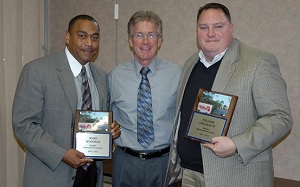 The Fall Meeting also saw the addition of two members to the 19-person council. Reese Public Schools athletic director Dave Derocher began a two-year term after being elected earlier this fall to represent Class C and D schools in the northern Lower Peninsula. Orlando Medina, who serves as athletic coordinator for Harrison Township L’Anse Creuse Public Schools, was appointed for a two-year term. He also previously served as athletic director at Detroit Cesar Chavez Academy. They fill positions formerly held by Beal City superintendent William Chilman IV and Romulus High School athletic director Mark Woodson, whose terms ended.
Also, Carmen Kennedy, principal at St. Clair Shores South Lake High School, was reappointed for a second two-year term. The Representative Council is the legislative body of the MHSAA. All but five members are elected by member schools. Four members are appointed by the Council to facilitate representation of females and minorities, and the 19th position is occupied by the Superintendent of Public Instruction or designee.
The most prominent points discussed at the Fall Meeting were risk minimization for athletes and possible strategies for making school sports safer. Among topics discussed were raising expectations for coaches’ participation in online safety courses and schools’ management of heat illness; the possible restructuring of practice policies in regards to hot weather; and game rules revisions to enhance safety especially in football, soccer and ice hockey.
The Council reviewed its previous actions on those topics, including discussions in December 2011 that led to the inclusion of health and safety content in online rules meetings. Council members considered a model policy for managing heat and humidity, and also a number of ideas collected during Fall Update meetings with administrators throughout the state.
No action was requested on those items at the Fall Meeting. Complete and vetted proposals are likely to be considered when the Council next meets in March and then May.
PHOTO: Outgoing Representative Council members Mark Woodson of Romulus (left) and William Chilman IV (right) are presented plaques for their service by MHSAA Executive Director Jack Roberts (middle) during the Fall Meeting.
Study: Single-Sport Athletes Injured More
November 3, 2016
A study conducted by the University of Wisconsin School of Medicine and Public Health and funded by the National Federation of State High School Associations (NFHS) Foundation revealed that high school athletes who specialize in a single sport sustain lower-extremity injuries at significantly higher rates than athletes who do not specialize in one sport.
The study was conducted throughout the 2015-16 school year at 29 high schools in Wisconsin involving more than 1,500 student-athletes equally divided between male and female participants. The schools involved in the study represented a mixture of rural (14), suburban (12) and urban (3) areas, and enrollments were equally diverse with 10 small schools (less than 500 students), 10 medium schools (501-1,000 students) and nine large schools (more than 1,000 students).
Athletes who specialized in one sport were twice as likely to report previously sustaining a lower-extremity injury while participating in sports (46%) than athletes who did not specialize (24%). In addition, specialized athletes sustained 60 percent more new lower-extremity injuries during the study than athletes who did not specialize. Lower-extremity injuries were defined as any acute, gradual, recurrent or repetitive-use injury to the lower musculoskeletal system.
“While we have long believed that sport specialization by high school athletes leads to an increased risk of overuse injury, this study confirms those beliefs about the potential risks of sport specialization,” said Bob Gardner, NFHS executive director. “Coaches, parents and student-athletes need to be aware of the injury risks involved with an overemphasis in a single sport.”
Among those who reported previously sustaining a lower-extremity injury, the areas of the body injured most often were the ankle (43%) and knee (23%). The most common types of previous injuries were ligament sprains (51%) and muscle/tendon strains (20%).
New injuries during the year-long study occurred most often to the ankle (34%), knee (25%) and upper leg (13%), with the most common injuries being ligament sprains (41%), muscle/tendon strains (25%) and tendonitis (20%).
In addition, specialized athletes were twice as likely to sustain a gradual onset/repetitive-use injury than athletes who did not specialize, and those who specialized were more likely to sustain an injury even when controlling for gender, grade, previous injury status and sport.
Thirty-four (34) percent of the student-athletes involved in the Wisconsin study specialized in one sport, with females (41%) more likely to specialize than males (28%). Soccer had the highest level of specialization for both males (45%) and females (49%). After soccer, the rate of specialization for females was highest for softball (45%), volleyball (43%) and basketball (37%). The top specialization sports for males after soccer were basketball (37%), tennis (33%) and wrestling (29%).
The study, which was directed by Timothy McGuine, Ph.D., ATC, of the University of Wisconsin, also documented the effects of concurrent sport participation (participating in an interscholastic sport while simultaneously participating in an out-of-school club sport), which indicated further risk of athletes sustaining lower-extremity injuries.
Almost 50 percent of the student-athletes involved in the survey indicated they participated on a club team outside the school setting, and 15 percent of those individuals did so while simultaneously competing in a different sport within the school. Seventeen (17) percent of the student-athletes indicated that they took part in 60 or more primary sport competitions (school and club) in a single year. Among those student-athletes in this group who sustained new lower-extremity injuries during the year, 27 percent were athletes who specialized in one sport.
The student-athletes involved in the study were deemed “specialized” if they answered “yes” to at least four of the following six questions: 1) Do you train more than 75 percent of the time in your primary sport?; 2) Do you train to improve skill and miss time with friends as a result?; 3) Have you quit another sport to focus on one sport?; 4) Do you consider your primary sport more important than your other sports?; 5) Do you regularly travel out of state for your primary sport?; 6) Do you train more than eight months a year in your primary sport?
Although some sports (field hockey, lacrosse) are not offered in Wisconsin and were not included in the study, the study concluded that since specialization increased the risk of lower-extremity injuries in sports involved in the survey it would also likely increase the risk of injuries in sports that were not a part of the study.