


Rep Council Wrap-up: Fall 2012
December 7, 2012
A change in format for the Boys Basketball Finals highlighted actions taken by the Representative Council of the Michigan High School Athletic Association during its annual Fall Meeting, Nov. 30 in East Lansing.
Mirroring closely the format of the MHSAA Girls Basketball Finals, the Boys Finals will move this season from three to two sessions. The first session will tip off with the Class D Final at 10 a.m., followed by the Class A championship game. The second session will begin tentatively at 4:30 p.m. with the Class C Final and conclude with the Class B title game.
Previously, the Class A and B Finals were separate sessions, with the Class A Final tipping at 4 p.m. and Class B at 8 p.m. The change will make for a shorter day for spectators wishing to attend all four games, and also allow them to do so by purchasing tickets for two sessions instead of three.
 The Fall Meeting also saw the addition of two members to the 19-person council. Reese Public Schools athletic director Dave Derocher began a two-year term after being elected earlier this fall to represent Class C and D schools in the northern Lower Peninsula. Orlando Medina, who serves as athletic coordinator for Harrison Township L’Anse Creuse Public Schools, was appointed for a two-year term. He also previously served as athletic director at Detroit Cesar Chavez Academy. They fill positions formerly held by Beal City superintendent William Chilman IV and Romulus High School athletic director Mark Woodson, whose terms ended.
Also, Carmen Kennedy, principal at St. Clair Shores South Lake High School, was reappointed for a second two-year term. The Representative Council is the legislative body of the MHSAA. All but five members are elected by member schools. Four members are appointed by the Council to facilitate representation of females and minorities, and the 19th position is occupied by the Superintendent of Public Instruction or designee.
The most prominent points discussed at the Fall Meeting were risk minimization for athletes and possible strategies for making school sports safer. Among topics discussed were raising expectations for coaches’ participation in online safety courses and schools’ management of heat illness; the possible restructuring of practice policies in regards to hot weather; and game rules revisions to enhance safety especially in football, soccer and ice hockey.
The Council reviewed its previous actions on those topics, including discussions in December 2011 that led to the inclusion of health and safety content in online rules meetings. Council members considered a model policy for managing heat and humidity, and also a number of ideas collected during Fall Update meetings with administrators throughout the state.
No action was requested on those items at the Fall Meeting. Complete and vetted proposals are likely to be considered when the Council next meets in March and then May.
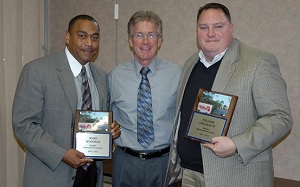
PHOTO: Outgoing Representative Council members Mark Woodson of Romulus (left) and William Chilman IV (right) are presented plaques for their service by MHSAA Executive Director Jack Roberts (middle) during the Fall Meeting.
Participation Again Bests Population Rank
August 11, 2016
By Geoff Kimmerly
Second Half editor
For the eighth straight year, Michigan ranked seventh nationally in high school sports participation, according to statistics for the 2015-16 school year released recently by the National Federation of State High School Associations. That level of participation continued to best Michigan’s national ranking for total number of residents of high school age, which remained ninth for the fourth consecutive year, and Michigan also again ranked ninth or higher in participation in 26 of 28 sports in which the Michigan High School Athletic Association conducts a postseason tournament.
Michigan’s participation ranking was based on a number of 295,436, with 126,160 girls and 169,276 boys taking part, and included sports in which the MHSAA does not conduct postseason tournaments. The totals count students once for each sport in which he or she participates, meaning students who are multiple-sport athletes are counted more than once.
The state’s girls participation remained seventh nationally for the fifth consecutive year, while the boys participation figure continued to rank sixth. According to the latest U.S. Census Bureau figures from 2015, Michigan ranks ninth in both females and males ages 14 through 17.
For the second straight year, 13 sports bested the state’s overall national participation ranking of seventh by placing sixth or higher on their respective lists. Six Michigan sports improved in national ranking during 2015-16, while three sports dropped one position.
Michigan girls bowling, girls tennis and girls and boys skiing all improved from fourth to third in national participation ranking, while wrestling improved to seventh and gymnastics one spot to 11th. Michigan also moved up to eighth, from 11th, for 8-player football participation – significant because the state’s 11-player football participation ranking didn’t fall with that increase, remaining at sixth nationally.
The three sports that fell in national rankings in 2015-16 still remained above population rank – competitive cheer from fifth to sixth nationally, girls track & field one spot to eighth and baseball also from seventh to eighth on its list.
The other Michigan sports that ranked sixth or higher all equaled their national rankings from 2014-15 and included boys basketball at sixth, boys bowling third, boys golf and girls golf both sixth, ice hockey fourth, boys tennis fifth and girls volleyball fourth. Other Michigan sports that equaled their 2014-15 national rankings were girls basketball at seventh, boys and girls cross country both also seventh, boys lacrosse eighth, girls lacrosse 13th, boys and girls soccer both ninth, softball seventh, boys swimming & diving ninth, girls swimming & diving 10th and boys track & field also seventh.
National participation in high school sports in 2015-16 set a record for the 27th consecutive year with 7,868,900 participants – an increase of 61,853 from the year before. After a decline the previous year, boys participation increased about 25,000 to an all-time high of 4,544,574, while girls participation increased for the 27th consecutive year with an additional 36,591 participants and set an all-time high of 3,324,326.
Track and field registered the largest increase in participants nationally for both boys and girls, with an additional 12,501 boys and 7,243 girls. Track and field ranked second to football in boys participants with 591,133, and remained the most popular sport for girls with 485,969 participants. In addition to track and field, six other top-10 girls sports registered increases nationally in 2015-16, including volleyball, soccer, softball, cross country, tennis and lacrosse. After track and field among the top 10 boys sports, soccer registered the largest gain with an additional 7,753 participants, followed by cross country (up 6,710), basketball (up 4,949) and baseball (up 2,248).
Football (1,083,308) remained the most-played high school sport overall and enjoyed an encouraging development. After a decline of nearly 10,000 participants in football the previous year, the number of boys playing 11-player football nationally in 2015 was almost identical to 2014 with a drop of just 309 from the 2014 total of 1,083,617.