


Rep Council Wrap-up: Fall 2012
December 7, 2012
A change in format for the Boys Basketball Finals highlighted actions taken by the Representative Council of the Michigan High School Athletic Association during its annual Fall Meeting, Nov. 30 in East Lansing.
Mirroring closely the format of the MHSAA Girls Basketball Finals, the Boys Finals will move this season from three to two sessions. The first session will tip off with the Class D Final at 10 a.m., followed by the Class A championship game. The second session will begin tentatively at 4:30 p.m. with the Class C Final and conclude with the Class B title game.
Previously, the Class A and B Finals were separate sessions, with the Class A Final tipping at 4 p.m. and Class B at 8 p.m. The change will make for a shorter day for spectators wishing to attend all four games, and also allow them to do so by purchasing tickets for two sessions instead of three.
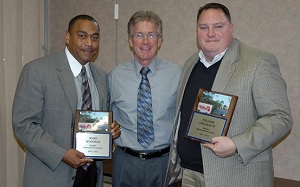 The Fall Meeting also saw the addition of two members to the 19-person council. Reese Public Schools athletic director Dave Derocher began a two-year term after being elected earlier this fall to represent Class C and D schools in the northern Lower Peninsula. Orlando Medina, who serves as athletic coordinator for Harrison Township L’Anse Creuse Public Schools, was appointed for a two-year term. He also previously served as athletic director at Detroit Cesar Chavez Academy. They fill positions formerly held by Beal City superintendent William Chilman IV and Romulus High School athletic director Mark Woodson, whose terms ended.
Also, Carmen Kennedy, principal at St. Clair Shores South Lake High School, was reappointed for a second two-year term. The Representative Council is the legislative body of the MHSAA. All but five members are elected by member schools. Four members are appointed by the Council to facilitate representation of females and minorities, and the 19th position is occupied by the Superintendent of Public Instruction or designee.
The most prominent points discussed at the Fall Meeting were risk minimization for athletes and possible strategies for making school sports safer. Among topics discussed were raising expectations for coaches’ participation in online safety courses and schools’ management of heat illness; the possible restructuring of practice policies in regards to hot weather; and game rules revisions to enhance safety especially in football, soccer and ice hockey.
The Council reviewed its previous actions on those topics, including discussions in December 2011 that led to the inclusion of health and safety content in online rules meetings. Council members considered a model policy for managing heat and humidity, and also a number of ideas collected during Fall Update meetings with administrators throughout the state.
No action was requested on those items at the Fall Meeting. Complete and vetted proposals are likely to be considered when the Council next meets in March and then May.
PHOTO: Outgoing Representative Council members Mark Woodson of Romulus (left) and William Chilman IV (right) are presented plaques for their service by MHSAA Executive Director Jack Roberts (middle) during the Fall Meeting.
2016 Bush Awards Honor Valued Educators
By
Geoff Kimmerly
MHSAA.com senior editor
June 20, 2016
Three educators who have combined for more than a century of service to high school athletics – Adrian Madison’s Kristen Isom, Holly’s Deb VanKuiken and Battle Creek’s Jim Cummins – have been named recipients of the Michigan High School Athletic Association's Allen W. Bush Award for 2016.
Al Bush served as executive director of the MHSAA for 10 years. The award honors individuals for past and continuing service to prep athletics as a coach, administrator, official, trainer, doctor or member of the media. The award was developed to bring recognition to men and women who are giving and serving without a lot of attention. This is the 25th year of the award, with selections made by the MHSAA's Representative Council.
“This year’s three Bush Award winners are tied by their dedication to working with our student-athletes on a day-to-day basis over the course of decades, providing guidance that in turn has been spread throughout their local and sport communities,” said John E. “Jack” Roberts, executive director of the MHSAA. “We are grateful for their service and pleased to honor them with the Bush Award.”
Isom, a member of the MHSAA’s Representative Council since 2008, recently completed her 30th year of service and currently is athletic director at Madison for grades 7-12. She’s also taught health and physical education and coached at least one of a variety of sports every year. She’s served as president of the Tri-County Conference for the last decade after previously serving as secretary and treasurer.
 An MHSAA tournament host for many events over the years, Isom was named Region 6 Athletic Director of the Year in 2000 from the Michigan Interscholastic Athletic Administrators Association. She’s a member of that association, the National Interscholastic Athletic Administrators Association and the Society of Health and Physical Educators of Michigan. The class adviser at Madison for this fall’s juniors, Isom also assists in selection for the MHSAA Student Advisory Council.
A graduate of Clinton High School, Isom earned her bachelor’s degree from Michigan State University, a master’s from Eastern Michigan University and has completed graduate courses from Fresno Pacific University. She’s active with Adrian’s United Church of Christ in various service projects, including an annual fundraiser for cancer research.
“As her community has grown over the years, and the needs and expectations have evolved for all of our schools, Kris Isom has provided valuable leadership at both the local and statewide levels,” Roberts said. “Her many contributions have been rooted in her belief in the mission of educational athletics. Her work with students at her school and input on selections for our Advisory Council show again her dedication to those learning those lessons by playing our games. She’s a worthy recipient of the Bush Award.”
VanKuiken also just completed her 30th year in education, including her 18th as an athletic administrator. She’s served as athletic director for Holly Area Schools the last 12 years after teaching at Bridgeport from 1984-1996 and then serving as assistant principal and athletic director at that school from 1996-2002. She coached softball, volleyball and both boys and girls tennis at various points during her time at Bridgeport, girls tennis as the varsity head coach from 1985-95. She also served as secretary and then president of the Tri-Valley Conference while at Bridgeport. Holly has added high school boys and girls bowling and middle school softball, baseball, swimming & diving and bowling during her tenure.
 The Region 9 Athletic Director of the Year in 2007, VanKuiken was elected to the MIAAA Executive Board in 2005 and served as president during the 2007-08 school year. She helped produce a “Critical Incident Plans” DVD for the association to assist administrators statewide and created the first strategic plan for the MIAAA during her term as president. She received the MIAAA’s George Lovich Service Award in 2011.
VanKuiken also has served on the board of directors for The Academy of Sports Leadership, which plans and organizes camps for future coaches every summer in Ann Arbor, and is a member of the NIAAA, serving on its endowment committee. After a three-sport career at Lansing Sexton, he earned her bachelor’s and master’s degrees from Central Michigan University and played field hockey collegiately, and she’s attained Certified Master Athletic Administrator status from the NIAAA. She received the MHSAA’s Women in Sports Leadership Award in 2009.
“Deb VanKuiken’s work shows she always has the athlete in mind, from the opportunities she’s worked to add through new programs at her school to the programs she’s initiated as a leader of the MIAAA,” Roberts said. “Her vision continues to benefit all groups she serves, not only athletes, but coaches and administrators as well. We’re pleased to recognize her with the Bush Award.”
Like VanKuiken, Cummins also coached a number of sports at the high school level and primarily tennis; he coached that sport for 47 years in addition to baseball, football, basketball for 33 years and volleyball for 11. At Battle Creek Springfield and Battle Creek Central, he coached 67 Regional tennis champions and four flights that won individual Finals titles. His teams finished third at MHSAA Finals four times and won eight straight Kalamazoo Valley Association titles.
 He’s perhaps most recognizable statewide for directing more than 40 MHSAA Tennis Finals for either boys or girls at various sites around the Lower Peninsula. He’s also managed an MHSAA Regional every year since 1974 for boys and all but three years since 1983 for girls, and has continued to serve on the MHSAA seeding and rules committees.
Cummins was twice named Class C/D Coach of the Year, once for boys season and once for girls, by the Michigan High School Tennis Coaches Association, and he was inducted into that association’s Hall of Fame in 1990. He also is a member of the Colon and Battle Creek Public Schools halls of fame and received the MHSTeCA’s Distinguished Service Award in 2014. Cummins graduated from Colon in 1963 and Central Michigan in 1967. He retired from public education after 30 years and currently is employed as an adjunct instructor of mathematics by Kellogg Community College. He was named Outstanding Educator by the W.K. Kellogg Foundation in 1990, 1992, 1994, 1995 and 1999.
“Jim Cummins’ impact on athletes and coaches over many years have turned into positive effects on hundreds as his lessons have been passed on,” Roberts said. “He has been especially valuable to the MHSAA as a knowledgeable voice in tennis and a tournament host in that sport at our highest level, and he’s also lent his time and expertise to our volleyball and wrestling tournaments over the years. We’re glad to honor Jim Cummins with the Bush Award.”
The MHSAA is a private, not-for-profit corporation of voluntary membership by more than 1,400 public and private senior high schools and junior high/middle schools which exists to develop common rules for athletic eligibility and competition. No government funds or tax dollars support the MHSAA, which was the first such association nationally to not accept membership dues or tournament entry fees from schools. Member schools which enforce these rules are permitted to participate in MHSAA tournaments, which attract more than 1.4 million spectators each year.