


Rep Council Wrap-Up: Fall 2014
December 11, 2014
By Geoff Kimmerly
Second Half editor
The promotion of junior high and middle school athletics and possibility of allowing younger students opportunities to compete in certain sports highlighted topics discussed by the Representative Council of the Michigan High School Athletic Association during its annual Fall Meeting on Dec. 5 in East Lansing.
Although no action was taken, the Council heard findings of the Junior High/Middle School task force created at the 2013 Fall Meeting to consider how the MHSAA should continue to encourage multi-sport experiences at that level and review the possibility of serving sixth-grade students in addition to those in the seventh and eighth grades.
The task force met four times during the 2014 calendar year. It provided support for longer quarters in basketball and football that were recommended by the MHSAA’s Junior High/Middle School Committee and approved by the Representative Council in March. The Junior High/Middle School Committee will consider another task force recommendation in January that would allow sixth graders to participate against seventh and eighth graders in all sports except football and ice hockey without seeking annual waivers from the MHSAA in order to do so. The Council could then review that recommendation when it reconvenes in March. Currently, the MHSAA serves 725 member schools at the 7th and 8th-grade level.
The Council also continued to examine the impact of increasing numbers of international students and additional rules approved in March to equalize the treatment of J-1 and F-1 visa students and standardize their opportunities at both public and non-public high schools.
A package of proposals adopted at the Council’s March 2014 meeting in part allowed for the MHSAA to approve school-operated international student placement programs if they were not listed by the Council on Standards for International Educational Travel (CSIET). The MHSAA for 2014-15 approved five such programs, with the notion that all programs would require CSIET approval moving forward. However, the Council will determine in March if the MHSAA will retain the ability to approve non-CSIET school-operated programs again in 2015-16.
An update also was provided on work to determine if rules regulating out-of-season coaching by school staff should be changed to allow those coaches more involvement with student-athletes out of season. MHSAA staff discussed possible changes with member school administrators at league meetings and then athletic director in-service and update meetings this fall and surveyed athletic directors on the desirability of potential changes in late October. The Council reviewed results of the survey and input from meetings and a schedule of upcoming discussions with coaches associations and league and conference leaders. Further Council discussion is slated for March with possible action during its final meeting of the school year in May.
The Council voted on two matters concerning MHSAA tournaments. E-cigarettes and other smoking devices were added to the list of substances prohibited at MHSAA tournament events. The Council also approved the opportunity for presentation of awards by a sport’s coaches association at MHSAA Finals for that sport so long as awards are to recognize students.
The Fall Meeting also saw the addition of Pat Watson, principal at West Bloomfield High School, to the 19-person Council. He was appointed to a two-year term and previously served as his school’s athletic director and coached baseball and girls and boys basketball. He fills the position formerly held by Carmen Kennedy, principal at St. Clair Shores South Lake High School, whose term ended. Also, Orlando Medina, athletic director at Harrison Township L’Anse Creuse High School, was reappointed for a second two-year term. Don Gustafson, superintendent of St. Ignace Area Schools, was appointed to the Upper Peninsula Athletic Committee for 2015.
The Council elected Scott Grimes, assistant superintendent of human services for Grand Haven Area Public Schools, as its president; Buchanan athletic director Fred Smith was elected vice president and Vic Michaels, director of physical education and athletics for the Archdiocese of Detroit, was elected secretary-treasurer. Grimes was elected to fill the position of recently-retired Negaunee Superintendent Jim Derocher, who had served as Council president since 2008. Grimes had served as vice president since 2009.
The Representative Council is the legislative body of the MHSAA. All but five members are elected by member schools. Four members are appointed by the Council to facilitate representation of females and minorities, and the 19th position is occupied by the Superintendent of Public Instruction or designee.
The MHSAA is a private, not-for-profit corporation of voluntary membership by more than 1,400 public and private senior high schools and junior high/middle schools which exists to develop common rules for athletic eligibility and competition. No government funds or tax dollars support the MHSAA, which was the first such association nationally to not accept membership dues or tournament entry fees from schools. Member schools which enforce these rules are permitted to participate in MHSAA tournaments, which attract more than 1.4 million spectators each year.
Trail-Blazing Beckett Leads On
By
Geoff Kimmerly
MHSAA.com senior editor
February 27, 2013
Barbara Beckett had an idea this was going to be big.
But until she arrived in East Lansing for the 1995 MHSAA Boys Basketball Finals, she had no idea how major a deal her next assignment would be.
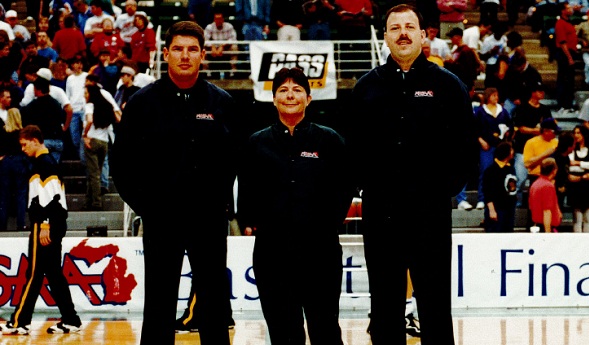
 Beckett had made the trip from Traverse City for Boys Finals weekend before, and officiated Semifinals two of the three previous seasons. But until that Saturday’s Class C Final between Ishpeming and Lakeview, no woman had ever officiated an MHSAA boys basketball championship game.
“I was pretty fearless. I was really, really driven to succeed,” Beckett said. “I was just so happy I got to be that person. It could’ve been a couple of other people. We had other women who were tremendous officials. I was very fortunate.”
Many who have worked with Beckett over the last three decades would claim the same. A 30-year MHSAA registered official, and the Grand Traverse Bay YMCA program director for the last 28, Beckett has left a long-lasting imprint on athletics not just in the northern Lower Peninsula, but statewide. She will be presented with the 26th MHSAA Women in Sports Leadership Award during halftime of the Girls Basketball Class A Final on March 16 at Michigan State University’s Breslin Center.
“Barbara Beckett is a demonstrated leader, evidenced by her previously being awarded the Norris Award for her efforts in recruiting and training officials,” said John E. “Jack” Roberts, executive director of the MHSAA. “In that regard, she’s a trailblazer for women in the officiating family, and her influence continues to be felt. We’re pleased to honor her with the Women In Sports Leadership Award.”
Each year, the Representative Council considers the achievements of women coaches, officials and athletic administrators affiliated with the MHSAA who show exemplary leadership capabilities and positive contributions to athletics.
Beckett worked with Donald Gustafson and Todd Geerlings on the crew that called the 1995 Class C Boys Basketball Final. But that wasn't her first experience reffing the guys.
On top of officiating games at lower levels of the MHSAA tournaments, she also had begun reffing rec league games at the Y during the early 1980s. That might’ve come as a shock to some of those players – but she must’ve won them over, as now she helps build programs for their children and grandchildren.
During her nearly three decades at the Y, she’s developed women’s, men’s and co-ed softball leagues that have grown to include more than 1,500 players and a men’s recreational basketball league with more than 250 participants. Under her guidance, the YMCA’s Pop Warner football league has grown to become one of the largest in the Midwest with 2,500 players.
She also achieved another MHSAA first in 2000 when she became the first female selected for the Vern L. Norris Award for her work as an official.
“My purpose always has been to be an advocate for the officials and game participants,” Beckett said. “I try to be an active advocate all the time. And working for the Y too, we’re all about participation. My time 24 hours a day is actively advocating for game participants and officials.”
Beckett is a 1971 graduate of Mount Pleasant High School and a 1973 graduate of Northwestern Michigan College. She briefly left Traverse City after college before returning a few years later, and became involved with the thriving and close-knit recreational scene in her new hometown. She soon began working part-time at the YMCA, in charge of organizing its basketball program.
Her credo as program director is similar to that of the MHSAA – she creates programs for people who want to participate, and she works to give them the best possible experience in part by making sure the programs are managed by qualified officials.
But she’s also made it a priority to mentor and provide a positive influence to women and men both who are following in her paths.
“At times, it can be very intimidating to be one of the few women in our field. Barb has such an amazing relationship with those she works with and for. To tell you the truth, I can’t say if I know of anyone more well-liked and respected who does so many things,” said Heather Simpson, who coaches volleyball at Traverse City St. Francis, girls basketball at Traverse City Central and works for Beckett at the YMCA.
“I can’t imagine where I would be had I not been able to work and learn from someone like Barb Beckett. I work with young athletes currently, and I want for them to see that women can be a success in whatever they choose. We talk about choices in life. … I try each day to choose to do something positive. That’s what I learned from Barb. Women can make an impact. Women can make a difference. Barb has made such an impact in our area in the world of athletics. She has opened so many doors for so many women.”
Beckett also has worked three MHSAA Girls Basketball Finals and three Softball Finals, twice serving at the latter as umpire in chief, and was an alternate for a number of other championship games. She has officiated several Boys and Girls Basketball Semifinals and Softball Quarterfinals during her career, and continues to serve as president of both the Grand Traverse Area Umpires Association and the Northern Sports Officials Association. She also serves as an assigner of girls and boys basketball and softball officials in the Traverse City area, and was named to the Basketball Coaches Association of Michigan Hall of Honor in 2006.
Beckett also has served as commissioner of District 19 of the Michigan Amateur Softball Association since 1992, and has been instrumental in hosting four women’s, two men’s and one co-ed state final. She’s officiated both women and men’s MASA state finals and received that body’s Award of Excellence in 1996.
“Barb Beckett believes in how athletics and extracurricular activities can impact our kids and communities in such a positive way. So often when I am frustrated with how things are going and how everyone points fingers, she simply says to me, ‘Heather, be part of the solution, not part of the problem,’” Simpson said. “She reminds me that I can make a difference, just as she has with so many. We are in a society where it’s all about travel teams and what the scoreboard says; Barb is still old school and cares about the product she puts out there and the relationships that are formed from her work at the YMCA and in athletics. People like Barb, who care so much for those around her, get lost in the shuffle.
"Administrators call her, officials call her, coaches call her and parents call her for advice and simply just to talk. For me, she has done so many things to help me grow as a person, as a coach and a leader in our community. It's an honor to work for and with Barb Beckett. I truly think that each and every one of us could benefit from sitting in her office and just listening to her."
Past Women In Sports Leadership Award recipients:
1990 – Carol Seavoy, L’Anse
1991 – Diane Laffey, Harper Woods
1992 – Patricia Ashby, Scotts
1993 – Jo Lake, Grosse Pointe
1994 – Brenda Gatlin, Detroit
1995 – Jane Bennett, Ann Arbor
1996 – Cheryl Amos-Helmicki, Huntington Woods
1997 – Delores L. Elswick, Detroit
1998 – Karen S. Leinaar, Delton
1999 – Kathy McGee, Flint
2000 – Pat Richardson, Grass Lake
2001 – Suzanne Martin, East Lansing
2002 – Susan Barthold, Kentwood
2003 – Nancy Clark, Flint
2004 – Kathy Vruggink Westdorp, Grand Rapids
2005 – Barbara Redding, Capac
2006 – Melanie Miller, Lansing
2007 – Jan Sander, Warren Woods
2008 – Jane Bos, Grand Rapids
2009 – Gail Ganakas, Flint; Deb VanKuiken, Holly
2010 – Gina Mazzolini, Lansing
2011 – Ellen Pugh, West Branch; Patti Tibaldi, Traverse City
2012 – Janet Gillette, Comstock Park
PHOTO: Barbara Beckett stands between Todd Geerlings (left) and Donald Gustafson moments before becoming the first woman to officiate an MHSAA Boys Basketball Final in 1995.