


Rep Council Wrap-Up: Fall 2015
December 14, 2015
By Geoff Kimmerly
Second Half editor
Results of recent changes to health and safety policies and possibilities for future work to help keep school sports safe were main topics of discussion by the Representative Council of the Michigan High School Athletic Association during its annual Fall Meeting on Dec. 4 in East Lansing.
Generally, Council takes only a few actions during its Fall Meeting, with topics often introduced for additional consideration and actions during its meetings in winter and spring. The Council heard reports on a number of subjects, chiefly the “4 H’s” of health and safety – Health Histories, Heads, Heat and Hearts – and the MHSAA’s recent work on these topics.
Among data most noteworthy, it was reported that 747 of 750 member high schools complied with the first-time requirement this fall that all head coaches have a valid certification in CPR. Eighty percent of high schools arranged in-person CPR training for all of their high school varsity head coaches, and two-thirds of high schools included assistant and subvarsity coaches in school-arranged in-person training.
The Council reviewed the preliminary concussion care data released to the public Dec. 9, recent actions by U.S. Soccer to reduce heading in youth soccer, discussion in the girls lacrosse community regarding head protection and actions taken by other states and the National Federation of State High School Association regarding football practice policies and their similarities to changes adopted for MHSAA schools prior to the 2014 season. Council members also examined results from this fall’s Update Meeting opinion poll, including questions related to the possibility of using electronic forms to track students’ health histories and the possibility of practice limitations for all sports similar to those adopted for football.
As a result of the recent amendment of the MHSAA Constitution allowing for membership at the 6th-grade level, a number of potential changes to the MHSAA Handbook necessitated by the amendment were presented to the Council, as was a draft of an updated 2016-17 Membership Resolution. Both are expected to be voted on at the March meeting.
The Council also received reports on athletic-motivated and athletic-related transfers, reviewed an updated list of Approved International Student Programs for 2015-16 and discussed concerns regarding the exception to the Transfer Regulation for residential students of boarding schools.
Changes to out-of-season coaching rules were among the most significant efforts taken up by MHSAA staff over the last year, and Council members shared their observations of the impacts of changes including the rule change that allows a school coach to work with up to four athletes at one time instead of the previous three. The Council discussed if the MHSAA should consider a policy requiring in all sports athletes to participate in a minimum number of contests against school teams to be eligible for MHSAA tournaments, but declined to take action on the topic beyond policies already in place for skiing, ice hockey and soccer. Council members also were presented with examples of calendars for a balanced school year and possible movement of standardized testing dates, which both have the potential to affect the school sports calendar in the future.
The Council voted on one matter concerning MHSAA tournaments, approving a recommendation by the Girls Lacrosse Committee to not accept the new overtime rule of U.S. Women’s Lacrosse that grants in tournament play sudden victory to the first team that scores. The MHSAA will retain its current overtime procedure for tournament games, which calls for two full 3-minute halves of stop-clock overtime – and, if the game remains tied after those first two halves – additional 3-minute overtime periods with sudden victory.
The Fall Meeting also saw the addition of Courtney Hawkins, athletic director at Flint Beecher High School, to the 19-person Council. He was appointed to a two-year term and also serves as his school’s varsity football coach. He fills the position formerly held by Maureen Klocke, athletic director at Yale High School, whose term ended. Also, Cheri Meier, principal at Ionia Middle School, was re-appointed for a second two-year term.
The Council re-elected Scott Grimes, assistant superintendent of human services for Grand Haven Area Public Schools, as its president; Benton Harbor athletic director Fred Smith was re-elected vice president and Vic Michaels, director of physical education and athletics for the Archdiocese of Detroit, was re-elected secretary-treasurer.
The Representative Council is the legislative body of the MHSAA. All but five members are elected by member schools. Four members are appointed by the Council to facilitate representation of females and minorities, and the 19th position is occupied by the Superintendent of Public Instruction or designee.
The MHSAA is a private, not-for-profit corporation of voluntary membership by more than 1,400 public and private senior high schools and junior high/middle schools which exists to develop common rules for athletic eligibility and competition. No government funds or tax dollars support the MHSAA, which was the first such association nationally to not accept membership dues or tournament entry fees from schools. Member schools which enforce these rules are permitted to participate in MHSAA tournaments, which attract more than 1.4 million spectators each year.
2026-27 MHSAA Officials Registration Underway
By
Geoff Kimmerly
MHSAA.com senior editor
June 15, 2026
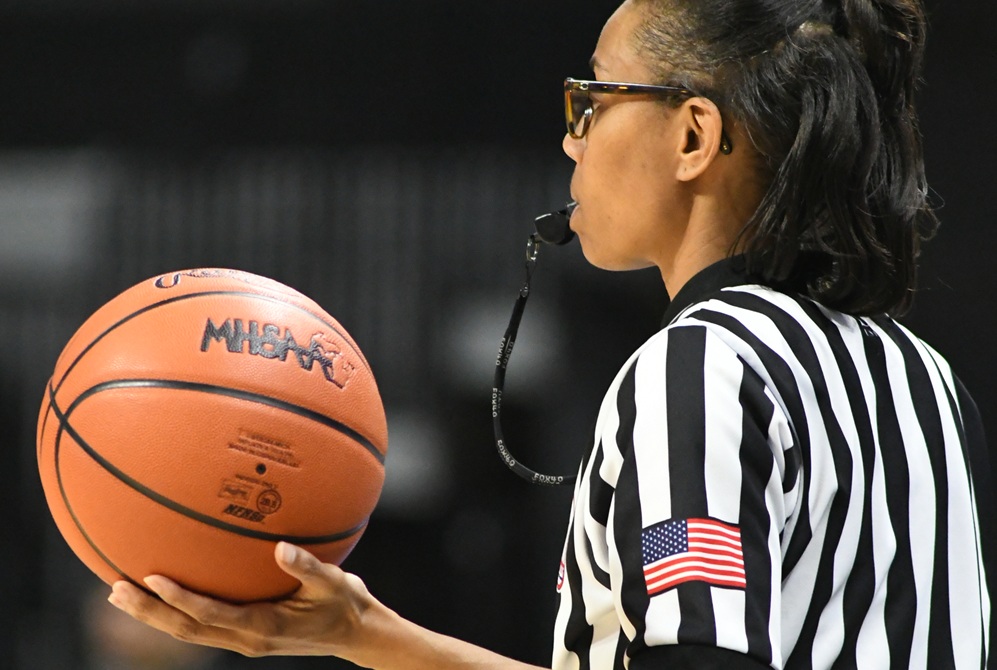
The Michigan High School Athletic Association is accepting registrations online for game officials for the 2026-27 school year.
The MHSAA registered 9,330 officials for the 2025-26 school year, an increase of 4.9 percent from the previous year’s total.
All officials who register may sign up for up to two sports as part of their registration. Officials also will receive membership in the National Association of Sports Officials (NASO), which comes with a variety of educational and training resources and the NASO’s Shield liability insurance that will provide $6 million in coverage for officials while they are working both MHSAA and non-MHSAA events.
For new and returning officials, a $70 fee covers registration for up to two sports. Officials may register for additional sports at $16 per sport.
To avoid a $30 late fee, all fall sport registration applications must be received by Aug. 17, 2026. Winter sports registrations must be received by Nov. 16 to avoid the late fee, and spring sports registrations must be received by March 24, 2027.
Online registration can be accessed on the Officials page. More information about officials registration may be obtained by contacting the MHSAA by phone at (517) 332-5046 or by e-mail at [email protected].
New officials and those who didn’t officiate during 2025-26 must complete an officials' registration test, derived from the MHSAA Officials Guidebook, and the online MHSAA Principles of Officiating course. Additional exams must be taken by those registering for football or basketball for the first time or those who were not registered for those sports during the previous school year. Links to the Officials Guidebook, Principles of Officiating presentation and the football and basketball mechanics manuals can be found by following the “New Officials” link on the Officials page of the MHSAA Website and completing the registration process.
There also are opportunities to officiate for students at least 14 years old and in grades 9-12 through the MHSAA Legacy Program. Juniors and seniors may officiate subvarsity contests, while freshmen and sophomores may officiate contests at the middle school/junior high levels. Mentor officials will work events with Legacy participants to provide guidance and support. Find information on the Legacy Program by clicking “Officials Registration” on the Officials page of the MHSAA Website and reading under “Student Legacy Program Requirements.”
While on MHSAA.com to register for the upcoming school year, officials also can register for Officiate Michigan Day 2026, set for July 25 in Grand Rapids.
Doors open at 7:30 a.m., with the first session at 9 a.m. at DeVos Place. The day-long event will feature dynamic speakers and presenters providing knowledge in several sports and all levels including collegiate and professional.
Cost is $45 if officials register by the end of June, and $50 beginning July 1. More information is on the way; keep posted at MHSAA.com/OMD.