


Rep Council Wrap-up: Fall 2019
December 16, 2019
By Geoff Kimmerly
Second Half editor
The adoption of an enhanced strength-of-schedule formula to determine 8-Player Football Playoff qualifiers beginning with the 2020 season was the most notable action taken by the Representative Council of the Michigan High School Athletic Association during its Fall Meeting on Dec. 6 in East Lansing.
Generally, the Council takes only a few actions during its Fall Meeting, with topics often introduced for additional consideration and action during its meetings in winter and spring. This Fall Meeting saw the Council take only two actions, while the majority of discussion centered on topics expected to receive more specific consideration at MHSAA sport committee meetings this winter.
The decision to alter the playoff selection process for 8-player football makes playoff selection consistent across both formats of the sport; 11-player football will begin using the enhanced strength-of-schedule formula as well in 2020, per Council approval at its Spring Meeting this past May. The new playoff selection formula places greater weight on the success of a team’s opponents and sets playoff divisions during the school classification process in March, instead of after the conclusion of the regular season as done previously in both 11 and 8-player football. Also similarly, teams will not be allowed to opt-up into a larger division in either format. The one difference for 8-player is that points assigned for defeating an opponent will be the same for teams in both divisions; in 11-player, more points are awarded on an escalating scale for defeating teams in larger-school divisions.
The Council also approved the permanent use of a policy for non-traditional draws in basketball and volleyball that has guided the scheduling of postseason play for those sports during the 2018-19 and 2019-20 school years. Non-traditional draws allow games to be played at a school’s home or closer neutral site instead of all teams at the same site to alleviate travel distance and time for teams facing long trips during the District and Regional rounds. The policy approved for continuation allows for non-traditional draws to be used for Districts made up of all Upper Peninsula teams, a combination of Upper and Lower Peninsula teams or Districts made up of seven or eight teams from any location; and for geographically-neutral sites to be selected for Regionals that include more than one District located entirely in the Upper Peninsula. For the two District scenarios including Upper Peninsula teams, a traditional draw still may be conducted if all participating teams agree to it.
A number of remaining discussions focused on results from this fall’s Update Meeting survey completed by administrators during the MHSAA’s annual presentations across the state. The Council at its Spring Meeting requested study by staff on a variety of topics – most notably amateur status, out-of-season coaching issues, use of football equipment in out-of-season activities and the MHSAA travel limitation both during the summer and in-season. A number of Update survey questions addressed those subjects, and conversations on those topics will continue at the separate sport committee meetings over the next few months in advance of further Council discussion in March and May.
The Council discussed efforts to promote and grow football, and staff reported on the upcoming Youth Football Summit to be held Jan. 19, 2020, at the MHSAA in partnership with USA Football and the Michigan High School Football Coaches Association. Those efforts, along with the history of use of football equipment out-of-season, are scheduled for further conversation at the MHSAA Football Committee meeting in January.
Additionally, MHSAA staff reported on current mental health initiatives – including the Association’s rules meeting partnership with the Mental Health Foundation of West Michigan and its “be nice.” education program – and on the first meeting of the Sports Medicine Advisory Council. Staff relayed feedback received this fall during the first season under the new sport-specific transfer rule, and also observations from the first-time use of limited District seeding in boys soccer during the recently-completed season. An update also was presented on officials registration and retention.
The Fall Meeting saw the addition of William McCoy, athletic director of Romulus Summit Academy North, to the 19-person Council. He was appointed to a two-year term. McCoy fills the position formerly held by Courtney Hawkins, athletic director of Flint Beecher High School, whose term ended. Also, Kris Isom, athletic director at Adrian Madison High School, was appointed to a two-year term. She replaces Justin Jennings, who previously served as superintendent for Muskegon Public Schools and vacated his Council appointment after leaving Muskegon for a position in Ohio this summer.
The Council reelected Scott Grimes, assistant superintendent of human services for Grand Haven Area Public Schools, as its president; and Vic Michaels, director of physical education and athletics for the Archdiocese of Detroit, as secretary-treasurer. Clare Middle School principal Steve Newkirk was elected Council vice president.
The Representative Council is the legislative body of the MHSAA. All but five members are elected by member schools. Four members are appointed by the Council to facilitate representation of females and minorities, and the 19th position is occupied by the Superintendent of Public Instruction or designee.
The MHSAA is a private, not-for-profit corporation of voluntary membership by more than 1,500 public and private senior high schools and junior high/middle schools which exists to develop common rules for athletic eligibility and competition. No government funds or tax dollars support the MHSAA, which was the first such association nationally to not accept membership dues or tournament entry fees from schools. Member schools which enforce these rules are permitted to participate in MHSAA tournaments, which attract more than 1.4 million spectators each year.
Forsythe Honorees Led with Statewide View
By
Geoff Kimmerly
MHSAA.com senior editor
March 6, 2019
Jim Derocher always tried to listen to everyone before making a decision while serving on the MHSAA's Representative Council. He wanted to best serve not just the stars but all student-athletes, and not just those down the road but all over Michigan.
Longtime Council member Fred Smith always thought back to something Lake Michigan Catholic coach Terry Rose once told him: when making decisions, do what's best for kids first. Smith did so while trying to consider the needs not just of the student-athletes in his community, but in the many communities all over the state.
Both Derocher and Smith served thousands of students locally over decades of service and provided statewide contributions that continue to guide educational athletics in Michigan today. In recognition of their dedication, Derocher and Smith have been named the 2019 recipients of the Michigan High School Athletic Association’s Charles E. Forsythe Award.
The annual award is in its 42nd year and named after former MHSAA Executive Director Charles E. Forsythe, the Association's first full-time and longest-serving chief executive. Forsythe Award recipients are selected each year by the MHSAA Representative Council, based on an individual's outstanding contributions to the interscholastic athletics community. Derocher and Smith will receive their honors during the break after the first quarter of the MHSAA Division 1 Boys Basketball Final on March 16 at the Breslin Student Events Center in East Lansing.
After beginning his career as a teacher and coach at L’Anse, Derocher went on to serve as athletic director and assistant principal at Ishpeming Westwood from 1989-94, then as superintendent at Brimley from 1994-98 and finally Negaunee from 1998-2014. He also represented the Upper Peninsula’s Class C & D schools on the MHSAA Representative Council from 2003-14 and served as its president from 2008-14.
Smith taught, coached and served as athletic director at St. Joseph Lake Michigan Catholic from 1981-91, then served as athletic director at Comstock from 1991-2007, Buchanan from 2007-2015 and Benton Harbor from 2015-17. He represented the Lower Peninsula’s Southwestern Class A & B schools on the MHSAA Representative Council from 2008-17, including serving as vice president his final four years.
“Jim Derocher was an outstanding Council president, always approaching things first as a superintendent and looking at the big picture,” MHSAA Executive Director Mark Uyl said. “He provided a statewide perspective through an Upper Peninsula prism, always considering how decisions would impact schools from Monroe to Menominee.
“Fred Smith is simply one of the best athletic directors I’ve gotten to work with during my career in athletics,” Uyl added. “I met him while he was at Comstock; from Comstock to Buchanan to Benton Harbor he was presented with and led his programs through different challenges. And he always served as a champion for those schools in that part of the state while keeping a statewide perspective when helping shape the Council’s work.”
 Derocher finished his time at L’Anse earning the Copper Country Conference Coach of the Year award for boys basketball in 1989, and he also served as an MHSAA-registered official in football, boys and girls basketball from 1970-90. While on the Representative Council, Derocher served concurrently on the Upper Peninsula Athletic Committee.
He was a member of the Michigan Association of School Administrators from 1994-2014 and selected as its Region 1 Superintendent of the Year in 2013. He also received MASA’s 20-year Distinguished Administrator Award.
“I believe the experiences our student-athletes get in school athletics molds their future, whether they are the stars of the team or the supporting cast that make a team. This experience is no different for students in Brimley, Negaunee or Detroit," Derocher said. "I was always trying to work with other members of the Representative Council to recognize that these student-athletes are the same all over the state. I wanted to provide the best possible experience while also giving equality to all.”
Smith’s impact continues to be far-reaching. He remains active as part of the Michigan Interscholastic Athletic Administrators Association (MIAAA) and National Interscholastic Athletic Administrators Association (NIAAA), having served on the Board of Directors for both and recently named to the Strategic Planning Committee for the latter. He also continues to teach courses for the MHSAA’s Coaches Advancement Program (CAP) and taught the NIAAA’s Leadership Training Course at the national conference and via the internet in 13 states. He has presented at a number of MHSAA New Athletic Administrator In-Service programs and served as the co-chairperson of the MIAAA’s Professional Development Committee.
 Smith has been a registered cross country and track & field official for more than 30 years, and while an athletic director at his various schools hosted a multitude of MHSAA Tournament events in cross country, volleyball, boys and girls tennis, boys and girls basketball, track & field, wrestling, baseball, boys and girls soccer and softball. He received the MHSAA’s Allen W. Bush Award in 2014 for his many contributions behind the scenes, was named the MIAAA’s Athletic Director of the Year in 2000 and George Lovich State Award of Merit winner in 2007, and received the Art Jevert/Bruce Jacobs Distinguished Service Award from the Association of Track Officials of Michigan (ATOM) in 2013. He was named Midwest Athletic Director of the Year in 2000 as well by the National Council of Secondary School Athletic Directors (NCSSAD), and recognized by the NIAAA with a special commendation in 1999, its Distinguished Service Award in 2000, its Thomas Frederick Award of Excellence in 2004 and its Frank Kovaleski Professional Development Award in 2012. Smith also is a member of the Battle Creek St. Philip and Comstock halls of fame.
“Looking back on the service, it goes back to something my mom taught me when I was young and tried to impress on my brothers and sisters – it’s better to serve than to be served,” Smith said. “I’ve always tried to serve. I was very blessed with good high school coaches, and I enjoyed my high school experience at St. Philip. I was wanting to give back and fell into that niche, and I really enjoyed it.”
Derocher graduated from L’Anse High School in 1970 and earned his bachelor’s in secondary education, mathematics and physics in 1975 and master’s in education in 1988, both from Northern Michigan University. He also earned education specialist certification in 2003. He was a member of the Lake Superior Community Partnership from 2003-14 and remains a member of the Negaunee Lions Club. He resides in Ishpeming and works as an account executive for SET SEG, which coordinates benefits for Michigan public schools and their employees.
Smith graduated from Battle Creek St. Philip in 1973 and Western Michigan University with his bachelor’s degree in 1979. He received the Certified Master Athletic Administrator designation from the NIAAA in 2004. He remains active through his church, Our Lady Queen of Peace Catholic Church in Bridgman, and resides in Stevensville.
Past recipients of the Charles E. Forsythe Award
1978 - Brick Fowler, Port Huron; Paul Smarks, Warren
1979 - Earl Messner, Reed City; Howard Beatty, Saginaw
1980 - Max Carey, Freesoil
1981 - Steven Sluka, Grand Haven; Samuel Madden, Detroit
1982 - Ernest Buckholz, Mt. Clemens; T. Arthur Treloar, Petoskey
1983 - Leroy Dues, Detroit; Richard Maher, Sturgis
1984 - William Hart, Marquette; Donald Stamats, Caro
1985 - John Cotton, Farmington; Robert James, Warren
1986 - William Robinson, Detroit; Irving Soderland, Norway
1987 - Jack Streidl, Plainwell; Wayne Hellenga, Decatur
1988 - Jack Johnson, Dearborn; Alan Williams, North Adams
1989 - Walter Bazylewicz, Berkley; Dennis Kiley, Jackson
1990 - Webster Morrison, Pickford; Herbert Quade, Benton Harbor
1991 - Clifford Buckmaster, Petoskey; Donald Domke, Northville
1992 - William Maskill, Kalamazoo; Thomas G. McShannock, Muskegon
1993 - Roy A. Allen Jr., Detroit; John Duncan, Cedarville
1994 - Kermit Ambrose, Royal Oak
1995 - Bob Perry, Lowell
1996 - Charles H. Jones, Royal Oak
1997 - Michael A. Foster, Richland; Robert G. Grimes, Battle Creek
1998 - Lofton C. Greene, River Rouge; Joseph J. Todey, Essexville
1999 - Bernie Larson, Battle Creek
2000 - Blake Hagman, Kalamazoo; Jerry Cvengros, Escanaba
2001 - Norm Johnson, Bangor; George Lovich, Canton
2002 - John Fundukian, Novi
2003 - Ken Semelsberger, Port Huron
2004 - Marco Marcet, Frankenmuth
2005 - Jim Feldkamp, Troy
2006 - Dan McShannock, Midland; Dail Prucka, Monroe
2007 - Keith Eldred, Williamston; Tom Hickman, Spring Lake
2008 - Jamie Gent, Haslett; William Newkirk, Sanford-Meridian
2009 - Paul Ellinger, Cheboygan
2010 - Rudy Godefroidt, Hemlock; Mike Boyd, Waterford
2011 - Eric C. Federico, Trenton
2012 - Bill Mick, Midland
2013 - Jim Gilmore, Tecumseh; Dave Hutton, Grandville
2014 - Dan Flynn, Escanaba
2015 - Hugh Matson, Saginaw
2016 - Gary Hice, Petoskey; Gina Mazzolini, Lansing
2017 - Chuck Nurek, Rochester Hills
2018 - Gary Ellis, Allegan
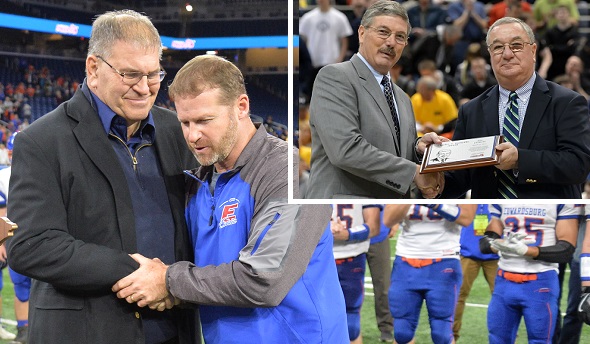
PHOTOS: (Top left) Fred Smith, left, congratulates Edwardsburg football coach Kevin Bartz after the 2017 Division 4 Final at Ford Field. (Top right) Jim Derocher, left, presents Tecumseh's Jim Gilmore with the Forsythe Award in 2013 at the Breslin Center.