


Rep Council Wrap-up: Spring 2013
May 20, 2013
A change in the transfer regulation and the addition of safety training for assistant and subvarsity coaches were among the most significant actions approved by the Representative Council of the Michigan High School Athletic Association during its annual Spring Meeting, May 5-6, in Gaylord.
The Spring meeting of the 19-member legislative body of the Association’s more than 1,500 member schools is generally the busiest of its three sessions each year. The Council considered 40 committee proposals and also dealt with a variety of eligibility rule, postseason tournament and operational issues.
The most significant change to the MHSAA body of regulations concerns students who transfer between schools for reasons related to athletics. Effective for the 2014-15 school year, a transfer student will be ineligible for 180 school days if he or she has partaken in an activity during the previous 12 months that demonstrates the transfer is related to athletics. Offending activities may include practicing, competing or training with a member of the new school’s coaching staff including during summer activities or non-school sports seasons like for AAU basketball. Attending an open gym at the new school or being coached by a current or incoming coach while the athlete still attended his or her former high school also would be considered an offending activity.
Currently, a school that loses a student for athletics-related reasons must report this to the MHSAA for that student to incur the 180-day transfer penalty. This is no longer necessary if the above activities are verified. The rule change beginning with the 2014-15 school year will consider a student’s activity taken place during the previous 12 months. Transfers may still qualify for one of 15 exemptions that allow for immediate eligibility.
The Council also approved another step in the MHSAA’s ongoing focus on health and safety issues. Also beginning with the 2014-15 school year, all assistant and subvarsity coaches at the high school level must complete the same MHSAA rules meeting required of varsity head coaches or, alternatively, one of the free online sports safety courses posted on or linked from the MHSAA Website that is designated as fulfilling this requirement.
Here is a summary of other actions taken at the Spring Representative Council Meeting which, unless noted, will take effect during the 2013-14 school year:
Handbook/Administrative Matters
• In cases of serious injury or extended illness, including concussion or suspected concussion and symptoms of sudden cardiac arrest, students must be re-examined by a physician (MD or DO) and provide a written release from that physician before returning to practice or competition. The clearance may not be on the same date on which an athlete was removed from activity. The emphases on sudden cardiac arrest and practice are new.
• A first-time 9th grader whose first 9-12 enrollment is in a non-traditional school or program may retain eligibility at a traditional school if that student registered at the traditional school before enrolling in the non-traditional school or program.
• A faculty member may supervise a school’s team or individual competitors in cases when the head coach is unable to do so for failure to complete the annual rules meeting requirement. Previously, only an administrator was allowed to take over that supervisory role when the head coach was not allowed to be present for this reason.
• When students in grades 9 through 12 are involved, high school administrators including athletic directors may not sponsor or support out-of-season programs or perform out-of-season functions which the school itself is prohibited from sponsoring or supporting – even if the administrator is not acting as affiliated with the school. Booster clubs, alumni groups, parent organizations and other groups that exist because of the school currently are governed by the same regulation for grades 7 through 12.
• Coaches in bowling and golf may be present at a non-school facility for those respective sports when more than three of their district’s students (grades 7-12) are present, even if the coach is not employed by the facility, as long as the coach is not directly coaching or teaching more than three players and the presence of more than three students is coincidental and not prearranged by the coach.
• Beginning in 2014-15, the maximum length for all junior high/middle school sports seasons will be 13 weeks. Also, the earliest start date for junior high/middle school fall sports, beginning this fall (2013), is the 14th Monday before Thanksgiving.
Sports Matters
• In Baseball and Softball, teams and individuals will be limited to 38 contests beginning with the 2014 season. Currently, teams may participate in a combination of 56 dates and contests.
• In Competitive Cheer, additional policies and penalties were adopted to assure teams utilize the correct number of competitors in all three rounds of competition.
• In Golf, devices that measures distance may be utilized in MHSAA tournaments beginning this fall. This does not, however, include smart phones. Also, beginning in 2014, the spring Lower Peninsula boys tournament will begin and end one week earlier than is scheduled for the current season.
• In Soccer, a National Federation (NFHS) rule was adopted for MHSAA play requiring a team to play short-handed (11 vs. 10) after a player receives a second yellow card. Currently, a player is ejected after the second yellow card, but his or her team is allowed to substitute another player to take the ejected player’s place on the field. The 10-minute sit-out period after receiving a first yellow card was eliminated.
• In Volleyball, beginning with the 2014 season, the royal blue, gray and white ball is required for all high school-level regular-season and MHSAA postseason matches.
The Council also reviewed reports on membership, with 758 senior high schools and 751 junior high/middle schools in 2012-13; eligibility advancement applications, which totaled 15 for the year; the use of Educational Transfer Forms, which remained stable this year; school violations, which remained significantly below recent average; attendance at athletic director and coaches in-service workshops; officials’ registrations; rules meeting attendance; and officials reports submitted for the past three sports seasons. The Association’s $9.9 million budget for the 2013-14 school year also was approved.
The Representative Council is the 19-member legislative body of the MHSAA. All but five members are elected by member schools. Four members are appointed by the Council to facilitate representation of females and minorities, and the 19th position is occupied by the Superintendent of Public Instruction or designee.
Awards Honor Those Lending a Hand
April 12, 2017
By Geoff Kimmerly
Second Half editor
Sports often make up a significant, although singular part of the lives of Michigan’s high school student-athletes and coaches.
 Many also find ways to have significant impacts on the lives of others – and we’d like to tell the rest of our state how they’re making a difference.
The Michigan High School Athletic Association, together with Lake Trust Credit Union, will award this spring the inaugural Community Service Awards to recognize individuals and teams that have worked to benefit their communities.
Each winner will receive a $1,000 award to be applied toward an individual college scholarship, credited to a team’s account with its athletic department or even gifted to the group helped by our honoree.
Please help us get the word out. Encourage a student, coach or administrator to tell us about a completed or ongoing community service project. Any student, team or coach currently participating in interscholastic athletics at an MHSAA member high school can apply. Applications should be e-mailed both to the school’s athletic director and MHSAA’s Kurt Tiesman at [email protected].
The deadline for applications is May 1, and multiple winners will be selected and notified by May 12. Click for more information.
We hear and read about these contributions and successes throughout the school year. Thank you in advance for your help in allowing us to honor some of this great work in the community by those who also shine on the field.
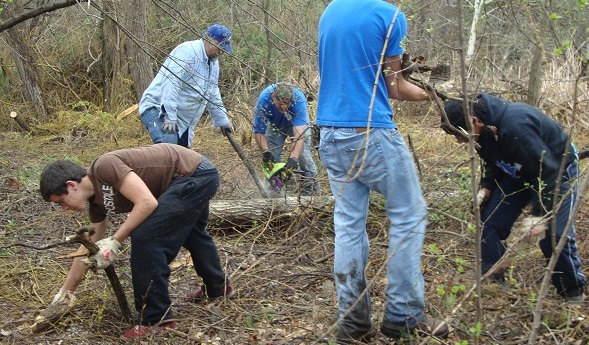
PHOTO: Members of the Adrian boys track & field team help clean up after a tornado in Dexter in 2012.