


Rep Council Wrap-up: Spring 2013
May 20, 2013
A change in the transfer regulation and the addition of safety training for assistant and subvarsity coaches were among the most significant actions approved by the Representative Council of the Michigan High School Athletic Association during its annual Spring Meeting, May 5-6, in Gaylord.
The Spring meeting of the 19-member legislative body of the Association’s more than 1,500 member schools is generally the busiest of its three sessions each year. The Council considered 40 committee proposals and also dealt with a variety of eligibility rule, postseason tournament and operational issues.
The most significant change to the MHSAA body of regulations concerns students who transfer between schools for reasons related to athletics. Effective for the 2014-15 school year, a transfer student will be ineligible for 180 school days if he or she has partaken in an activity during the previous 12 months that demonstrates the transfer is related to athletics. Offending activities may include practicing, competing or training with a member of the new school’s coaching staff including during summer activities or non-school sports seasons like for AAU basketball. Attending an open gym at the new school or being coached by a current or incoming coach while the athlete still attended his or her former high school also would be considered an offending activity.
Currently, a school that loses a student for athletics-related reasons must report this to the MHSAA for that student to incur the 180-day transfer penalty. This is no longer necessary if the above activities are verified. The rule change beginning with the 2014-15 school year will consider a student’s activity taken place during the previous 12 months. Transfers may still qualify for one of 15 exemptions that allow for immediate eligibility.
The Council also approved another step in the MHSAA’s ongoing focus on health and safety issues. Also beginning with the 2014-15 school year, all assistant and subvarsity coaches at the high school level must complete the same MHSAA rules meeting required of varsity head coaches or, alternatively, one of the free online sports safety courses posted on or linked from the MHSAA Website that is designated as fulfilling this requirement.
Here is a summary of other actions taken at the Spring Representative Council Meeting which, unless noted, will take effect during the 2013-14 school year:
Handbook/Administrative Matters
• In cases of serious injury or extended illness, including concussion or suspected concussion and symptoms of sudden cardiac arrest, students must be re-examined by a physician (MD or DO) and provide a written release from that physician before returning to practice or competition. The clearance may not be on the same date on which an athlete was removed from activity. The emphases on sudden cardiac arrest and practice are new.
• A first-time 9th grader whose first 9-12 enrollment is in a non-traditional school or program may retain eligibility at a traditional school if that student registered at the traditional school before enrolling in the non-traditional school or program.
• A faculty member may supervise a school’s team or individual competitors in cases when the head coach is unable to do so for failure to complete the annual rules meeting requirement. Previously, only an administrator was allowed to take over that supervisory role when the head coach was not allowed to be present for this reason.
• When students in grades 9 through 12 are involved, high school administrators including athletic directors may not sponsor or support out-of-season programs or perform out-of-season functions which the school itself is prohibited from sponsoring or supporting – even if the administrator is not acting as affiliated with the school. Booster clubs, alumni groups, parent organizations and other groups that exist because of the school currently are governed by the same regulation for grades 7 through 12.
• Coaches in bowling and golf may be present at a non-school facility for those respective sports when more than three of their district’s students (grades 7-12) are present, even if the coach is not employed by the facility, as long as the coach is not directly coaching or teaching more than three players and the presence of more than three students is coincidental and not prearranged by the coach.
• Beginning in 2014-15, the maximum length for all junior high/middle school sports seasons will be 13 weeks. Also, the earliest start date for junior high/middle school fall sports, beginning this fall (2013), is the 14th Monday before Thanksgiving.
Sports Matters
• In Baseball and Softball, teams and individuals will be limited to 38 contests beginning with the 2014 season. Currently, teams may participate in a combination of 56 dates and contests.
• In Competitive Cheer, additional policies and penalties were adopted to assure teams utilize the correct number of competitors in all three rounds of competition.
• In Golf, devices that measures distance may be utilized in MHSAA tournaments beginning this fall. This does not, however, include smart phones. Also, beginning in 2014, the spring Lower Peninsula boys tournament will begin and end one week earlier than is scheduled for the current season.
• In Soccer, a National Federation (NFHS) rule was adopted for MHSAA play requiring a team to play short-handed (11 vs. 10) after a player receives a second yellow card. Currently, a player is ejected after the second yellow card, but his or her team is allowed to substitute another player to take the ejected player’s place on the field. The 10-minute sit-out period after receiving a first yellow card was eliminated.
• In Volleyball, beginning with the 2014 season, the royal blue, gray and white ball is required for all high school-level regular-season and MHSAA postseason matches.
The Council also reviewed reports on membership, with 758 senior high schools and 751 junior high/middle schools in 2012-13; eligibility advancement applications, which totaled 15 for the year; the use of Educational Transfer Forms, which remained stable this year; school violations, which remained significantly below recent average; attendance at athletic director and coaches in-service workshops; officials’ registrations; rules meeting attendance; and officials reports submitted for the past three sports seasons. The Association’s $9.9 million budget for the 2013-14 school year also was approved.
The Representative Council is the 19-member legislative body of the MHSAA. All but five members are elected by member schools. Four members are appointed by the Council to facilitate representation of females and minorities, and the 19th position is occupied by the Superintendent of Public Instruction or designee.
Mazzolini's Impact Felt Across Generations
By
Geoff Kimmerly
MHSAA.com senior editor
July 14, 2016
By Geoff Kimmerly
Second Half editor
A lifetime in competitive athletics has provided piles of memories for retiring MHSAA assistant director Gina Mazzolini.
 Four decades as an athlete, coach and association administrator also left her with plenty of souvenirs to sort through as she finishes her final days in the East Lansing office.
There’s a letter dated 1976 – and passed on to Mazzolini in 2004 – from the MHSAA to tennis coaches warning against stacking their lineups, an issue she’s worked to resolve over the last 20+ years.
Autographs from famous coaches John Wooden and Tom Landry made a 1991 National Federation Hall of Fame program worth saving. Just as significant was a thank-you from legendary Battle Creek St. Philip volleyball coach Sheila Guerra – who led teams to nine MHSAA titles from 1983-97 – sent in 2005 after Guerra’s daughter Vicky Groat led the Tigers to the first of what has become 10 Class D championships over the last 12 seasons.
In a number of high school sports circles, Mazzolini’s contributions are considered similarly legendary. She’s frequently been referred to as a “pioneer” – one of the first star female high school athletes from the Lansing area who went on to star at Central Michigan University and then lend her expertise to growing girls sports in this state and beyond.
“I didn’t do it because I was a woman and wanted to be the first,” Mazzolini said. “That’s just what I wanted to do, and after Title IX those jobs just opened up. And because I had some experience in coaching, officiating and playing, they took a chance on me, or they recruited me because they needed someone to run girls programs.
"I will miss people and relationships, watching things start, grow and get better.”
Mazzolini recently was recognized with a Citation from the National Federation of State High School Associations after a career that began in 1981 with Texas’ University Interscholastic League and ends after the last 23 years as an assistant director in her home state – and a mere 20 miles south of where she took the first steps toward a career that covered nearly the whole of female high school and college sports in Michigan, as a first-generation athlete and the builder of games for generations of girls and women to come.
Pioneer, indeed
Mazzolini’s senior year at St. Johns High School, 1973-74, was the first for girls basketball playoffs sponsored by the MHSAA, and Mazzolini led the Redwings to a District title that fall. She went on to star in both basketball and volleyball at CMU – still ranking among the Chippewas’ all-time hoops statistical leaders – and then to coach volleyball at Ovid-Elsie High School, Michigan State and the University of Texas.
All of that set Mazzolini up to provide a key voice and insight to rules-making bodies at the state and national levels. She’s retiring as MHSAA administrator for girls volleyball, swimming & diving, alpine skiing and tennis, and also has handled the sanctioning of out-of-state competitions and foreign exchange and international student issues. Nationally, she’s served multiple times on rules committees for soccer, swimming & diving and volleyball.
“Having worked in athletics for 46 years, I know few, if any, administrators who have a passion for excellence as does Gina Mazzolini in everything she undertakes,” wrote Marcy Weston, a retired executive associate director of athletics at CMU. “Ethics, integrity, creativity, loyalty and fortitude are just a few words that describe Gina’s work persona. And compassion, kind and supportive are words that siblings and friends access when they describe Gina.”
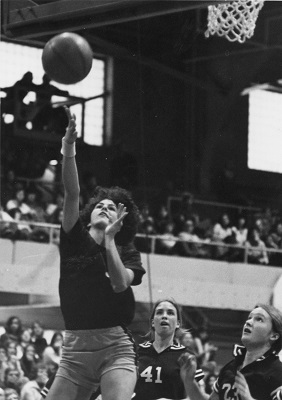 Weston coached Mazzolini on the CMU volleyball team for four seasons and women’s basketball team for two. At that time, with those programs and women’s college athletics as a whole in their early stages, Mazzolini and her teammates wore the same uniforms for both sports for two years.
Obviously, much has changed. And she’s played a large part.
Mazzolini first got involved as more than an athlete after taking Weston’s officiating class at CMU. Mazzolini registered as an MHSAA official – but all she knew of the MHSAA was that was where she paid her registration fee.
She still didn’t know much about state association work when offered a job at the UIL by then-executive director Bailey Marshall, who was familiar with Mazzolini because his wife Becky was the trainer for the University of Texas volleyball team when Mazzolini was an assistant coach.
“He said we’ve got to add women’s sports – they had them but not as many,” Mazzolini said. “I applied for the job and got it, and I’m still not sure what I’m going to do.”
What she lacked in initial knowledge, she made up for in passion.
Texas’ high school association at that time was adding girls tennis and soccer, beefing up some of its other offerings and reworking other sports to put females on a level playing field.
Her work there led to her first of many contributions to national rules-making committees. Early on, Mazzolini brought the perspective of someone who had played to groups that often included many who had not. She eventually chaired the volleyball committee from 2004-08 and worked with notable contributors to amateur sports including the first NCAA national coordinator of officials, Joan Powell.
“A number of people have made comments that when Gina was appointed to a national committee, the National Federation staff would breathe a sigh of relief because she would bring her patience and perspective to the table when they were forming national rules,” said MHSAA Executive Director Jack Roberts, who has served in his position since 1986.
“It’s clear to me that not just in Michigan, but across the country, there are several people who have affection for Gina as a person.”
Leaving a legacy
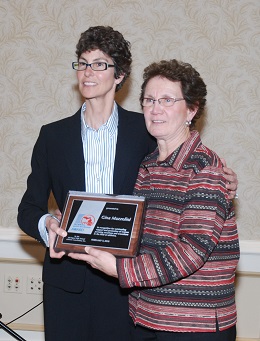
In addition to her recent Citation, Mazzolini is a member of the CMU Athletic Hall of Fame and received the MHSAA’s Women in Sports Leadership Award in 2010. This winter, she became the first woman to receive the MHSAA’s Charles E. Forsythe Award for her contributions to interscholastic sports.
It didn’t take long for Michigan coaches to realize she would make an impact.
 Among accomplishments she’s most proud of from her time at the MHSAA are improved relationships with the tennis and swimming communities, developed by increased communication and with the help of longtime veterans like Gary Ellis and Tiger Teusink in tennis and Denny Hill in the pool.
She was once told by a coach she was brave to show up at a regular-season event because of the grumbles toward the MHSAA in that sport – but soon another coach told her, “I wanted to hate you, but I like you.”
Mazzolini may choose to stick around athletics as an official, but only at the middle school level. She’ll definitely have no problems continuing to attend some of her favorite events in the sports she’s helped form over the years.
And it seems just a little coincidental that she’s stepping away from a community she’s affected so greatly at the end of the same school year that saw one of her nieces, St Johns senior Brooke Mazzolini, help the Redwings to their first MHSAA Girls Basketball Semifinal in nearly 20 years – the latest step on a path her aunt began to blaze 40 years ago, even as Gina doesn’t see herself as the “pioneer” she’s frequently made out to be.
“I played because I loved to play. I got that from my dad, and we were in an athletic neighborhood. I got into officiating and that was fun,” Mazzolini said. “And then (athletic director) Bob Forebeck at Ovid-Elsie called and said, ‘Hey I need a volleyball coach; what do you think?’ And that was a blast.
“And then I got into state associations, and I’ve really enjoyed that. There were rough patches – like when you tell people ‘no’ – but everything I’ve done, I’ve loved it. It’s hard to consider it a job, because you look forward to doing most of it.”
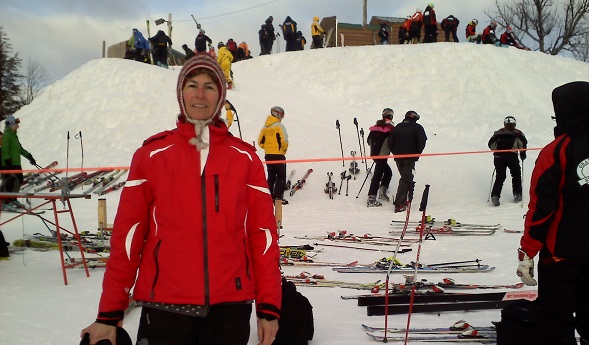
PHOTOS: (Top) Gina Mazzolini poses briefly while directing an MHSAA Final in skiing. (Middle) Mazzolini starred for the Central Michigan University women's basketball team. (Below) Mazzolini stands with her St. Johns high school basketball coach Beth Swears after receiving the MHSAA Women in Sports Leadership Award in 2010.