


Rep Council Wrap-Up: Spring 2015
May 11, 2015
By Geoff Kimmerly
Second Half editor
The Representative Council of the Michigan High School Athletic Association took a number of significant actions during its annual Spring Meeting, May 3-4, in Glen Arbor, highlighted by changes to out-of-season coaching rules, a call for a member vote on a Constitutional amendment affecting middle school and junior high athletics, and initiatives to promote participant health and safety.
The Spring Meeting of the 19-member legislative body of the Association’s more than 1,400 member schools is generally the busiest of its three sessions each year. The Council considered 13 committee proposals and also dealt with a variety of eligibility rule, postseason tournament and operational issues.
For the past eight months, the MHSAA focused member schools’ attention on an overhaul of out-of-season coaching rules. While support was lacking for a radically different approach, consensus developed for several significant changes within the existing approach for expanding contact between school coaches and their students out-of-season during the school year.
Included in the changes are that coaches will be permitted to work with up to four players in all situations out-of-season during the school year; previously, coaches could work with three or four players, depending on the circumstance. Coaches also will be allowed out of season during the school year to provide coaching in non-school competition to up to four students from that coach’s school. Under this same set of out-of-season coaching rules during the school year, the Council permitted more contact among school coaches and students allowing for previously banned offseason practice rotations to occur. Voluntary workouts out-of-season that involve rotations from conditioning, open gyms, weight lifting and sport-specific skill work may occur so long as there is no more than one four-player station with sport skills being coached.
Following up on more than a year of consideration by the MHSAA Junior High/Middle School Committee and a Junior High/Middle School Task Force created in December 2013, the Council also approved a request for a membership vote to amend the MHSAA Constitution to allow for school membership beginning at the 6th grade. The membership vote is expected to be conducted in late October; if membership approves the amendment, the Council will consider for which sports 6th-graders will be eligible to compete with and against 7th- and 8th- graders.
The MHSAA’s historical concern for health and safety has been intensified during the past six years of an eight-year campaign focused on “4 H’s” – Health Histories, Heads, Heat and Hearts – and the Council approved several initiatives which continue to improve the environment of school-based sports.
The Council authorized up to three pilot programs to be conducted by volunteer schools, aimed at assisting in decision-making regarding the removal of athletes from activity after possible concussion events as well as in reporting and record-keeping of those events.
The Council mandated that member schools report head injury events through a web-based reporting system the MHSAA is developing. The Council also approved the purchase of another level of insurance aimed at assuring that children of uninsured or underinsured families receive prompt and professional care for suspected head injuries. Both the reporting requirement and the insurance protection are for eligible athletes in all levels of all sports, grades 7 through 12, in both practices and competition.
The Council was briefed on an electronic system that could be used to track pre-participation physical examination forms while improving injury reporting and record-keeping; currently, the MHSAA provides paper forms to member schools at no charge. The Council also was updated on MHSAA plans to provide at no cost to every high school in Michigan the ANYONE CAN SAVE A LIFE – Emergency Action Planning Guide, and informed on the MHSAA’s support of the MI HEARTSafe School initiative of the Michigan Department of Health and Human Services, which on May 13 will recognize 128 schools and/or districts for cardiac emergency preparedness.
Here is a summary of other actions taken by the Representative Council at the Spring Meeting, which will take effect during the 2015-16 school year:
Handbook/Administrative Matters
- Participation was expanded by the Council for 9th- and 10th-grade transfer students with no history of high school athletic participation who gain immediate subvarsity eligibility through a waiver by the MHSAA Executive Committee. Students who are granted such a waiver may now participate in designated non-scoring subvarsity heats or non-scoring races of varsity individual contests in sports such as swimming and diving, cross country and track and field. Previous to this action, subvarsity eligibility was permitted in subvarsity team sports only or subvarsity-only meets in individual sports. The subvarsity definition also will apply to international students present in the U.S. on an F-1 Visa but not from an MHSAA-approved international student program.
- Athletes in ice hockey and boys and girls soccer must compete in four regular-season games against other MHSAA schools to be eligible to compete with their school teams in the MHSAA Tournament. This currently is a requirement in alpine skiing, and a waiver procedure similar to what is utilized in skiing will be developed for hockey and soccer as well.
- Non-school sports activities coordinated or directed by administrators and parents were added to situations which trigger an athletic link and an extended period of ineligibility for transfer students if those students then enroll at new schools that have association with those administrators or parents. The Council expanded the athletic-related transfer rule which previously involved only non-school coaches and transferring students who do not make a residential change.
Classification
- The Council created a “life line” allowance for schools to form a cooperative agreement in excess of the 3,500-student enrollment cap in sports sponsored by fewer than 250 schools. A program may be approved by the Executive Committee for up to three years, if during the previous year, the school or the cooperative program in which the school was a part dropped the sport because of a demonstrated lack of participation. Sports sponsored by 250 or fewer schools during 2014-15 were gymnastics, ice hockey, boys and girls lacrosse, boys and girls alpine skiing and boys and girls swimming and diving. This three-year “life line” allowance is similar to the regulation which allows for a “startup” cooperative program to be created among schools whose combined enrollment exceeds 3,500 students but the schools involved did not sponsor the sport in the previous school year.
Sport Matters
- For boys and girls basketball, the Council approved an MHSAA Basketball Committee recommendation to seek permission from the National Federation of State High School Associations (NFHS) to allow teams to play up to two regular-season games made up of 18-minute halves instead of the current 8-minute quarters. If permission is granted by the NFHS, schools will be required to seek permission from the MHSAA prior to events and provide reports after 36-minute games are played.
- In bowling, it was announced that Kegel is developing a bowling lane oil pattern for high school bowling called the “Allen Pattern,” named after former MHSAA Assistant Director Randy Allen, who administered the MHSAA bowling program from its inception during the 2003-04 school year until retirement in 2013. Michigan has the largest number of schools in the U.S. sponsoring interscholastic bowling. The Allen Pattern is being designed specifically for the high school level and will be utilized for the 2016 MHSAA Bowling Tournament.
- In cross country, the MHSAA will appoint and administer a task force of coaches and athletic administrators to address unbalanced Lower Peninsula Cross Country Regionals – including some Regionals having more complete teams in competition than others because teams decide to not compete or cannot compete with a full lineup after Regional groups are drawn. The task force will present its findings to the Council in 2016.
- For ice hockey, four-person officiating crews were approved for Quarterfinals. The MHSAA began using four-person crews for Semifinals and Finals in 2014.
- In boys lacrosse, a “play in” game was approved for teams seeded 9-16 in each Regional. Play-in games will be played three days earlier than the traditional start of the MHSAA Tournament, with winners then playing teams seeded 5-8 at the traditional start of tournament play.
- In wrestling, the Council approved a recommendation by the MHSAA Wrestling Committee that eliminates the second weigh-in at the MHSAA Team Finals. The Friday weigh-in before the start of Quarterfinals will be used for all three rounds of competition during Finals weekend.
The Council also reviewed reports on membership, with 754 senior high schools and 703 junior high/middle schools in 2014-15; eligibility advancement applications, which totaled four for the year; the use of Educational Transfer Forms, which held steady this year; school violations, attendance at athletic director in-service workshops and Coaches Advancement Program sessions, officials’ registrations, rules meetings attendance and officials reports submitted for the past three sports seasons. The Association’s $10.4 million budget for the 2015-16 school year also was approved.
The Representative Council is the 19-member legislative body of the MHSAA. All but five are elected by member schools. Four members are appointed by the Council to facilitate representation of females and minorities, and the 19th position is occupied by the Superintendent of Public Instruction or designee.
The MHSAA is a private, not-for-profit corporation of voluntary membership by more than 1,400 public and private senior high schools and junior high/middle schools which exists to develop common rules for athletic eligibility and competition. No government funds or tax dollars support the MHSAA, which was the first such association nationally to not accept membership dues or tournament entry fees from schools. Member schools which enforce these rules are permitted to participate in MHSAA tournaments, which attract more than 1.4 million spectators each year.
Scholars and Athletes 2016: Class B
By
Geoff Kimmerly
MHSAA.com senior editor
February 8, 2016
By Geoff Kimmerly
Second Half editor
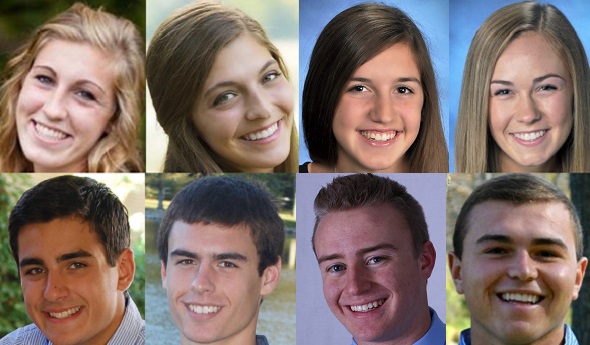
The Michigan High School Athletic Association has selected eight student-athletes from Class B member schools to receive scholarships through the Farm Bureau Insurance Scholar-Athlete Award program.
 Farm Bureau Insurance, in its 27th year of sponsoring the award, will give $1,000 college scholarships to 32 individuals who represent their member schools in at least one sport in which the Association sponsors a postseason tournament. The first 30 scholarships are awarded proportionately by school classification and the number of student-athletes involved in those classes; also, there are two at-large honorees who can come from any classification.
Students applying for the Scholar-Athlete Award must be carrying at least a 3.5 (on a 4.0 scale) grade-point average and have previously won a letter in a varsity sport in which the Michigan High School Athletic Association sponsors a postseason tournament. Other requirements for the applicants were to show active participation in other school and community activities and produce an essay on the importance of sportsmanship in educational athletics.
Each of the scholarship recipients will be honored at halftime ceremonies of the Class C Boys Basketball Final game March 26 at the Breslin Student Events Center in East Lansing. Commemorative medallions will be given to the finalists in recognition of their accomplishments.
The Class B Scholar-Athlete Award honorees are: Lindsey Carlson, Charlotte; Spencer Keoleian, Bloomfield Hills Cranbrook Kingswood; Josef Philipp, Hillsdale; Paiton Plutchak, Menominee; Austin Thompson, Onsted; Kate Tobin, Grosse Ile; Trevor Trierweiler, Portland; and Katherine Williams, Grosse Ile.
Overviews of the scholarship recipients of the Class B Scholar-Athlete Award follow. A quote from each recipient's essay also is included:
Lindsey Carlson, Charlotte
Ran four seasons of varsity cross country and will play fourth season of varsity soccer this spring. Earned all-state honors in cross country as both a freshman and sophomore and earned league and Regional championships in addition to a top-10 finish at the MHSAA Finals and top-50 Finals finishes all four seasons. Served as captain of both of her teams. Serving as president in her third year on student council and also as president of student cheering section after helping create it as a junior. Participating in fourth year of Fellowship of Christian Athletes and her church youth group, and has served as a camp counselor, mentor and as a Junior Rotarian for her local club. Also played two years in the school band, attaining first chair and earning awards for saxophone solo and ensemble. Will attend Eastern Illinois University and study dietetics.
Essay Quote: “Sportsmanship is an admirable habit that will last a lifetime. … A caring, sportsmanlike action can go a long way, and the relationships and satisfaction made from it means much more than a temporary place in a race and a medal around the neck.”
Paiton Plutchak, Menominee
Played two seasons of varsity tennis and ran three seasons of varsity track and field and one of varsity cross country. Earned four league and one MHSAA Finals championship as a hurdler and sprinter, and earned all-Upper Peninsula honors playing No. 1 doubles in tennis. Served as team captain of both of those teams during 2015. Also has participated on a statewide level in forensics and as part of the Business Professionals of America state leadership conference. Served as BPA chapter president and National Honor Society chapter president, and is serving as her student council’s secretary. Participating for fourth year on local Healthy Youth Coalition, third as part of the local teen court and earned a Daughters of the American Revolution Good Citizens Award; also participated as a delegate at the American Legion Auxiliary Girls State conference. Will attend Central Michigan University and study business.
Essay Quote: “High school athletics have tested my character and sportsmanship. … Sportsmanship is being humble, helpful and complimentary. I learned that if others try to bring you down, you need to stand tall and fight back with compliments and hard work. The most peaceful way to get back at someone is with success and compliments.”
Kate Tobin, Grosse Ile
Played four seasons of varsity volleyball, four of varsity basketball and will play third of varsity soccer this spring. Earned all-league and all-state honors in all three sports and has served as captain of both the volleyball (two seasons) and basketball teams. Participating on student council – and has held multiple leadership positions – for fourth year, and as part of National Honor Society for third after earning early induction into the latter. Also participates with her local Rotary Interact Club and has mentored freshman students and worked as a helper at a local elementary school. Also is serving as a referee for the local youth basketball league for the fourth year. Will attend the College of Charleston in South Carolina and study elementary education.
Essay Quote: “What makes sportsmanship so important is that it’s a legacy that will never die. Athletes can make their choice on whether or not they want to carry on the tradition, but all those who are a part of this legacy know that no one will ever be great without it. You can always be a great athlete, but your greatness is derived from sportsmanship.”
Katherine Williams, Grosse Ile
Played four seasons of varsity golf and will play her third of varsity soccer this spring; also played two seasons of subvarsity basketball. Played in four MHSAA Golf Finals and on the Lower Peninsula Division 4 champion team as a sophomore. Earned all-league and academic all-state honors in golf and served as that team’s captain, and also played on a league champion soccer team. Participating in third year of National Honor Society and has served as president, and also is in third year on student council. Plays in her school’s marching and symphonic bands and is the clarinet section leader, and has earned solo, ensemble and symphonic awards of excellence. Also has participated in a number of theatrical performances. Founded three service projects that have benefited her community’s needy and cancer research and awareness. Is undecided where she will attend college but intends to study advertising and communications.
Essay Quote: “Personally, athletics aren’t my everything. I do not live, breathe and sleep sports. I can experience the same “take the field” adrenaline in a marching band uniform or performing on stage. However, sportsmanship did help me fit in with the diehard … and that is why I believe an emphasis on integrity and kindness is so crucial in athletics.”
Spencer Keoleian, Bloomfield Hills Cranbrook Kingswood
Participating in his fourth season of swimming and diving and will play his second season of varsity lacrosse this spring; also played junior varsity football as a freshman. Qualified for MHSAA Swimming & Diving Finals his first three seasons and contributed to team’s first and second team Finals championships. Earned all-state recognition in two events and is serving as captain this winter. Also contributed to last season’s lacrosse MHSAA Finals title. Led retreats and participated in community outreach for four years as part of Bridge the Divide and co-founded Horizons Upward Bound Swim program to teach swimming to urban youth. Received University of Michigan’s Youth and Community Program Youth Leadership and Social Justice Schools and Communities certification. Selected by faculty to sit on school’s Conduct Review Disciplinary Board and participated in student government. Will attend Cornell University and study operations management and research engineering.
Essay Quote: “I thought this was the best feeling anyone could feel in athletics, the genuine happiness felt by one teammate for another who had done so well. However, as time passed, I realize there was more to it than just that. … I realized sportsmanship is not necessarily limited to organized athletics, but encompasses all forms of friendly competition.”
Josef Philipp, Hillsdale
Played four seasons of varsity football and soccer, is playing his third of varsity basketball and will play his fourth of varsity golf this spring. Owns school records for extra points and field goals and helped football team to the playoffs every season; contributed to league, District and Regional championships over three sports. Served as captain of soccer, basketball and golf teams and earned all-league honors in soccer and golf and all-state special and honorable mention in football. Selected for National Honor Society and has participated in a variety of volunteer services including as a board member of the school’s Freshman Mentor Program, Future Corps and as founding member and treasurer of Interact Club created for community work. Will attend Hillsdale College and study biochemistry.
Essay Quote: “Everyone wants to win. The question is how far does a participant, team or coach push to gain that win? Good sportsmanship needs to be taught to young people early as part of the game. It’s a culture that a coach, team, school and community must create. Good sportsmanship is also sometimes difficult to maintain, as it only takes one student, coach or fan to ruin a healthy culture.”
Austin Thompson, Onsted
Played two seasons of varsity football, is playing his second of varsity basketball, and will play his second of varsity golf and participate in his fourth of varsity track and field this spring. Qualified for MHSAA Finals for pole vault as a junior and helped basketball team to a league title last season and the track and field team to a league title in 2014. Earned sportsmanship and scholar-athlete awards from the Lenawee County Athletic Association. Captained football team in the fall. Holds top spot academically in his class with a 4.20 grade-point average and has served as his class president four years; also won the Tri-County Science Fair. Participating in fourth year of Fellowship of Christian Athletes and third of National Honor Society. Participated in a number of service projects including as a blood drive coordinator. Will attend University of Michigan or the University of Detroit Mercy and study actuarial mathematics.
Essay Quote: “I now know that sportsmanship off the field is a very powerful thing. Our opposing players were respecting us. They were showing appropriate and polite behavior. They were gracious with our loss and there to help us when we were down. The heartfelt gratitude our team showed in return formed strong bonds between many players.”
Trevor Trierweiler, Portland
Played two years of varsity tennis, is playing his second of varsity basketball and will play his third of varsity baseball this spring; also played two seasons of subvarsity football. Earned all-state honors for tennis in setting school single-season record for wins at No. 1 doubles, and earned all-league honors in baseball; also earned academic all-league honors in all three of his varsity sports. Served as captain of baseball team last season. Also serves as a member of the MHSAA Student Advisory Council. Participating in National Honor Society for third year and his school’s Captains Club for second. Earned academic letter for honors all four years; holds a 3.98 grade-point average. Volunteers as part of sport and non-sport service projects including “No More Sidelines” helping to provide sports opportunities to children and young adults with special needs. Will attend Kalamazoo College and study engineering.
Essay Quote: “Sportsmanship is not something that we are born with. Sportsmanship is a way to react/behave that we are taught through family, competition and athletics in general. Sometimes that idea of good sportsmanship gets lost in translation from emotions to behavior. … However, the display of good sportsmanship can help change the entire atmosphere around a team/school/community.”
Other Class B girls finalists for the Scholar-Athlete Award were: Erin Isola, Allegan; Greta Wilker, Belding; Keri Frahm, Frankenmuth; Alexis LaChappa, Harrison; Camryn A. Klein, Ionia; Fallon Gates, Manistee; Abigail Ufkes, Marshall; Erica Lynn Schwegman, Pontiac Notre Dame Prep; Elizabeth Swartz, Pontiac Notre Dame Prep; Amanda Pohl, Portland; Claudia Raines, Saginaw Swan Valley; and Brenna James, Sault Ste. Marie.
Other Class B boys finalists for the Scholar-Athlete Award were: Geoffrey Richard Pisani, Big Rapids; Nicolas Arons, Chelsea; Brendan Spangler, Coldwater; Evan Ciancio, Comstock Park; Ryan Mangulabnan, Dearborn Divine Child; Kyle Gavulic, Goodrich; Caleb E. Doane, Grant; Adam Kopp, Grosse Ile; Blake Willison, Grosse Ile; Justin Carlson, Hastings; Austin Davis, Onsted; and David Arnst, Ovid-Elsie.
The Class C and D scholarship award recipients were announced Feb. 2, and the Class A honorees will be announced Feb. 16.
Farm Bureau Insurance of Michigan was founded in 1949 by Michigan farmers who wanted an insurance company that worked as hard as they did. Those values still guide the company today and are a big reason why it is known as Michigan’s Insurance Company, dedicated to protecting the farms, families, and businesses of this great state. Farm Bureau Insurance agents across Michigan provide a full range of insurance services—life, home, auto, farm, business, retirement, Lake Estate®, and more—protecting nearly 500,000 Michigan policyholders.
The MHSAA is a private, not-for-profit corporation of voluntary membership by more than 1,400 public and private senior high schools and junior high/middle schools which exists to develop common rules for athletic eligibility and competition. No government funds or tax dollars support the MHSAA, which was the first such association nationally to not accept membership dues or tournament entry fees from schools. Member schools which enforce these rules are permitted to participate in MHSAA tournaments, which attract more than 1.4 million spectators each year.