


Rep Council Wrap-up: Spring 2019
May 8, 2019
By Geoff Kimmerly
Second Half editor
The addition of seeding at the District level in basketball and soccer and multiple adjustments to the process used to select the playoff field for 11-player football were among the most notable actions taken by the Representative Council of the Michigan High School Athletic Association during its annual Spring Meeting, May 5-6 in Gaylord.
The Spring Meeting of the 19-member legislative body of the Association’s more than 1,500 member schools is generally the busiest of its three sessions each year. The Council considered 26 committee proposals and dealt with a variety of eligibility rule, postseason tournament and operational issues.
Beginning with the 2019-20 school year, girls and boys basketball and soccer will employ a seeding process to place the top two teams in every District on opposite sides of that bracket, guaranteeing those two teams could not play each other before the District championship game.
The two teams to be seeded in each District will be determined using a Michigan Power Ratings computer formula based on regular-season results against other MHSAA Tournament-eligible teams and opponents’ strength of schedule. (Games against out-of-state or non-MHSAA opponents will not count in the MPR formula.) The MHSAA will draw all brackets two weeks before the start of District play. After the top seeds are determined and separated to opposite sides of the bracket, the draw process will place the remaining teams on the bracket based on a randomly-selected order determined earlier in the season. However, the draw process does not guarantee the seeded teams will receive byes or serve as home teams.
The MPR is being used this spring to seed the Boys Lacrosse Tournament. Separate seeding proposals were recommended to the Council by the MHSAA committees for both soccer and basketball.
The changes to the 11-Player Football Playoffs selection process were proposed by the MHSAA Football Committee and are designed to reward teams that play more successful opponents. Beginning with the 2020 season, eight divisions will be determined before the season, and 32 playoff qualifiers from each division will be selected at the end of the regular season based on playoff-point average – there no longer will be automatic qualification based on win total. The adjusted playoff points formula will award bonus points for all opponents’ wins, regardless of whether the team beat or lost to those opponents. Currently bonus points are awarded only if the team defeated an opponent. More points also are awarded for defeating teams from larger divisions. The Football Committee proposed these changes believing the bonus points received for a “good loss” – combined with the elimination of automatic qualifiers – will be enough incentive for teams to schedule more successful opponents, easing the annual difficulty in football scheduling and taking away arguably the most cited reason for the breakup of leagues and conferences.
Also on recommendation by the Football Committee, the Council approved an enrollment limit of 215 students for teams to be eligible for the MHSAA 8-Player Playoffs. This too will take effect for the 2020 season. Currently, a school must be Class D to be eligible for the postseason, or in a one-year grace period if it grew larger than Class D for the current school year. While the Class D enrollment line changes annually, the 8-player line of 215 students will remain static year to year. The grace period also will remain for schools that might receive a one-year enrollment bump before falling back below 215 students.
The Council also approved a committee recommendation to add limited video review of scoring plays or potential scoring plays, or of turnovers or potential turnovers at MHSAA Football Finals for both the 11 and 8-player formats. This process will be available at Finals only because of the availability of camera coverage provided by broadcasts of those highest-level games of the tournament. Although all scoring and turnover plays could be reviewed, a play will be reversed only when there is indisputable video evidence showing the original call was incorrect.
Continuing its focus on safety in football, the Council also approved a committee recommendation to adopt revised definitions and limits on contact allowed during preseason practices and practices after games have begun. Beginning with this 2019 football season, teams will be allowed no more than six hours of full-pads collision contact per week during the preseason and no more than 30 minutes of collision contact during a week of in-season (after games begin) practice. “Collision” is defined as contact at game speed, with the execution of full tackles at a competitive pace, taking players to the ground.
However, while “collision” contact will be limited, “thud” contact will be unlimited. “Thud” is defined as full speed but above the waist only, with no player taken to the ground and no winner or loser. Thud contact is not considered collision contact. The revised definitions of “collision” and “thud” and related time limitations are products of collaboration between the MHSAA, Michigan High School Football Coaches Association and Practice Like Pros, a national movement dedicated to safety in high school football. The recommendation was brought to the Football Committee by leadership of the Michigan High School Football Coaches Association and further defines the degree and amount of practice contact following similar practice safety changes approved by the Council for football in 2014 and 2017.
The new sport-specific transfer rule will take effect with the 2019-20 school year, and the Council approved a series of corresponding changes. Most notably, the Council approved a change to the athletic-related (links) rule to not grant immediate eligibility with a residential change if a student follows a coach from his or her former school to a school where the coach has been newly hired. The Council also approved a sport-specific penalty for the athletic-motivated transfer rule so that a student would not be eligible during the current school year in the sport played the previous school year if that student was confirmed to have made an athletic-motivated transfer.
The Council additionally approved clarifications under the sport-specific transfer rule for multi-school districts which have schools that are both geographical boundary schools and schools which are district-wide, for students transferring to nonpublic or charter schools and for students who have taken part in international student exchange programs and chosen to stay in Michigan.
To provide consistency for officials’ jurisdiction across all sports, the Council approved the addition of wording that allows an official to disqualify a student or coach following the conclusion of a contest – but before the official has left the facility and/or grounds – if that student or coach commits an offense worthy of ejection and disqualification against the official. (Example: A player or coach verbally berates an official while following that official to his or her vehicle.) This penalty also would include the next-day-of-competition suspension. This does not apply if the official has remained at the facility and encounters the offense while as a spectator for another event.
Here is a summary of other notable actions taken by the Representative Council at the Spring Meeting, which will take effect during the 2019-20 school year unless noted:
Regulations
• The Council approved an increase from $25 to $40 as the maximum value for any award (trophies, medals, plaques, etc.) that an athlete may receive for participation in an athletic event without conflicting his or her amateur status.
Sport Matters
• In track & field, the Council approved a Cross County/Track & Field Committee recommendation to allow Upper Peninsula and Lower Peninsula Regional competitions to be conducted on Thursdays, in addition to the current Fridays and Saturdays, to provide for more flexibility for tournament hosts and participants when up against other school activities and college entrance exam testing dates.
• Also in track & field, the Council approved a recommendation to allow for use of a double waterfall mark and step-up start in the 800, 1,600 and 3,200 meters, beginning in 2020 when those events will begin employing a one-turn stagger.
• In golf, a committee recommendation was approved allowing golfers to use cell phones during play in four circumstances – to call a coach or tournament administrator for a health and safety issue, for use in inputting scores for live scoring or other scoring applications, to contact a rules official with questions, and for use as a distance-measuring device.
• The Council approved a Golf Committee recommendation setting the maximum allowable score at 12 strokes per hole, in part to help improve pace of play.
• The Council also approved a Golf Committee recommendation to allow for a Lower Peninsula Regional to be played any day, Monday through Saturday, during the week reserved for that round of the tournament. Similar to track & field, this allowance was made to increase scheduling flexibility.
• In girls competitive cheer, the Council approved a committee recommendation allowing for non-braced static inversions at the high school level only with the following stipulations: the original base or spotter maintains constant contact with the flyer, prior to the static inverted position the flyer must originate from below shoulder level, and the inversion must dismount to the cheering surface, cradle, any waist-level position or a non-inverted stunt at shoulder level. Also, twists from inversions and inversions released to extended level are illegal.
• The Council also approved a recommendation to allow for the review and possible restructuring of the girls competitive cheer format as early as the 2020-21 season, keeping athlete safety and efforts to increase participation as the primary focuses.
• In girls gymnastics, the Council approved a committee recommendation solidifying language stating that when four judges are contracted for a meet in which two events are conducted simultaneously, a total of 28 gymnasts may compete per event in a double-dual or quad meet, with up to 14 per school per event (for schools with A and B teams).
• In boys lacrosse, the Council approved a committee recommendation allowing for a multi-team tournament option of playing two full games (four 12-minute quarters) with a possible four-minute sudden-victory overtime period, instead of three running-time games (25-minute halves) with no overtimes allowed.
• In soccer, the Council approved a recommendation to allow for multi-team tournaments to be played not only on non-school days, but on days not followed by a school day.
• The Council also approved a committee recommendation in soccer removing a rule that previously required District and Regional Finals to begin after 5 p.m. on SAT and ACT national testing days.
• In diving, the Council approved a Swimming & Diving Committee recommendation requiring divers who enter MHSAA Qualifying Meets to provide a name of a designated MHSAA-certified coach to serve on the judging panel. After volunteers are accepted from the list, a random draw of those designated coaches will fill out the rest of the seven-judge panel.
• In tennis, the Council approved two committee recommendations regarding MHSAA Tournament play. The first requires any lineup substitution be made before the end of the last scheduled coaches meeting prior to play to allow for the automatic redrawing of a bracket if a seeded player is unable to play. The Council also approved the allowance of three coaches on the first day of MHSAA Finals, when play often takes place at many courts and at multiple sites. In the case of multiple sites, an additional coach may be added for each site (all coaches must continue to meet MHSAA coaching requirements). On the second day of the Finals, only two coaches are allowed.
• Additionally in tennis, the Council approved a committee recommendation allowing coaches who are on-court for coaching purposes during matches to text coaches or players not engaged in matches, as long as it is not disruptive to play. The Council also approved a committee recommendation allowing coaches at the subvarsity and middle school levels to offer coaching at any time during a match as long as the coach remains off court and does not disrupt the flow of play.
In an effort to increase recruitment of young officials, the Council approved a staff proposal to expand the Student Officials Legacy Program to include freshman and sophomore students at least 14 years of age. These underclassmen will be allowed to officiate with a mentor official at the junior high/middle school level only.
The Council also discussed various other topics, including work by the Multi-Sport Task Force toward a possible awards program and the MHSAA’s growing efforts as a presenting sponsor at junior high/middle school events and at high school events that have ties to MHSAA member schools but are not MHSAA-sponsored sports (that is by competition rules, governance, etc.).
The Council also reviewed reports on membership, with 750 senior high schools and 810 junior high/middle schools in 2018-19 plus 56 elementary schools with 6th-grader participation; cooperative programs, with 313 programs for 552 teams during 2018-19; eligibility advancement applications, which totaled three for this school year; the use of Educational Transfer Forms, out-of-state practice requests, school violations, attendance at athletic director in-service workshops and Coaches Advancement Program sessions, officials’ registrations, rules meetings attendance and officials reports submitted for the past three sports seasons. The Association’s $11.9 million budget for the 2019-20 school year also was approved.
The Representative Council is the 19-member legislative body of the MHSAA. All but five are elected by member schools. Four members are appointed by the Council to facilitate representation of females and minorities, and the 19th position is occupied by the Superintendent of Public Instruction or designee.
The MHSAA is a private, not-for-profit corporation of voluntary membership by more than 1,500 public and private senior high schools and junior high/middle schools which exists to develop common rules for athletic eligibility and competition. No government funds or tax dollars support the MHSAA, which was the first such association nationally to not accept membership dues or tournament entry fees from schools. Member schools which enforce these rules are permitted to participate in MHSAA tournaments, which attract more than 1.4 million spectators each year.
2015-16 Classifications Announced
By
Geoff Kimmerly
MHSAA.com senior editor
March 30, 2015
Classifications for Michigan High School Athletic Association elections and postseason tournaments in traditionally classified sports (A, B, C, D) for the 2015-16 school year have been announced, with enrollment breaks for postseason tournaments set up by divisions posted to each sport’s page on the MHSAA Website.
Classifications for the upcoming school year are based on a second semester count date, which for MHSAA purposes was Feb. 11. The enrollment figure submitted for athletic classification purposes may be different from the count submitted for school aid purposes, as it does not include students ineligible for athletic competition because they reached their 19th birthday prior to September 1 of the current school year and will not include alternative education students if none are allowed athletic eligibility by the local school district.
After all the counts are submitted, tournament-qualified member schools are ranked according to enrollment, and then split as closely into quarters as possible. For 2015-16, there are 750 tournament-qualified member schools with 187 schools in both Class A and Class B, and 188 schools in both Class C and Class D.
Effective with the 2014-15 school year, schools with 875 or more students are in Class A in MHSAA postseason tournament competition. The enrollment limits for Class B are 420-874; Class C is 213-419; and schools with enrollments of 212 and fewer are Class D. The break between Classes A and B decreased seven students from 2014-15, the break between Classes B and C decreased four students, and the break between Classes C and D is two students fewer than the current school year.
The new classification breaks will see 13 schools move up in class for 2015-16, while 17 schools will move down.
Schools recently were notified of their classification. MHSAA Executive Director John E. "Jack" Roberts said schools may not subsequently lower their enrollment figure. However, if revised enrollment figures should be higher and indicate that a school should be playing in a higher class, that school would be moved up.
Schools have the option to play at any higher classification for a minimum of two years, but must exercise the option by April 15 for fall sports, August 15 for winter sports and October 15 for spring sports.
MHSAA tournament sports that will be conducted in traditional classifications for 2014-15 are Basketball and Girls Volleyball. Football will use traditional classifications to determine playoff points.
Sports which will compete in nearly equal divisions are: Baseball, Bowling, Girls Competitive Cheer, Lower Peninsula Cross Country, Lower Peninsula Golf, Ice Hockey, Lacrosse, Lower Peninsula Soccer, Skiing, Softball, Lower Peninsula Swimming and Diving, Lower Peninsula Tennis, Lower Peninsula Track and Field and Wrestling.
Visit the respective sport pages on the MHSAA Website to review the divisional alignments.
The divisions and qualifiers for the MHSAA Football Playoffs will be announced on Selection Sunday, Oct. 25, 2015.
A complete list of school enrollments used to determine classifications for the 2015-16 school year can be found on the Enrollment & Classification page of the MHSAA Website.
Here is a complete list of schools changing classification for 2015-16. (Note: This list does not include schools opting up in class/division for tournaments, which can be found on the Administrators page of the MHSAA Website, under Enrollment and Classification):
Moving Up From Class B to Class A
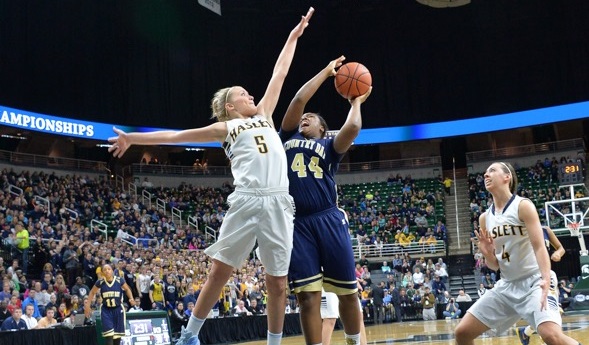
Haslett
Jackson Northwest
Parma Western
South Lyon East
Sturgis
Moving Down From Class A to Class B
Detroit Mumford
Fruitport
Hazel Park
Sault Area
Stevensville Lakeshore
Moving Up From Class C to Class B
Fennville
Grand Rapids West Michigan Aviation Academy
Hillsdale
Jackson Lumen Christi
Jonesville
Warren Michigan Collegiate
Moving Down From Class B to Class C
Delton Kellogg
Detroit Community
Detroit Pershing
Detroit Southeastern
Detroit West Side Academy
Hemlock
Lakeview
Moving Up From Class D to Class C
Burton Madison Academy
St. Ignace LaSalle
Moving Down From Class C to Class D
Highland Park Renaissance Academy
Marcellus
Potterville
Rogers City
Vestaburg
New Postseason Eligible Tournament Schools in 2015-16
Brighton Charyl Stockwell Preparatory
Canton Preparatory
Detroit Cornerstone Health & Technology
Detroit Public Safety Academy
Detroit Westside Christian Academy
Grand Rapids Hope Academy of West Michigan
Enrollment Breaks by Classes – 2015-16
(Number of schools in parentheses)
Class A: 875 and above (187 schools)
Class B: 420 – 874 (187)
Class C: 213 – 419 (188)
Class D: 212 and below (188)
The MHSAA is a private, not-for-profit corporation of voluntary membership by more than 1,400 public and private senior high schools and junior high/middle schools which exists to develop common rules for athletic eligibility and competition. No government funds or tax dollars support the MHSAA, which was the first such association nationally to not accept membership dues or tournament entry fees from schools. Member schools which enforce these rules are permitted to participate in MHSAA tournaments, which attract more than 1.4 million spectators each year.
PHOTO: Haslett, this season's Class B girls basketball runner-up, will play in Class A for the 2015-16 season.