


Rep Council Wrap-Up: Winter 2017
April 1, 2017
By Geoff Kimmerly
Second Half editor
To accommodate an increasing number of member schools moving to 8-player football, while continuing to provide a championship opportunity for schools with the smallest enrollments, the Representative Council of the Michigan High School Athletic Association approved the addition of a second division to the 8-Player Football Playoffs among multiple actions taken during its annual Winter Meeting on March 24 in East Lansing.
A total of 60 Class D schools have declared so far they will sponsor 8-player varsity football teams this fall, a 20-percent increase in tournament-eligible teams from last season (only Class D schools currently are eligible for the MHSAA tournament in this sport). The Council voted to expand the 8-player tournament to two four-week, 16-team brackets, with schools divided based on enrollment. Since its first season of MHSAA tournament sponsorship in 2011, 8-player football has finished with one 16-team playoff.
The two-division, four-week format provides the smallest MHSAA member schools a shorter tournament involving schools with a smaller difference in enrollment, both of which may enhance participant health and safety. The championships games will occur the weekend before Thanksgiving. Qualification criteria, enrollment limits and MHSAA Finals venues will be discussed at the Council’s Spring Meeting, May 7-8.
The Council also discussed venue possibilities for future wrestling and basketball Finals rounds, with sites for the 2017-18 school year to be selected not later than the Spring Meeting. The Basketball Finals, played the last many seasons at Michigan State University’s Breslin Center for both girls and boys, would have with their currently-scheduled dates one or the other in conflict in future seasons with Breslin’s potential opportunity to host NCAA Tournament first and second-round games for MSU’s women’s basketball team. The Council will review proposals for hosting the Basketball Finals at the Spring Meeting, and also consider the possibility of altering schedules for the tournaments to accommodate venue availability.
The MHSAA Wrestling Finals have been conducted for the team tournament the last two years at Central Michigan University’s McGuirk Arena, while the individual tournament has finished the last 15 seasons at The Palace of Auburn Hills. The contract with McGuirk Arena ended with this winter’s tournament, and with the future of The Palace uncertain, the MHSAA is considering options for moving that event as well.
The Council also approved a recommendation from the MHSAA Baseball/Softball Committee to classify those two sports independently beginning with the 2017-18 school year. Currently, schools are placed in the same divisions for both sports, and also play in the same tournament groupings for both. This action allows for the sports to be organized separately, and came in response to fewer schools sponsoring both baseball and softball teams, which has led to Districts with uneven numbers of teams (more for softball at a particular site than for baseball, or vice versa).
Also in football, the Council approved a Football Committee recommendation that the MHSAA seek permission from the National Federation of State High School Associations (NFHS) to continue to experiment with a 40-second clock for use between plays. Teams taking part in the experiment will have 40 seconds from the end of the previous play to snap the ball to begin the next, unless there is an administrative stoppage (for penalty, measurement, etc.). MHSAA schools began experimenting with the 40-second clock during the 2016 season.
In addition to sport matters, the Council discussed a paper prepared by the Michigan State University Institute for the Study of Youth Sports entitled “Gender Differences in Youth Sport Concussion.” The paper delved into findings by the MHSAA during its 2015-16 concussion reporting that showed a greater number of reports of concussions for females than males in the same sport (for example, basketball and soccer). The MHSAA’s findings, and the Institute’s comparisons with findings of other organizations and researchers, will be used to help shape MHSAA services and support to school sports.
The Representative Council is the legislative body of the MHSAA. All but five members are elected by member schools. Four members are appointed by the Council to facilitate representation of females and minorities, and the 19th position is occupied by the Superintendent of Public Instruction or designee.
The MHSAA is a private, not-for-profit corporation of voluntary membership by more than 1,400 public and private senior high schools and junior high/middle schools which exists to develop common rules for athletic eligibility and competition. No government funds or tax dollars support the MHSAA, which was the first such association nationally to not accept membership dues or tournament entry fees from schools. Member schools which enforce these rules are permitted to participate in MHSAA tournaments, which attract more than 1.4 million spectators each year.
Applications Available for 2026-27 MHSAA/Farm Bureau Insurance Scholar-Athlete Awards
By
Geoff Kimmerly
MHSAA.com senior editor
October 6, 2026
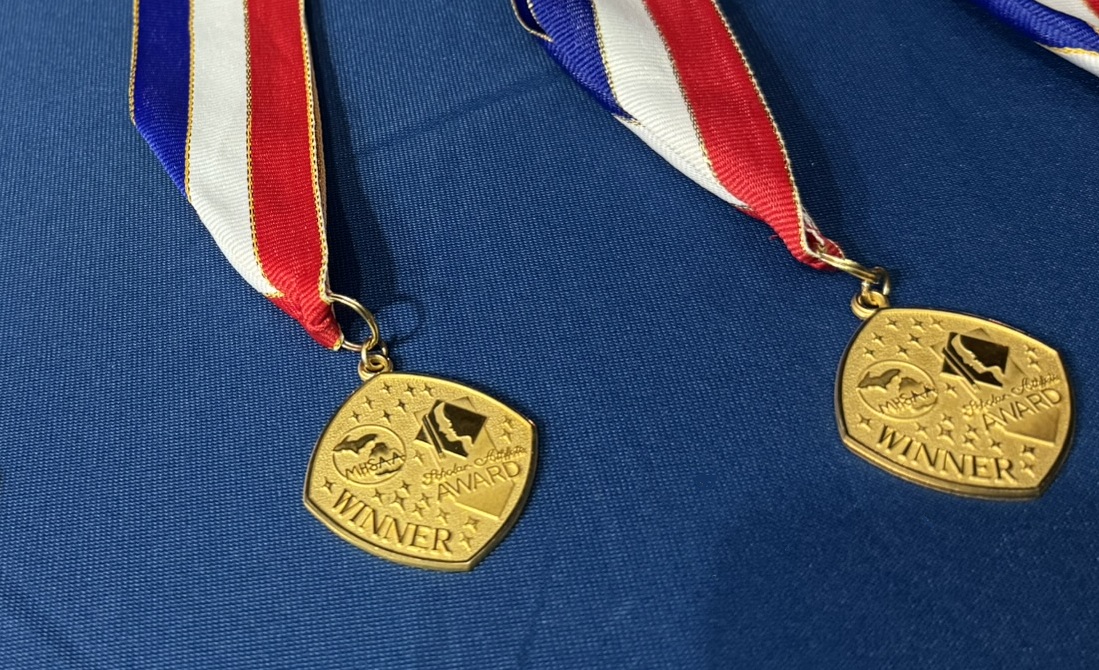
One of the Michigan High School Athletic Association’s most popular programs, the Scholar-Athlete Award, will again with Farm Bureau Insurance present 32 $2,000 scholarships to top student-athletes at member high schools during the 2026-27 school year.

The MHSAA/Farm Bureau Insurance Scholar-Athlete Award highlights the value extracurricular activities play in the total education of high school students, often improving their academic achievements in the process. The Scholar-Athlete Award is in its 38th year. Since the award’s inception in 1988-89, Farm Bureau Insurance has presented more than $1 million in scholarships through this program.
The first 30 scholarships will be presented on a graduated basis across the MHSAA’s traditional class structure. From Class A schools, six boys and six girls will receive scholarships; from Class B schools, four boys and four girls; from Class C schools, three boys and three girls; and from Class D schools, two boys and two girls will be honored. The final two scholarships will be awarded at-large to minority recipients, regardless of school size. The scholarships may be used at the institution of higher learning the recipients attend during the first year at those colleges.
Applications from individual schools will be limited to the number of available scholarships in their enrollment class. Class A schools may submit the names of six boys and six girls, Class B schools may submit four boys and four girls, Class C may submit three boys and three girls and Class D may submit two boys and two girls.
Students applying for Scholar-Athlete Awards must be graduating during the 2026-27 school year, carrying an unrounded 3.5 (on a 4.0 scale) grade-point average and have won a varsity letter in a sport in which the MHSAA sponsors a postseason tournament: baseball, girls and boys basketball, girls and boys bowling, competitive cheer, girls and boys cross country, field hockey, football, girls and boys golf, gymnastics, ice hockey, girls and boys lacrosse, girls and boys skiing, girls and boys soccer, softball, girls and boys swimming & diving, girls and boys tennis, girls and boys track & field, girls and boys volleyball and girls and boys wrestling.
Applicants will be required to show involvement in other school and community activities and submit an essay on the importance of sportsmanship in educational athletics.
Information – including answers to a number of frequently asked questions – and links to the application are available online on the Scholar-Athlete Award page. Applications are available in digital format only and must be submitted online by 4 p.m. Dec. 4.
A committee composed of school administrators from across the state will select finalists and winners in late January, with the winners to be announced throughout February. All applicants, finalists and scholarship recipients will be announced on the MHSAA Website. The 32 scholarship recipients will be recognized during the 2027 MHSAA Boys Basketball Finals at the Breslin Student Events Center in East Lansing.
Farm Bureau Insurance of Michigan was founded in 1949 by Michigan farmers who wanted an insurance company that worked as hard as they did. Those values still guide the company today and are a big reason why it is known as Michigan’s Insurance Company, dedicated to protecting the farms, families, and businesses of this great state. Farm Bureau Insurance agents across Michigan provide a full range of insurance services – life, home, auto, farm, business, retirement, Lake Estate®, and more – protecting more than 660,000 Michigan residents.
The MHSAA is a private, not-for-profit corporation of voluntary membership by more than 1,500 public and private senior high schools and junior high/middle schools which exists to develop common rules for athletic eligibility and competition. No government funds or tax dollars support the MHSAA, which was the first such association nationally to not accept membership dues or tournament entry fees from schools. Member schools which enforce these rules are permitted to participate in MHSAA tournaments, which attract more than 1.4 million spectators each year.