


Rep Council Wrap-Up: Winter 2019
March 28, 2019
By Geoff Kimmerly
Second Half editor
An adjustment to the Ice Hockey Tournament schedule was the most notable action taken by the Representative Council of the Michigan High School Athletic Association during its annual Winter Meeting on March 22 in Grand Rapids, while a number of additional topics were discussed in advance of expected votes at its next meeting.
The Winter Meeting frequently serves as an opportunity for the Council to discuss items expected to come up for action at its final meeting of the school year, scheduled for May 5-6. However, a proposal from the MHSAA’s Ice Hockey Committee required immediate action as it affects the 2019-20 regular and postseason, and schools are in the midst of building their schedules for that sport.
The Council approved a proposal that will change the number of weeks for the MHSAA Tournament in ice hockey from two to three, spreading the maximum of six games that may be played from the start of Regionals through Finals over 20 days instead of the previous 13. This change goes into effect with the 2019-20 tournament.
The dates for the start of the regular season and Finals (second Saturday in March) will remain the same, as will the total number of regular-season games allowed. However, the MHSAA Tournament will begin on the third Monday before the Finals instead of two weeks before.
Also concerning tournaments, the Council heard updates on proposed seeding plans from the Basketball and Soccer Committees, along with a summary of how seeding currently is utilized in boys lacrosse and team wrestling. The Council also discussed a Football Committee recommendation that would change the strength-of-schedule formula used to determine qualifiers for the MHSAA 11-Player Playoffs, and reviewed results of a survey of varsity head coaches on the topic. Both seeding proposals and the football strength-of-schedule proposal will be voted upon in May.
In advance of the new sport-specific transfer rule taking effect with the 2019-20 school year, the Council considered possible adjustments that may need to be made beforehand, including ones regarding residential changes. The possible changes would go into effect with the new transfer rule and will require action at the Spring Meeting.
The Council heard a report on mental health initiatives being formulated by staff, which has conducted a pair of meetings and received valuable input from a variety of parties with interest and expertise in this area. The Council also received an update on how other states are considering esports and reported responses staff has received from school administrators and others with current or potentially future involvement.
The Representative Council is the legislative body of the MHSAA. All but five members are elected by member schools. Four members are appointed by the Council to facilitate representation of females and minorities, and the 19th position is occupied by the Superintendent of Public Instruction or designee.
The MHSAA is a private, not-for-profit corporation of voluntary membership by more than 1,500 public and private senior high schools and junior high/middle schools which exists to develop common rules for athletic eligibility and competition. No government funds or tax dollars support the MHSAA, which was the first such association nationally to not accept membership dues or tournament entry fees from schools. Member schools which enforce these rules are permitted to participate in MHSAA tournaments, which attract more than 1.4 million spectators each year.
2026-27 MHSAA Officials Registration Underway
By
Geoff Kimmerly
MHSAA.com senior editor
June 15, 2026
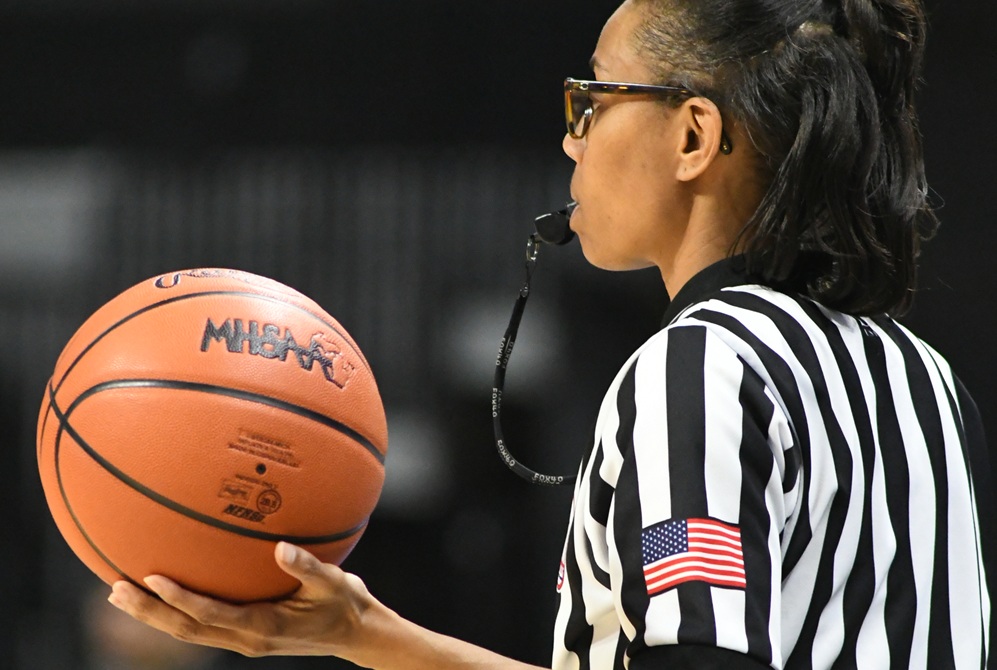
The Michigan High School Athletic Association is accepting registrations online for game officials for the 2026-27 school year.
The MHSAA registered 9,330 officials for the 2025-26 school year, an increase of 4.9 percent from the previous year’s total.
All officials who register may sign up for up to two sports as part of their registration. Officials also will receive membership in the National Association of Sports Officials (NASO), which comes with a variety of educational and training resources and the NASO’s Shield liability insurance that will provide $6 million in coverage for officials while they are working both MHSAA and non-MHSAA events.
For new and returning officials, a $70 fee covers registration for up to two sports. Officials may register for additional sports at $16 per sport.
To avoid a $30 late fee, all fall sport registration applications must be received by Aug. 17, 2026. Winter sports registrations must be received by Nov. 16 to avoid the late fee, and spring sports registrations must be received by March 24, 2027.
Online registration can be accessed on the Officials page. More information about officials registration may be obtained by contacting the MHSAA by phone at (517) 332-5046 or by e-mail at [email protected].
New officials and those who didn’t officiate during 2025-26 must complete an officials' registration test, derived from the MHSAA Officials Guidebook, and the online MHSAA Principles of Officiating course. Additional exams must be taken by those registering for football or basketball for the first time or those who were not registered for those sports during the previous school year. Links to the Officials Guidebook, Principles of Officiating presentation and the football and basketball mechanics manuals can be found by following the “New Officials” link on the Officials page of the MHSAA Website and completing the registration process.
There also are opportunities to officiate for students at least 14 years old and in grades 9-12 through the MHSAA Legacy Program. Juniors and seniors may officiate subvarsity contests, while freshmen and sophomores may officiate contests at the middle school/junior high levels. Mentor officials will work events with Legacy participants to provide guidance and support. Find information on the Legacy Program by clicking “Officials Registration” on the Officials page of the MHSAA Website and reading under “Student Legacy Program Requirements.”
While on MHSAA.com to register for the upcoming school year, officials also can register for Officiate Michigan Day 2026, set for July 25 in Grand Rapids.
Doors open at 7:30 a.m., with the first session at 9 a.m. at DeVos Place. The day-long event will feature dynamic speakers and presenters providing knowledge in several sports and all levels including collegiate and professional.
Cost is $45 if officials register by the end of June, and $50 beginning July 1. More information is on the way; keep posted at MHSAA.com/OMD.