

Representative Council Approves Expansion of Personal Branding Activities for Student-Athletes
By
Geoff Kimmerly
MHSAA.com senior editor
January 27, 2026
The Representative Council of the Michigan High School Athletic Association has approved an expansion of personal branding activities (PBA) – also commonly referred to as Name-Image-Likeness (NIL) – allowing student-athletes at MHSAA member schools, effective immediately, to potentially benefit from such opportunities.
The MHSAA previously allowed some PBA opportunities, including the abilities for student-athletes to conducts camps, clinics and private lessons. The expanded policy allows student-athletes to capitalize on PBA through several more options as long as those activities are individual opportunities for individual students – while not disrupting competitive equity that would result from the creations of group activities including collectives and other pay-for-play opportunities now the norm at the collegiate level.
The topic of PBA/NIL had been discussed at length with membership over the last three years during MHSAA Update meetings and various other conferences with schools and their administrators. The Council had debated the possibility of these rule changes since the Michigan Legislature proposed amending state law to allow for student-athletes’ use of NIL in 2023, and also after closely monitoring similar developments in surrounding states.
“We have said from the start of this conversation that the MHSAA could be comfortable with a policy that provides individual branding opportunities for individual student-athletes, and this rule change provides those while excluding the possibility of collectives, and boosters and school people getting involved in those activities,” MHSAA Executive Director Mark Uyl said. “This is the essence of what NIL was supposed to allow in the first place, and we’re confident we’ve crafted language that allows true NIL opportunities without affecting competitive equity among our member schools.”
Additional activities allowed by the new PBA policy include social media endorsements and promotions, personal appearances, photo sessions or autograph signings; modeling, advertising, merchandise, sports cards or apparel sales; and the use of a student’s name, image or likeness in marketing materials.
PBA activities must be consistent with MHSAA rules and school policies. A student-athlete may not capitalize on PBA based on athletic performances, awards/recognition, team participation or competition outcomes. A student-athlete also may not involve school names, logos, mascots, trademarks or other obvious identifiers, uniforms or other intellectual property, and PBA activity may not occur during school attendance or any MHSAA event (including practice) and cannot take place on school property or be promoted on school media channels.
Schools, including coaches and other employees, are not allowed to solicit, arrange, negotiate or promote PBA activities on behalf of their student-athletes. Doing so may put that school’s MHSAA membership in jeopardy, in addition to rendering that student-athlete ineligible for MHSAA athletics.
“The MHSAA will guard the competitive equity we have promoted for more than 100 years, and take with the utmost seriousness any attempts to break or blur this rule,” Uyl said. “We have provided clear language and sufficient guidance on what is allowed to assist our schools as they navigate this ever-changing landscape.”
PBA associated with products, services, individuals, companies or industries deemed inappropriate, unsafe or inconsistent with the values and goals of interscholastic athletics, as determined by the MHSAA – for example gaming or gambling, alcoholic beverages and banned substances – are also prohibited.
All PBA activities must be disclosed to the MHSAA within seven days of an opportunity or contract for disclosure and approval. Schools may choose to have stricter rules regarding PBA if they choose to do so.
For more details on what is and what is not allowed, and frequently asked questions about PBA in regards to MHSAA regulations, visit the MHSAA Name, Image, Likeness page.
The Representative Council is the legislative body of the MHSAA. All but five members are elected by member schools. Four members are appointed by the Council to facilitate representation of females and minorities, and the 19th position is occupied by the Superintendent of Public Instruction or designee.
The MHSAA is a private, not-for-profit corporation of voluntary membership by more than 1,500 public and private senior high schools and junior high/middle schools which exists to develop common rules for athletic eligibility and competition. No government funds or tax dollars support the MHSAA, which was the first such association nationally to not accept membership dues or tournament entry fees from schools. Member schools which enforce these rules are permitted to participate in MHSAA tournaments, which attract more than 1.4 million spectators each year.
MHSAA Suspends Winter Tournaments
March 12, 2020
By Geoff Kimmerly
Second Half editor
Postseason events sponsored by the Michigan High School Athletic Association have been suspended immediately and indefinitely due to concerns related to COVID-19.
The Ice Hockey, Girls Gymnastics and Lower Peninsula Boys Swimming & Diving Finals had been scheduled for this weekend, while the Girls & Boys Basketball Tournaments are midway through earlier rounds of their playoff progressions.
On Wednesday, Gov. Gretchen Whitmer recommended a stoppage of large gatherings in order to assist in preventing the spread of COVID-19.
“Based on the events of the last 48 hours and with things changing by the minute, we believe we have no choice but to suspend our winter tournaments immediately,” MHSAA Executive Director Mark Uyl said. “This is a suspension until we have a better handle on the situation. The health and welfare of everyone involved is our number one priority.”
Uyl added that more information and updates will be forthcoming over the next few days. No timetable has been determined for possible rescheduling for tournaments.
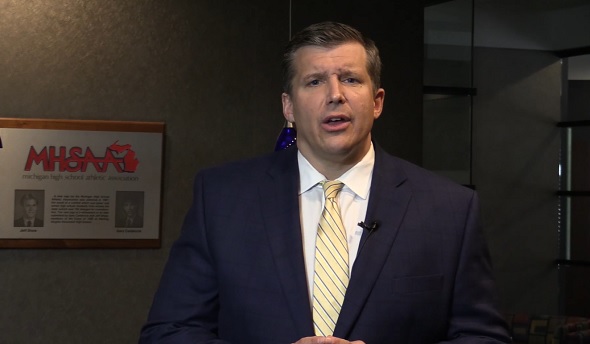
Click for a video statement from Mark Uyl.
The MHSAA is a private, not-for-profit corporation of voluntary membership by more than 1,500 public and private senior high schools and junior high/middle schools which exists to develop common rules for athletic eligibility and competition. No government funds or tax dollars support the MHSAA, which was the first such association nationally to not accept membership dues or tournament entry fees from schools. Member schools which enforce these rules are permitted to participate in MHSAA tournaments, which attract more than 1.4 million spectators each year.