

Representative Council Approves Expansion of Personal Branding Activities for Student-Athletes
By
Geoff Kimmerly
MHSAA.com senior editor
January 27, 2026
The Representative Council of the Michigan High School Athletic Association has approved an expansion of personal branding activities (PBA) – also commonly referred to as Name-Image-Likeness (NIL) – allowing student-athletes at MHSAA member schools, effective immediately, to potentially benefit from such opportunities.
The MHSAA previously allowed some PBA opportunities, including the abilities for student-athletes to conducts camps, clinics and private lessons. The expanded policy allows student-athletes to capitalize on PBA through several more options as long as those activities are individual opportunities for individual students – while not disrupting competitive equity that would result from the creations of group activities including collectives and other pay-for-play opportunities now the norm at the collegiate level.
The topic of PBA/NIL had been discussed at length with membership over the last three years during MHSAA Update meetings and various other conferences with schools and their administrators. The Council had debated the possibility of these rule changes since the Michigan Legislature proposed amending state law to allow for student-athletes’ use of NIL in 2023, and also after closely monitoring similar developments in surrounding states.
“We have said from the start of this conversation that the MHSAA could be comfortable with a policy that provides individual branding opportunities for individual student-athletes, and this rule change provides those while excluding the possibility of collectives, and boosters and school people getting involved in those activities,” MHSAA Executive Director Mark Uyl said. “This is the essence of what NIL was supposed to allow in the first place, and we’re confident we’ve crafted language that allows true NIL opportunities without affecting competitive equity among our member schools.”
Additional activities allowed by the new PBA policy include social media endorsements and promotions, personal appearances, photo sessions or autograph signings; modeling, advertising, merchandise, sports cards or apparel sales; and the use of a student’s name, image or likeness in marketing materials.
PBA activities must be consistent with MHSAA rules and school policies. A student-athlete may not capitalize on PBA based on athletic performances, awards/recognition, team participation or competition outcomes. A student-athlete also may not involve school names, logos, mascots, trademarks or other obvious identifiers, uniforms or other intellectual property, and PBA activity may not occur during school attendance or any MHSAA event (including practice) and cannot take place on school property or be promoted on school media channels.
Schools, including coaches and other employees, are not allowed to solicit, arrange, negotiate or promote PBA activities on behalf of their student-athletes. Doing so may put that school’s MHSAA membership in jeopardy, in addition to rendering that student-athlete ineligible for MHSAA athletics.
“The MHSAA will guard the competitive equity we have promoted for more than 100 years, and take with the utmost seriousness any attempts to break or blur this rule,” Uyl said. “We have provided clear language and sufficient guidance on what is allowed to assist our schools as they navigate this ever-changing landscape.”
PBA associated with products, services, individuals, companies or industries deemed inappropriate, unsafe or inconsistent with the values and goals of interscholastic athletics, as determined by the MHSAA – for example gaming or gambling, alcoholic beverages and banned substances – are also prohibited.
All PBA activities must be disclosed to the MHSAA within seven days of an opportunity or contract for disclosure and approval. Schools may choose to have stricter rules regarding PBA if they choose to do so.
For more details on what is and what is not allowed, and frequently asked questions about PBA in regards to MHSAA regulations, visit the MHSAA Name, Image, Likeness page.
The Representative Council is the legislative body of the MHSAA. All but five members are elected by member schools. Four members are appointed by the Council to facilitate representation of females and minorities, and the 19th position is occupied by the Superintendent of Public Instruction or designee.
The MHSAA is a private, not-for-profit corporation of voluntary membership by more than 1,500 public and private senior high schools and junior high/middle schools which exists to develop common rules for athletic eligibility and competition. No government funds or tax dollars support the MHSAA, which was the first such association nationally to not accept membership dues or tournament entry fees from schools. Member schools which enforce these rules are permitted to participate in MHSAA tournaments, which attract more than 1.4 million spectators each year.
MHSAA Provides Heat & Hydration Reminders with 2026 Fall Practices Soon to Begin
By
Geoff Kimmerly
MHSAA.com senior editor
August 3, 2026
Multiple regions across Michigan approached record-high temperatures this summer, just another reminder of the importance of adhering to hot-weather precautions as schools and families prepare for the start of fall sports practices and competitions this month at Michigan High School Athletic Association member schools.
Each year, the MHSAA provides information to its member schools to help them prepare for hot-weather practice and game conditions during the late summer and early fall. Practices for all Fall 2026 sports – cross country, field hockey, football, Lower Peninsula girls golf, boys soccer, Lower Peninsula girls swimming & diving, Lower Peninsula boys and Upper Peninsula girls tennis, and girls volleyball – may begin Monday, Aug. 10.
The “Health & Safety” page of MHSAA.com has links to several information sources, including the MHSAA preseason publication Heat Ways, which is available for download and includes valuable information on heat management in addition to requirements and resources regarding head injuries, sudden cardiac arrest and emergency action plans.
Heat Ways also again includes a statement on air quality and its potential effects on activity, given conditions across the state especially over the last month resulting from wildfires and smoke they have created.
The first days of formal practices in hot weather should be more for heat acclimatization and instruction than the conditioning of athletes, and practices in such conditions need planning to become longer and more strenuous over a gradual progression of time. Schools also must consider moving practices to different locations or different times of day, or changing practice plans to include different activities depending on the conditions. Furthermore, football practice rules allow for only helmets to be worn during the first two days, only shoulder pads to be added on the third and fourth days, and full pads to not be worn until the fifth day of team practice.
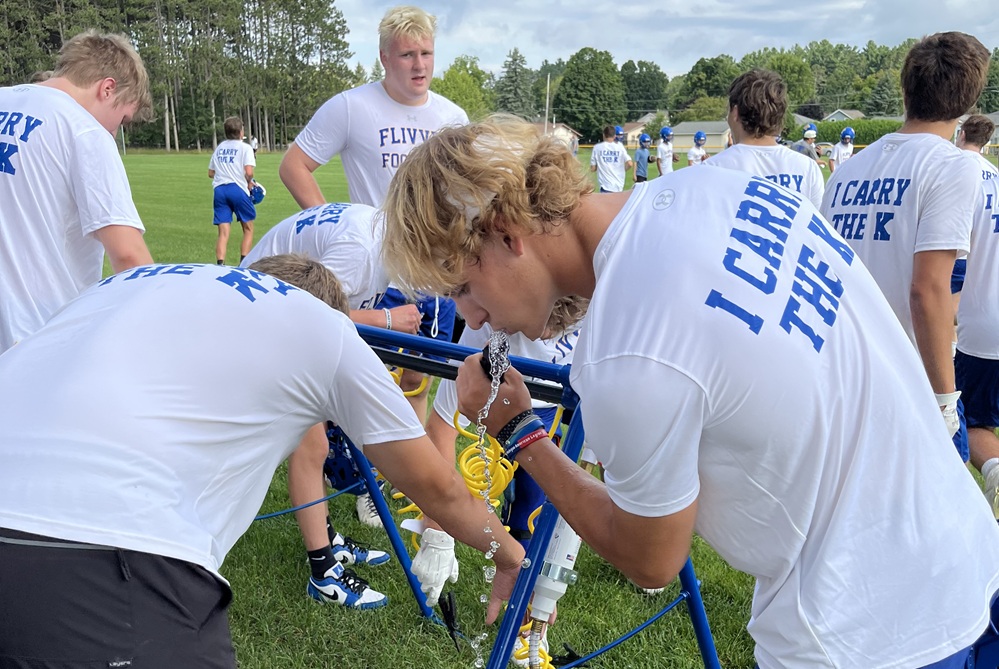
The MHSAA advises student-athletes to make sure to hydrate all day long – beginning before practice, continuing during and also after practice is done. Water and properly-formulated sports drinks are the best choices for hydration. The National Federation of State High School Associations (NFHS) advises that a 6-to-8 percent carbohydrate formulation is the maximum that should be utilized in a sports drink, while fruit juices with greater than 8-percent carbohydrate content and carbonated soda can both result in a bloated feeling and abdominal cramping.
A number of member schools follow the MHSAA’s Model Policy for Managing Heat & Humidity, which while not mandated for member schools was adopted as a rule for MHSAA postseason competition in 2013. The plan directs schools to begin monitoring the heat index at the activity site once the air temperature reaches 80 degrees and provides recommendations when the heat index reaches certain points, including ceasing activities when it rises above 104 degrees. (When the temperature is below 80 degrees, there is no combination of heat and humidity that will result in a need to curtail activity.)
The model heat & humidity policy is outlined in a number of places on the MHSAA Website, including as part of Heat Ways and the football-focused Safety Blitz preseason guide.
PHOTO Kingsford football players hydrate during last season's first day of practice. (Photo by Keith Dunlap.)