Retired MHSAA Executive Director Roberts Selected for NFHS Hall of Fame
By
Geoff Kimmerly
MHSAA.com senior editor
March 8, 2022
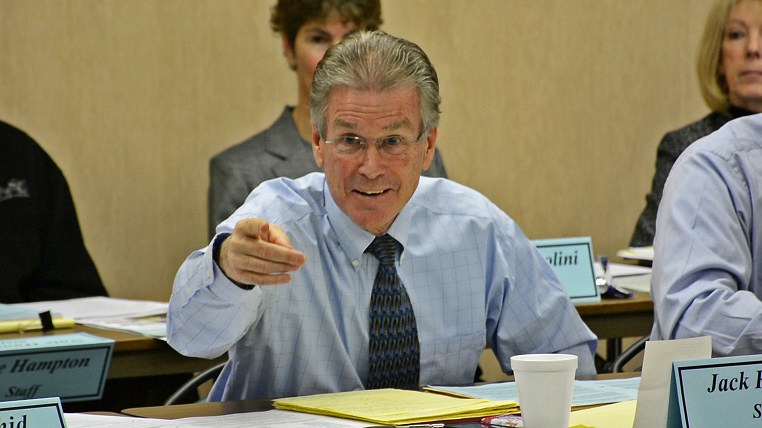
During an award introduction two years ago, MHSAA associate director Tom Rashid described his longtime close friend Jack Roberts as the leader who “took our darkest hours and problems and turned them into positives.”
The MHSAA has faced its share of challenging times, and those may have been among Roberts’ finest hours over 32 years as MHSAA executive director – and admittedly the times when his adrenaline flowed most. But there were many more good times and memorable advances for Michigan school sports under his leadership, and he will be recognized again this summer both for those and a lifetime of service to school sports in this state and across the nation.
John E. “Jack” Roberts was one of 12 honorees announced Tuesday as this year’s inductees into the National High School Sports Hall of Fame by the National Federation of State High School Associations (NFHS). He will be inducted as one of three former state association administrators selected for the 39th Hall of Fame class at a ceremony during the NFHS summer meeting July 1 in San Antonio, Texas.
He began his tenure as MHSAA executive director in 1986, and at the time of his retirement he was the nation’s longest-serving executive director of a state high school athletic association. He was the fourth person to serve the MHSAA in that leadership role full time, following Charles E. Forsythe (1931-42, 1945-68), Allen W. Bush (1968-78) and Vern L. Norris (1978-86).
Roberts will become the Hall of Fame’s ninth inductee from Michigan, joining Forsythe (inducted 1983), River Rouge boys basketball coach Lofton Greene (1986), Warren Regina athletic director, softball and basketball coach Diane Laffey (2000), Fennville basketball and baseball standout Richie Jordan (2001), Grosse Pointe Woods University Liggett boys and girls tennis coach Bob Wood (2005), Bloomfield Hills Cranbrook hockey standout Jim Johnson (2007), Owosso football, basketball and baseball all-stater Brad Van Pelt (2011); and Vermontville Maple Valley baseball national record holder Ken Beardslee (2016).
Roberts also follows in the footsteps of his late father, John Roberts, who served as executive director of the Wisconsin Interscholastic Athletic Association from 1957-85 and was inducted into the National High School Hall of Fame in 2000. They will be the first father-son team in the Hall of Fame.
Jack Roberts began his career serving as an assistant director for the National Federation from 1973-80. He was involved with the implementation of Title IX at the local and state levels and made immense contributions as the NFHS representative to the landmark Amateur Sports Act of 1978, and also played a significant role in the NFHS rules-writing process as the organization started writing and publishing rules for a number of new sports during the 1970s.
The MHSAA enjoyed continued growth under Roberts’ guidance, particularly in the number of Michigan students participating in athletics and in the number of MHSAA-sponsored tournament sports available to them. Several key rules changes came under Roberts’ watch and direction, and he made the MHSAA a national leader in health and safety efforts particularly in the areas of head injury care, heart safety initiatives and heat management strategies.
“I had a head start in this work. Growing up in the home of the executive director of the Wisconsin Interscholastic Athletic Association and then spending most of my 20s working for the National Federation office, and much of it with (longtime NFHS executive director) Cliff Fagan, was a jumpstart on this career,” Roberts said. “But I’m also satisfied at this point that, to paraphrase Hamilton in the musical ‘Hamilton,’ I didn’t give up on my shot. I was given a shot, I took it and I didn’t waste the chance.
“The job fit me, and I think I maxed the opportunity I had to serve educational athletics in this job, and that’s satisfying to think about at this time.”
 Under Roberts’ leadership, overall participation in high school athletics in Michigan increased 10 percent, and the MHSAA added more than 200 schools in increasing its membership by more than 15 percent at the high school and junior high/middle school levels combined. His tenure saw the addition of girls competitive cheer (1994), girls & boys bowling (2004) and girls & boys lacrosse (2005) to the MHSAA Tournament sport lineup, the creation of a separate wrestling tournament to determine champions by team format (1988), and 8-player football (2010, first playoffs 2011) as many small schools across the state began having trouble fielding 11-player teams because of enrollment and population decreases. Meanwhile, also under his leadership, the 11-player Football Playoffs expanded, doubling to 256 teams in 1999.
Among rules changes put in place during Roberts’ tenure was the addition of opportunities for multiple schools to create cooperative teams in sports where participation is lagging. He also helped Michigan become a national leader in improving sportsmanship; a comprehensive package enacted in 1996 set a statewide tone for appropriate behavior and perspective that continues to make an impact today.
Perhaps the most significant influences by Roberts came on the topics of health and safety. The MHSAA has led nationally in concussion care with its first programming in 2000 and return-to-play protocols enacted in 2010, and with mandated concussion reporting and insurance for those who suffer head injuries rolled out in 2015. A heat management policy and CPR requirements for coaches were introduced in 2013.
Also under this leadership, the first program for coaches education was launched in 1987 and evolved into the Coaches Advancement Program, with nearly 34,000 courses administered as part of CAP since 2004-05. The Women in Sports Leadership Conference was created in 1989 and remains the first, largest and longest-running program of its type in the country, regularly drawing upwards of 500 participants. The first of now-annual statewide Athletic Director In-Service Programs was conducted in 1992, and Michigan also remains a national leader in student services thanks to a variety of programs that were introduced under Roberts’ leadership.
Internally, he put the MHSAA on the leading edge nationally when it came to use the technology, especially in the realm of communications, where he put special emphasis on telling the story of school sports. “I think I was considered a conservative as to rules for eligibility and competition, and a progressive in how we delivered services to schools and school sports,” Roberts said.
In addition to his work specifically in Michigan, Roberts carried significant influence at the national level. He served as part of the NFHS Board of Directors and led the creation of the NFHS Network for video productions in 2012, serving as that board’s chairperson. He also has served on the board of directors of the National Association of Sports Officials (NASO).
“For 32 years, Jack Roberts was the epitome of what leadership looks like. He was the strongest advocate for high school sports that anyone could ever hope for,” said MHSAA Executive Director Mark Uyl, who succeeded Roberts in 2018. “He is without question one of the preeminent pioneers and difference-makers in the world of high school sports over the past 100 years.
“And other than my father, there has not been a man who has had a bigger impact and positive influence on my life personally than Jack Roberts.”
The National High School Hall of Fame was started in 1982 by the NFHS, and the rest of this year’s class is made up of athletes, coaches, administrators and an official. The 12 individuals were chosen after a two-level selection process involving a screening committee composed of active high school state association administrators, coaches and officials, and a final selection committee composed of coaches, former athletes, state association officials, media representatives and educational leaders. Nominations were made through NFHS member associations. Also chosen for this class were athletes Notah Begay (New Mexico), Walter Payton (Mississippi), Sanya Richards-Ross (Florida) and Thurman Thomas (Texas); sport coaches Ray Crowe (Indiana), Ron Kordes (Kentucky) and Lamar Rogers (Tennessee); administrators E. Wayne Cooley (Iowa) and Becky Oakes (Missouri), official Jeff Risk (North Dakota) and speech/debate coach Susan McLain (Oregon). (Click for more.)
Roberts came to the MHSAA in 1986 from the Fellowship of Christian Athletes, which he served as executive vice president. He is a 1970 graduate of Dartmouth College and taught English and coached football at high schools in Milwaukee and Denver before joining the NFHS staff.
He and his wife Peggy reside in East Lansing, and in retirement they together have increased their contributions to environmental matters and international refugee issues while both serving in leadership roles. Jack Roberts has served as board president for the Refugee Development Center in Lansing for 13 years, and Peggy Roberts served six years as chairperson of the board for Lansing’s Fenner Nature Center. As part of their environmental work, the Roberts are working within a small group of organizations to help them acquire and preserve land.
Rally Champs 'Survive' Fun-Filled Forest
August 19, 2013
By Geoff Kimmerly
Second Half editor
As one of Michigan’s top high school swimming sprinters, Fenton senior Gabbi Haaraoja no doubt was in strong shape to start this summer.
But she and her Tigers teammates made sure to prepare for this month’s preseason “survival trip” with plenty of miles running and yards swimming a local lake.
All that training paid off during three days and two nights at Pigeon River Country State Forest near Vanderbilt as the team prepared for last week’s first day of practice and a run at a 10th-consecutive league championship.
And the Tigers have kicked off the title effort by being named winners of the MHSAA’s inaugural Prep Rally, a contest that was part of the MHSAA’s PLAY (Preparation Lasts All Year) initiative to encourage athletes to remain active during the offseason so they are prepared physically and acclimated to warm weather when practice begins in the fall.
“Being out in nature, it’s really pretty there. You appreciate it more,” Haaraoja said, then adding some tongue-in-cheek. “It definitely was fun. But it was a lot more work than what we were used to. I think I’m actually glad I’m a senior.”
 Athletes from Grosse Pointe Woods University Liggett and Beal City also were finalists. Participating athletes from Fenton’s girls swimming and diving team will receive tickets to an MHSAA Final of their choice, where they will be recognized for their achievement.
Fenton has taken similar training trips heading into all 14 seasons under coach Brad Jones. Others have included activities like canoeing and dune climbing, The last four years, the team journeyed to El Cortez Beach Resort in Oscoda for some time on Lake Huron together before practice began.
This season’s seniors asked to do something new. And it was a new experience for many in more ways than one.
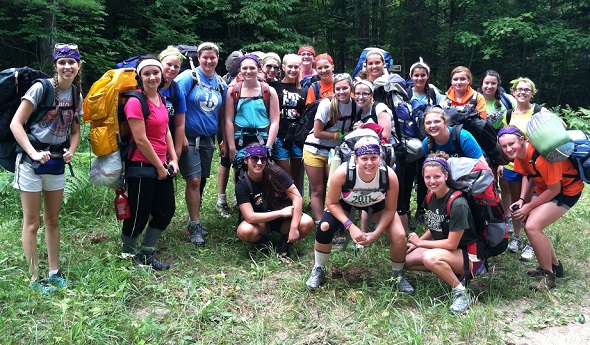
The team left Aug. 11 and returned home two days later in time for the first day of practice. Jones took north 24 athletes, and some had never camped or slept outside. Six seniors made their fourth preseason trip with the team – but for 12 freshmen, this was their first experience as high schoolers.
That team demographic made this summer’s trip especially important for bonding. But it also had a desired effect physically – both heading into this fall and in setting preparation expectations for the future.
Pigeon River Country has 67 miles of trails, and the team hiked four or more miles between camp sites each day – making this the most physically taxing of the trips any of the Tigers had been on to start swimming and diving season.
“We were very up front that in August we’re taking this trip, and you need to be able to go 6-7 miles walking. We put that out there early on,” Jones said. “We have pretty good girls doing what they’re needing to do outside of (swimming) training. (But) we were pretty up front that you don’t put your backpack on and your hiking shoes on for the first time in August.”
Haaraoja said the hikes made it obvious quickly who had prepped during the summer and who needed to catch up. Seniors rotated throughout the line of teammates, so those who began a hike leading the group finished at the back with those working harder to keep in step.
Once in the woods, Jones split his athletes into four teams for a series of challenges that included building their own fires, cooking their own meals (they didn’t receive food until the fire was started) and breaking camp the next day. One trail ran past a small lake, and the athletes swam across it in a relay to earn more points. Another relay-type event involved filling buckets with water.
The challenge champions received ice cream.
“By the time we get home, everybody knows everybody else,” Jones said. “Once we get into training, the top girls are in one lane and the beginners are in another. So there’s not a lot of interaction. But this gives the whole team a chance to get to know each other.”
That’s the part Haaraoja said she’ll remember most fondly, while also appreciating the edge the added physical activity of the summer prep and trip should give the team this fall and in years to come.
“For the underclassmen, they realized where they should be at the beginning of the season next year so they don’t come into it completely out of shape,” Haaraoja said. “It helped our underclassmen learn what our goals were. They know what they’re working for.”
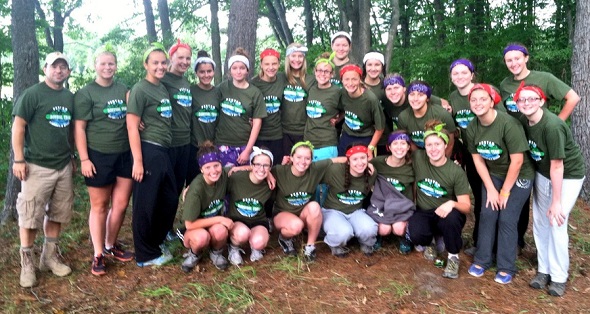
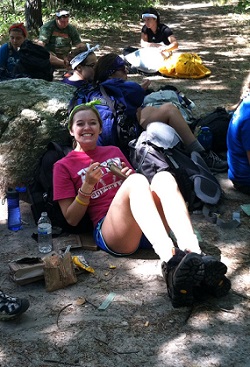
PHOTOS: (Top) Fenton's girls swimming and diving athletes take a moment for a photo during their three-day "survival trip." (Middle) The Tigers take a quick lunch break during a hike at Pigeon River Country State Forest. (Below) The Fenton athletes pose for one more photo wearing their "survivor" T-shirts. (Photos courtesy of Fenton coach Brad Jones.)