


Rules Changes Minimize Health Risks
August 3, 2017
By Geoff Kimmerly
Second Half editor
A pair of football rules changes taking effect this season build on continuing work to minimize health risks in all interscholastic sports as 2017-18 fall practices begin next week for member schools of the Michigan High School Athletic Association.
Practice in football must begin on Aug. 7 for all schools wishing to begin regular-season games the weekend of Aug. 24-26. Schools must have 12 days of preseason practice at all levels before their first game, over a period of 16 calendar days before the first kickoff.
Practice sessions for all other sports begin Wednesday (Aug. 9). In golf and tennis, competition may commence no earlier than after three separate days of team practice, and not before seven calendar days. The first day competition may take place in golf and tennis is Aug. 16. In all other fall sports, contests can take place after seven days of practice for the team and not before nine calendar days. The first day competition may take place in cross country, soccer, swimming & diving, and volleyball is Aug. 18.
This fall, two football game dates again precede Labor Day, and a number of MHSAA schools will play their first varsity games on Thursday, Aug. 24. In Week 1, 141 varsity games will be played on Thursday, 153 contests will be played on Friday, and 16 games will be played on Saturday. In the second week, four games will be played Wednesday, 238 games will take place Thursday, 64 will be played Friday, and five contests are Saturday.
A change to the allowable level of contact on a blindside block in football is one of the latest rules changes aimed at increasing player safety. A blindside block involves contact by a blocker against an opponent who, because of physical positioning and focus of concentration (for example, while following a ball carrier on a kickoff return), is vulnerable to injury by a block coming from outside his field of vision. Blindside blocks now must be initiated with open hands only; blindside contact that is forceful and initiated with other parts of the body outside of the free blocking zone will be penalized as excessive and unnecessary.
In addition to redefining the blindside block, the National Federation of State High School Associations (NFHS) sought to also minimize risk by eliminating the pop-up kick – that is, any free kick during which the kicker drives the ball immediately to the ground, causing it to bounce only once and into the air similar to the flight of a ball kicked directly off the tee. Kicks off a tee that bounce multiple times and then pop into the air remain allowed.
A few other notable rules changes in football will be apparent this fall:
• A defensive player will be called for encroachment for striking the offensive snapper’s hand or arm, or the ball, prior to the snapper releasing the ball to begin a play.
• Non-contact face guarding is no longer considered pass interference.
• A team accepting a penalty during the final two minutes of either half now will have the option of re-starting the clock at the snap of the ball rather than the referee’s ready-for-play signal.
While most fall sports face at least minor rules changes this season, a few more of the most noticeable adjustments will come in boys soccer and girls swimming & diving.
• In boys soccer, overtime periods and shootouts during the regular season have been eliminated. Leagues and conferences are allowed an overtime option for their end-of-season bracketed tournaments, but overtime in those cases must not exceed two 10-minute periods plus a shootout. Multi-team regular-season tournaments also may receive waivers to employ a shootout if it is used to determine the winner of a game.
• Also in soccer, kickoffs may now travel in any direction from the center of the field. Previously, kickoffs at the high school level were required to move forward down the field of play.
• In girls swimming & diving, a diver will need only four regular-season wins (instead of the previous five) to qualify for the Regional Diving Qualification Meet. A diver also may qualify if she places ahead of all divers from opposing schools in varsity competition in at least four meets, even if she does not finish ahead of her teammates.
• Also in swimming & diving, to promote safer take-offs during relays, the second, third and fourth swimmers must have at least one foot in contact with the starting platform in front of the starting block wedge during take-off. Those second, third and fourths swimmers may not take off with both feet on top of the starting block wedge.
The 2017 fall campaign culminates with postseason tournaments beginning with the Upper Peninsula Girls Tennis Finals the week of Sept. 25 and wraps up with the 11-Player Football Playoff Finals on Nov. 24 and 25. Here is a complete list of fall tournament dates:
Cross Country
U.P. Finals – Oct. 21
L.P. Regionals – Oct. 27 or 28
L.P. Finals – Nov. 4
11-Player Football
Selection Sunday – Oct. 22
Pre-Districts – Oct. 27 or Oct. 28
District Finals – Nov. 3 or 4
Regional Finals – Nov. 10 or 11
Semifinals – Nov. 18
Finals – Nov. 24-25
8-Player Football
Selection Sunday – Oct. 22
Regional Semifinals – Oct. 27 or Oct. 28
Regional Finals – Nov. 3 or 4
Semifinals – Nov. 11
Finals – Nov. 17
L.P. Girls Golf
Regionals – Oct. 11 or 12 or 13 or 14
Finals – Oct. 20-21
Soccer
Boys L.P. Districts – Oct. 16-21
Boys L.P. Regionals – Oct. 24-28
Boys L.P. Semifinals – Nov. 1
Boys L.P. Finals – Nov. 4
L.P. Girls Swimming & Diving
Diving Regionals – Nov. 9
Swimming/Diving Finals – Nov. 17-18
Tennis
U.P. Girls Finals – Sept. 27-30
L.P. Boys Regionals – Oct. 12 or 13 or 14
L.P. Finals – Oct. 20-21
Girls Volleyball
Districts – Oct. 30-Nov. 4
Regionals – Nov. 7 & 9
Quarterfinals – Nov. 14
Semifinals – Nov. 16-17
Finals – Nov. 18
Participation Stays Above Enrollment Dip
July 13, 2017
By Geoff Kimmerly
Second Half editor
Enrollment in Michigan High School Athletic Association member high schools continued a trend of slight declines in 2016-17, but participation in sports held firm as records were set in three of the 28 sports for which postseason tournaments are sponsored by the MHSAA.
A total of 283,625 participants competed in MHSAA-sponsored sports this past school year, down 0.21 percent from 2015-16. However, this year’s decrease falls in line with a decrease in enrollment at member schools of 0.40 percent. The overall MHSAA participation totals count students once for each sport in which they participate, meaning students who are multiple-sport athletes are counted more than once.
Despite a drop in girls enrollment of 0.60 percent in 2016-17, girls participation increased for the second straight school year to 119,937 participants, an increase of 0.55 percent. Boys overall participation fell 0.76 percent to 163,688 participants, slightly sharper than the drop in boys enrollment of 0.21 percent for the school year. However, eight girls sports and eight boys sports saw increases in participation in 2016-17.
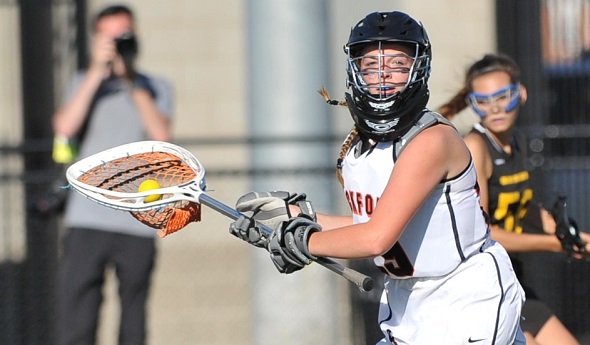
Boys and girls lacrosse continued their record-setting climb, boys lacrosse with 5,114 participants to increase 3.3 percent from 2015-16 and break its record set in 2013-14. Girls lacrosse saw 2,814 participants, an increase of 1.4 percent from the previous year, to continue its streak of setting a participation record every season since becoming a sponsored tournament sport in 2005. Boys cross country also set a record for the second straight season, this time with an increase of 1.7 percent to 9,415 participants total.
Good news also came from girls basketball, which ended a string of 10 straight declines in participation with an increase of 2.2 percent in 2016-17 – those 15,896 participants were the most in the sport since 2013-14. The largest percentage increases by far in 2016-17 were seen in boys and girls skiing, which were up 16.4 and 14.4 percent, respectively, with 837 boys participants and 746 girls after both experienced decreases in participation the school year before.
A number of other sports also saw increases on both the boys and girls’ sides: swimming & diving saw a 5.2 percent increase for boys and 4.1 increase for girls, track & field saw a 2.4 percent increase for girls and 1.9 percent increase for boys, girls cross country joined its boys counterpart with a 1.0 percent increase in participation, and tennis saw a 2.8 percent increase for girls and 0.48 increase for boys. That boys tennis increase ended a string of seven straight years of declining participation.
Other sports to see increases in 2016-17 were girls golf, increasing for the second straight season, this time 2.9 percent to 3,561 participants; boys ice hockey, up 1.8 percent to 3,411 participants; and boys soccer up 0.38 percent to 14,630 participants.
Also of note in this year’s survey:
• The increase in participation for 16 sports during 2016-17 was compared to an increase in 15 sports for 2015-16 and only eight sports in 2014-15.
• After a significant slowing in participation decline in football over the previous three years, 2016-17 saw a decline of 4.6 percent, or 1,805 participants from 2015-16. The number of school-sponsored football programs remained consistent over the last two years – there were 642 in 2015-16 and 640 in 2016-17 (up from 630 in 2014-15). But there was a shift of programs from 11-player to 8-player; there were 15 fewer 11-player programs in 2016-17 than the year before, but 13 more 8-player programs.
• Of the 12 MHSAA sports that saw participation declines in 2016-17, three were by mere hundredths of a percent. Boys wrestling saw a decline of three participants total, girls gymnastics had two fewer participants and boys golf participation decreased by one person.
The participation figures are gathered annually from MHSAA member schools to submit to the National Federation of State High School Associations for compiling of its national participation survey. Results of Michigan surveys from the 2000-01 school year to present may be viewed by clicking here.
The following chart shows participation figures for the 2016-17 school year from MHSAA member schools for sports in which the Association sponsors a postseason tournament:
|
BOYS |
GIRLS |
|||
SPORT |
SCHOOLS (A) |
PARTICIPANTS |
SCHOOLS (A) |
PARTICIPANTS (B) |
|
Baseball |
635/656/6 |
17,989 |
- |
0/9 |
|
Basketball |
722/735/1 |
21,263 |
690/725 |
15,896/4 |
|
Bowling |
363/381/10 |
3,792 |
341/369 |
2,926/24 |
|
Competitive Cheer |
- |
- |
334/349 |
6,720 |
|
Cross Country |
618/649/0 |
9,415 |
609/646 |
8,489 |
|
Football - 11 player |
580/592/87 |
36,460 |
- |
0/111 |
|
- 8-player |
60/61/11 |
1,130 |
- |
14 |
|
Golf |
496/526/59 |
6,170 |
329/342 |
3,561/100 |
|
Gymnastics |
- |
- |
72/88 |
636 |
|
Ice Hockey |
233/257/14 |
3,397 |
|
0/14 |
|
Lacrosse |
147/153/3 |
5,110 |
107/107 |
2,814/4 |
|
Skiing |
92/102/3 |
830 |
89/103 |
746/7 |
|
Soccer |
481/499/23 |
14,541 |
459/483 |
13,212/89 |
|
Softball |
- |
- |
616/646 |
13,641 |
|
Swimming & Diving |
243/274/12 |
4,919 |
256/283 |
5,600/60 |
|
Tennis |
293/309/9 |
6,085 |
327/341 |
8,920/21 |
|
Track & Field |
655/683/0 |
23,232 |
648/681 |
17,009/0 |
|
Volleyball |
- |
- |
704/720 |
19,067 |
|
Wrestling |
459/483/159 |
9,355 |
- |
0/2 |
(A) The first number is the number of schools reporting sponsorship on the Sports Participation Survey. The second number indicates schools sponsoring the sport including primary and secondary schools in cooperative programs as of May 22, 2017. The third number indicates the number of schools that had girls playing on teams consisting primarily of boys.
(B) The second number indicates the number of additional g