


Scholar-Athlete Finalists Announced
By
Geoff Kimmerly
MHSAA.com senior editor
January 25, 2013
The 120 finalists for the Michigan High School Athletic Association's Scholar-Athlete Award for the 2012-13 school year have been announced.
The program, which has been recognizing student-athletes since the 1989-90 school year, will honor 32 individuals from MHSAA member schools who participate in at least one sport in which the Association sponsors a postseason tournament. Farm Bureau Insurance underwrites the Scholar-Athlete Award, and will present a $1,000 scholarship to each recipient. Since the beginning of the program, 576 scholarships have been awarded.
Scholarships will be presented proportionately by school classification, with 12 scholarships to be awarded to Class A student-athletes, six female and six male; eight scholarships will be awarded to Class B student-athletes, four female and four male; six scholarships will be awarded to Class C student-athletes, three female and three male; and four scholarships will be awarded to Class D student-athletes, two female and two male. In addition, there also will be two at-large honorees which also are part of the general judging process, may come from any classification, and are designated by their school at the time of entry.
Every MHSAA member high school could submit as many applications as there are scholarships available in its classification, and could have more than one finalist. Saline has five finalists this year, while Kalamazoo Hackett and Muskegon Mona Shores have three. Eleven schools each had two finalists: Ann Arbor Gabriel Richard, Comstock Park, Grosse Ile, Hillsdale Academy, Macomb Dakota, Okemos, Oxford, Portland, Rock Mid-Peninsula and Sand Creek.
Multiple-sport participation remains the norm among applicants. The average sport participation rate of the finalists is 2.48, while the average of the application pool was 2.16 – both within a tenth of last year’s rates in those categories. There are 59 three-plus sport participants in the finalist field, and all but one of the 28 sports in which the MHSAA sponsors postseason tournaments are represented.
Of 409 schools which submitted applicants, 54 submitted the maximum allowed. This year, 1,675 applications were received. All will be presented with certificates commemorating their achievement. Additional Scholar-Athlete information, including a complete list of scholarship nominees, can be found on the MHSAA Website.
The applications were judged by a 66-member committee of school coaches, counselors, faculty members, administrators and board members from MHSAA member schools. Selection of the 32 scholarship recipients will take place in early February. Class C and D scholarship recipients will be announced on February 5; Class B scholarship recipients will be announced on February 12, and Class A scholarship recipients will be announced on February 19. All announcements will be made on the MHSAA Website.
To honor the 32 Scholar-Athlete Award recipients, a ceremony will take place during halftime of the Class C Boys Basketball Final, March 23, at the Breslin Student Events Center in East Lansing.
To be eligible for the award, students must have a cumulative grade point average of 3.50 (on a 4.0 scale), and previously have won a varsity letter in at least one sport in which the MHSAA sponsors a postseason tournament. Students also were asked to respond to a series of short essay questions, submit two letters of recommendation and submit a 500-word essay on the importance of sportsmanship in educational athletics.
Farm Bureau Insurance, one of Michigan's major insurers, has a statewide force of more than 400 agents serving more than 380,000 Michigan policyholders. Besides providing life, home, auto, farm, business and retirement insurance, the company also sponsors life-saving, real-time Doppler weather tracking systems in several Michigan communities.
2012-13 Scholar-Athlete Award Finalists
BOYS CLASS A
Marcus William Barnett, St Clair Shores Lake Shore
Connor James Bos, Holland
Andrew Camp, Midland Dow
Bryan Condra, Hartland
Jarrod Eaton, St. Johns
Tristan Eggenberger, Okemos
Alex Fauer, Macomb Dakota
Thomas Greidanus, Grand Rapids Christian
Kalvis Hornburg, Traverse City Central
Reed Hrynewich, Muskegon Mona Shores
Austin Jones, Bay City Central
Tyler Scott Kemerer, Saginaw Heritage
Anthony Lamus, Saline
Jacob J. Presto, Orchard Lake St Mary's
Charles Robert Proctor, Bay City Western
David Read, Midland Dow
Harrison Schurr, Jenison
Jeremy Simon, Richland Gull Lake
Jonathan Sollish, Berkley
Thomas Spicuzza, Oxford
Jason Vander Horst, Milford
Kevin W. Walsh, Detroit Catholic Central
Pierce Watson, Lowell
Adam Whitener, Saline
GIRLS CLASS A
Kristy Allen, East Grand Rapids
Casie Ammerman, Ann Arbor Huron
Jacqueline Burke, Troy
Francesca Ciaramitaro, Grosse Pointe North
Lara Fawaz, Dearborn
Kayla Giese, Macomb Dakota
Morgan Alexandria Gilliam, North Farmington
Kristin Nicole Green, Saline
Sarah Gutknecht, Farmington
Kelly Hall, Saline
Hailey Hrynewich, Muskegon Mona Shores
Jessica Kalbfleisch, Traverse City West
Jillian Klein, Muskegon Mona Shores
Brooke Kovacic, Oxford
Teresa LaForest, St. Joseph
Elizabeth Michno, Macomb L'Anse Creuse North
Kelly Raterink, Zeeland East
Roxanne Raven, Okemos
Kerigan Riley, Livonia Churchill
Haley Schaafsma, Riverview
Carley Serowoky, Waterford Kettering
Kendall Tamler, Birmingham Seaholm
Reinie Thomas, Portage Central
Lindsay Walter, Saline
BOYS CLASS B
Michael Azzopardi, Detroit Country Day
Michael Broderick, Pontiac Notre Dame Prep
Brice Brown, Ionia
Michael Chickeral, Flat Rock
Thomas D. Finch, Otsego
Alec Robert Fisher, Battle Creek Harper Creek
Mark Gibson, Freeland
Patrick Gifford, Haslett
Andrew Hammond, Grand Rapids Forest Hills Eastern
Michael Heinrich, Ludington
Luke James Hurst, Ovid-Elsie
Matthew Liu, Bloomfield Hills Cranbrook-Kingswood
Adam Olszewski, Ann Arbor Gabriel Richard
Scott Parkinson, Grayling
Keeton Thayer Ross, Grosse Ile
Ryan Schall, Comstock Park
GIRLS CLASS B
Brittany Beeler, Spring Lake
Ashley M. Carney, Jackson Northwest
Kelsi Caywood, Sturgis
Amanda Ciancio, Comstock Park
Morgan Kathleen Cinader, Goodrich
Mary Emington, Cadillac
Hannah C. Engle, Adrian
Nicole L. Green, Portland
Haley June Obetts, Wayland Union
Molly Oren, Hamilton
Catherine Polgar, Grosse Ile
Emily Quinn, Portland
Florence Ann Sobell, Croswell-Lexington
Anjali Sood, Ann Arbor Gabriel Richard
Megan Taylor, Houghton Lake
Shelby Walsh, Livonia Ladywood
BOYS CLASS C
Brian Christopher Aldrich, Kalamazoo Hackett
Jesse Anderson, Union City
Kenner Broullire, Manistique
Jesse Corbat, Breckenridge
Parker Eldred, Blanchard Montabella
Ashwin Fujii, Ann Arbor Greenhills
Zachary A. Kerr, Saugatuck
Connor Lockman, Royal Oak Shrine Catholic
Mike O'Brien, Maple City-Glen Lake
Elliott Rains, Sand Creek
Quinton Rice, Marcellus
Luke Schaffner, Clinton
GIRLS CLASS C
Alyssa R. Briolat, Ubly
Kara Craig, Schoolcraft
Lindsey Dopheide, Lawton
Margaret Elizabeth Durbin, Boyne City
Macayla Geiner, Hart
Natalie Perry, Sand Creek
Theresa Pickell, Reese
Abigail Radomsky, Kalamazoo Hackett
Kylei Ratkowski, Bronson
Faith Schroeder, Saginaw Michigan Lutheran Seminary
Grace Smith, Kalamazoo Hackett
Nicole Winter, Watervliet
BOYS CLASS D
Charles Barchett, Watervliet Grace Christian
Charles A. Blood, Hillsdale Academy
Brett Branstrom, Rock-Mid Peninsula
Matthew R. Katz, Tekonsha
Alexander G. Knight, Lake Linden-Hubbell
Francisco Jay Noyola, Lansing Christian
Joseph Samuel Paquette, Munising
Hunter Selby, Genesee Christian
GIRLS CLASS D
Anna Marie Couture, Posen
Sarah Cullip, St. Ignace
Erica LeClaire, Dollar Bay
Elyse Kathleen Lisznyai, Hillsdale Academy
Elena Victoria Luce, Mason County Eastern
Christina Smith, Gaylord St. Mary
Kari L. Steenwyk, Ellsworth
Krysta M. VanDamme, Rock-Mid Peninsula
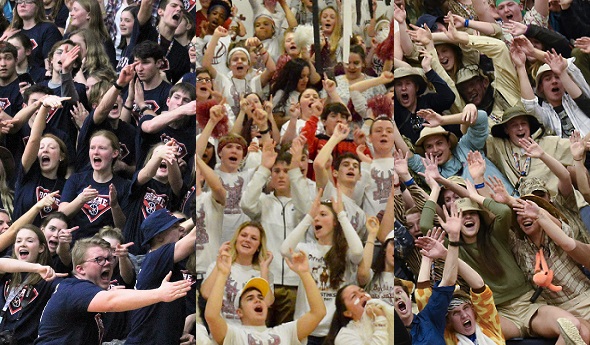
Battle of the Fans VII: Vote Now
February 19, 2018
By Geoff Kimmerly
Second Half editor
Three finalists have shown us this month why they should win the Battle of the Fans VII championship.
 But we need your help deciding which should be called the state's best student cheering section for 2017-18.
Vote today through 4 p.m. Thursday on your favorite of these three (enrollments in parentheses) – Boyne City (429), Buchanan (420) and Petoskey (941) – by liking, sharing and re-tweeting on the MHSAA’s Facebook, Twitter and Instagram sites
But before you do, take a few minutes to watch all three videos and read the stories behind the sections by clicking the links below.
The contest is sponsored by the MHSAA Student Advisory Council, which will have the final vote on the champion. SAC members will use all resources available to make their decision – including giving significant weight to the public social media vote. Votes will be valued proportionate to the size of the school receiving them (for example, one vote for Class B Boyne City or Buchanan will be worth more than one vote for Class A Petoskey).
The champion will be announced Friday on Second Half. All three finalists will be invited to Michigan State University's Breslin Center on March 23 for the Class B Boys Basketball Semifinals, and the winner will be presented with a championship banner at center court.
And now, the finalists, in alphabetical order:
Boyne City
Read all about it: Boyne City Wants You to Get Rowdy
Buchanan
Read all about it: No Place Buchanan's Herd Would Rather Be
Petoskey
Read all about it: Revived Blue Crew Continues to Thrive