

Stoney Creek Leaders Speak Up to Save Lives
May 26, 2017
By Geoff Kimmerly
Second Half editor
The crowd for Rochester Hills Stoney Creek’s boys basketball game against rival Rochester was as rowdy as could be hoped for most of the evening Feb. 28.
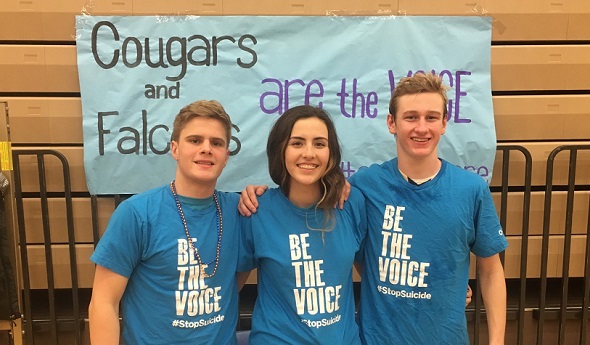
 But it fell silent during halftime as Stoney Creek juniors Nate Davis, Kevin Price and Isabella Ubaydi spoke of how suicide had affected them and their community.
A student had committed suicide every year during their high school careers – including Price’s brother just six months before.
All three are members of the school’s Cougar Athletic Leadership Council, which put on the Suicide Prevention Awareness basketball game not only to raise money for the American Foundation for Suicide Prevention, but also to start the conversation on a sensitive topic that has hit home.
“We wanted to get the word out that it’s OK to talk about these issues – help the topic get out of the dark,” Ubaydi said.
“It was insane. It was awesome. There were so many people. Our student section area where we all sit was filled up to the top row. There were a lot of people from the community who didn’t go to Stoney Creek, or have alumni (associated with the school) or anything like that. But they were at Stoney Creek, and it was great to show people actually care in our community.”
The leadership council is a club made up of Stoney Creek athletes who coordinate special events, including for athletics, with an eye especially on helping the community’s youth, elderly and those with disabilities. Ubaydi, Price and Davis are co-chairs of the CALC’s special events committee.
The tragic circumstances of the last three years led the group to bring suicide prevention to the forefront. While Ubaydi spoke mostly about why the event was held and how donations would be spent, Price and Davis (Price’s best friend) talked about how suicide had affected them personally. “You could hear a pin drop,” Ubaydi said. “After we were done, (the crowd) gave a standing ovation.”
CALC raised nearly $3,500 selling T-shirts that also included free student admission to the game. After Ubaydi, Price and Davis spoke, buckets were passed through the crowd during a “miracle minute” and filled with another $1,200.
All profits from the night, including $500 from concessions, were donated to the American Foundation for Suicide Prevention, and Ubaydi said the $1,000 from the Community Service Award also will be sent to AFSP.
She’s since heard stories from teachers of classmates coming forward to express worries about people in their lives, a sign awareness is paying off. At the same time, Ubaydi and her co-chairs are just as concerned about people who didn’t attend the Suicide Prevention Awareness game and might be experiencing troubles in their lives – but the hope is the event spoke loudly enough to be heard by anyone who needs help.
All three leaders are juniors beginning to contemplate their futures after high school; Ubaydi is leaning toward Roanoke College in Virginia to study political science and minor in theology, while Price is considering Michigan State to study environmental science and Davis is looking at options for pre-law or political science. They hope to host the suicide prevention event again as seniors before they graduate, with future CALC students then carrying on the mission.
“Suicide is an uncomfortable topic to talk about. Since people saw us relating to how it has affected us personally, the community will become comfortable discussing mental illnesses together,” Ubaydi wrote in CALC’s award application.
“I wanted to have this event so people understand that the influence that one person can make may be life-changing. This then causes them to be there for others, see the signs quicker, and save more lives.”
PHOTO: (Top) Cougar Athletic Leadership Council leaders Kevin Price, Isabella Ubaydi and Nate Davis show their shirts from the school’s Suicide Prevention Awareness night. VIDEOS: (Top) State Champs! Network covered the event and interviewed its organizers. (Below) Davis, Ubaydi and Price speak during halftime, also filmed by State Champs! Network.
2017 Community Service Awards
Sunday: Colon "Yard Squad" - Read
Monday: Bailey Brown, Brighton - Read
Tuesday: Justice Ottinger, Newaygo - Read
Thursday: Katie Sesi, Ann Arbor Huron - Read
Friday: Nikki Sorgi, Utica Ford - Read
Friday: Cougar Athletic Leadership Council, Rochester Hills Stoney Creek - Read

Scholar-Athlete Applications Available
By
Geoff Kimmerly
MHSAA.com senior editor
October 22, 2014
By Geoff Kimmerly
Second Half editor
One of the Michigan High School Athletic Association’s most popular programs, the Scholar-Athlete Award, will again present 32 $1,000 scholarships to top student-athletes at member high schools during the 2014-15 school year.
 The MHSAA-Farm Bureau Insurance Scholar-Athlete Award highlights the value extracurricular activities play in the total education of high school students, often improving their academic achievements in the process. The Scholar-Athlete Award is in its 26th year. Since the award’s inception in 1988-89, Farm Bureau Insurance has presented more than $640,000 in scholarships through this program.
The first 30 scholarships will be presented on a graduated basis across the MHSAA’s traditional class structure. From Class A schools, six boys and six girls will receive scholarships; from Class B schools, four boys and four girls; from Class C schools, three boys and three girls; and from Class D schools, two boys and two girls will be honored. The final two scholarships will be awarded at-large to minority recipients, regardless of school size. The scholarships may be used at the institution of higher learning the recipients attend during the first year at those colleges.
Applications from individual schools will be limited to the number of available scholarships in their enrollment class. Class A schools may submit the names of six boys and six girls, Class B schools may submit four boys and four girls, Class C may submit three boys and three girls and Class D may submit two boys and two girls.
Students applying for Scholar-Athlete Awards must be graduating during the 2014-15 school year, be carrying an unrounded 3.5 (on a 4.0) grade-point average and have won a varsity letter prior to senior year in a sport in which the MHSAA sponsors a postseason tournament: baseball, girls and boys basketball, girls and boys bowling, girls competitive cheer, girls and boys cross country, football, girls and boys golf, girls gymnastics, ice hockey, girls and boys lacrosse, girls and boys skiing, girls and boys soccer, softball, girls and boys swimming and diving, girls and boys tennis, girls and boys track and field, girls volleyball and wrestling.
Applicants will be required to show involvement in other school and community activities and submit an essay on the importance of sportsmanship in educational athletics.
Applications are available only in digital format. The downloadable forms on the MHSAA Website need only be saved to a computer, filled out in nearly any word processing program – in Windows or Macintosh platforms – and then printed to be attached to the required essay and letters of recommendation. Students must submit their applications to their school athletic director, principal or guidance counselor by Nov. 24, 2014. Students should check with their school administration to determine who the internal coordinator for the program is, and if the school has an earlier internal application deadline. Schools have additional materials to submit with student applications, and each school must submit all of its applications at one time. Individually mailed applications to the MHSAA office will not be accepted.
Click for application materials available online on the Scholar-Athlete Award page of the MHSAA Website.
A committee composed of school administrators from across the state will select finalists and winners in early February, with the winners to be announced later in the month. All applicants, finalists and scholarship recipients will be announced on the MHSAA Website. The 32 scholarship recipients will be recognized during the MHSAA Boys Basketball Finals at the Breslin Student Events Center in East Lansing on March 28, 2015.
Farm Bureau Insurance, one of Michigan's major insurers, has a statewide force of 450 agents serving nearly 500,000 Michigan policyholders. Besides providing life, home, auto, farm, business and retirement insurance, the company also sponsors life-saving, real-time Doppler weather tracking systems in several Michigan communities.
The MHSAA is a private, not-for-profit corporation of voluntary membership by more than 1,400 public and private senior high schools and junior high/middle schools which exists to develop common rules for athletic eligibility and competition. No government funds or tax dollars support the MHSAA, which was the first such association nationally to not accept membership dues or tournament entry fees from schools. Member schools which enforce these rules are permitted to participate in MHSAA tournaments, which attract more than 1.4 million spectators each year.