


Tournament Attendance Tops 1.4 Million
September 17, 2013
By Geoff Kimmerly
Second Half editor
The 2012-13 school year marked the sixth straight that attendance at Michigan High School Athletic Association postseason tournaments totaled more than 1.43 million fans, with attendance at girls tournaments topping 430,000 for the fourth straight year.
Total attendance for 2012-13 was 1,433,356 fans, with 1,002,663 at boys tournaments and 430,693 spectators at girls tournaments. Attendance is kept for all sports except golf, skiing and tennis, for which admission typically is not charged.
Girls tournament attendance first topped 400,000 for a school year in 2008-09, then rose over 430,000 for the first time the following year. Helping fuel the total in 2012-13 was a record crowd of 25,290 for competitive cheer (District, Regional and Final rounds combined), and also a record attendance of 12,508 for the girls and boys bowling tournament.
Total attendance did dip slightly in 2012-13, down from 1,479,152 the year before, a drop of 3.1 percent and the lowest since 2006-07. However, four sports joined cheer and bowling with attendance increases from 2011-12 – girls basketball up 4.8 percent to 166,153 fans, gymnastics up 16.8 percent to 2,290, team wrestling up 1.2 percent to 28,863 and ice hockey up 6.5 percent with 59,037 fans this past season.
Football again was the most attended tournament for the sixth consecutive year with 397,944 fans in 2012 – although that represented a 7.3 percent drop from the 2011 playoffs. However, the Regional (5.6 percent) and Semifinal (6.3) rounds both saw increases in fans from the previous season.
Similarly, boys basketball again was second in attendance with 318,325 fans, despite a 1.4 percent decrease from 2011-12. However, the District, Regional and Quarterfinal rounds showed a combined increase of 2.4 percent over the previous season. Girls basketball attendance increased in every round from 2011-12 for an overall increase of 4.8 percent. The Finals weekend total, including semifinals and championship games for each class, was 19,003, the highest since 1992-93.
Girls lacrosse total attendance dropped 9.7 percent to 5,009 fans, but still totaled its second most as an MHSAA sport and set records for Semifinals (1,027) and Finals (1,171) attendance. Volleyball attendance (96,151) remained above 96,000 fans for the fourth consecutive year despite falling 3.2 percent from its 2011-12 record high. Girls soccer dropped less than half a percent from 2011-12 to 26,836 fans, but set a Regional round record with 10,574.
Awards Honor Those Lending a Hand
April 12, 2017
By Geoff Kimmerly
Second Half editor
Sports often make up a significant, although singular part of the lives of Michigan’s high school student-athletes and coaches.
 Many also find ways to have significant impacts on the lives of others – and we’d like to tell the rest of our state how they’re making a difference.
The Michigan High School Athletic Association, together with Lake Trust Credit Union, will award this spring the inaugural Community Service Awards to recognize individuals and teams that have worked to benefit their communities.
Each winner will receive a $1,000 award to be applied toward an individual college scholarship, credited to a team’s account with its athletic department or even gifted to the group helped by our honoree.
Please help us get the word out. Encourage a student, coach or administrator to tell us about a completed or ongoing community service project. Any student, team or coach currently participating in interscholastic athletics at an MHSAA member high school can apply. Applications should be e-mailed both to the school’s athletic director and MHSAA’s Kurt Tiesman at [email protected].
The deadline for applications is May 1, and multiple winners will be selected and notified by May 12. Click for more information.
We hear and read about these contributions and successes throughout the school year. Thank you in advance for your help in allowing us to honor some of this great work in the community by those who also shine on the field.
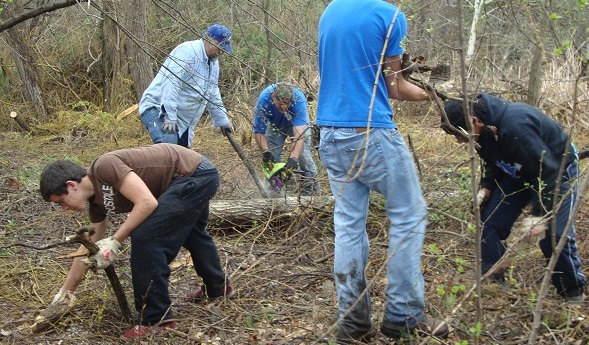
PHOTO: Members of the Adrian boys track & field team help clean up after a tornado in Dexter in 2012.