


Use of Participate Fees Falls in 2016-17
July 20, 2017
By Geoff Kimmerly
Second Half editor
Just under half of high schools responding to an annual Michigan High School Athletic Association survey assessed participation fees to help fund interscholastic athletics in 2016-17, making it the first school year since 2009-10 that fewer than 50 percent of respondents reported not charging student-athletes to play sports.
The survey, completed by 557 high schools – or 74 percent of the MHSAA membership – showed 49.7 percent charged participation fees, down from 51.5 percent in 2015-16.
There were 750 senior high schools in the MHSAA membership in 2016-17. This was the 13th survey of schools since the 2003-04 school year, when members reported fees were charged by 24 percent of schools. The percentage of member schools charging fees crossed 50 percent in 2010-11 and reached a high of 56.6 percent in 2013-14.
Class A schools remained the largest group charging fees, as 70 percent of respondents did so in 2016-17 and at least 70 percent have charged for the last five years. Class B schools ticked up to 52 percent charging fees, but Class C (42 down from 49 percent) and Class D (35 down from 38 percent) both reported lower percentages of schools charging fees.
Charging a standardized fee for each team on which a student-athlete participates – regardless of the number of teams – remains the most popular method among schools assessing fees, with that rate at 44 percent of schools that assessed fees for the second straight year. Schools charging a one-time standardized fee per student-athlete rose slightly, from 27 to 31 percent over the last year. Also for the second straight year, the survey showed a slight decrease in schools assessing fees based on tiers of the number of sports a student-athlete plays (for example, charging a larger fee for the first team and less for additional sports) and also a slight decrease in fees being assessed based on the specific sport being played.
The amounts of most fees also remained consistent from 2015-16 to 2016-17: the median annual maximum fee per student at $150, the median annual maximum family fee at $300 and the median per-team fee at $75 – all for at least the third straight year. The median fee assessed by schools that charge student-athletes once per year increased again, but only $5 to $125 after showing a $20 increase per student-athlete between 2014-15 and 2015-16.
The survey for 2016-17 and surveys from previous years can be found on the MHSAA Website by clicking here.
The MHSAA is a private, not-for-profit corporation of voluntary membership by more than 1,400 public and private senior high schools and junior high/middle schools which exists to develop common rules for athletic eligibility and competition. No government funds or tax dollars support the MHSAA, which was the first such association nationally to not accept membership dues or tournament entry fees from schools. Member schools which enforce these rules are permitted to participate in MHSAA tournaments, which attract more than 1.4 million spectators each year.
Participation Stays Above Enrollment Dip
July 13, 2017
By Geoff Kimmerly
Second Half editor
Enrollment in Michigan High School Athletic Association member high schools continued a trend of slight declines in 2016-17, but participation in sports held firm as records were set in three of the 28 sports for which postseason tournaments are sponsored by the MHSAA.
A total of 283,625 participants competed in MHSAA-sponsored sports this past school year, down 0.21 percent from 2015-16. However, this year’s decrease falls in line with a decrease in enrollment at member schools of 0.40 percent. The overall MHSAA participation totals count students once for each sport in which they participate, meaning students who are multiple-sport athletes are counted more than once.
Despite a drop in girls enrollment of 0.60 percent in 2016-17, girls participation increased for the second straight school year to 119,937 participants, an increase of 0.55 percent. Boys overall participation fell 0.76 percent to 163,688 participants, slightly sharper than the drop in boys enrollment of 0.21 percent for the school year. However, eight girls sports and eight boys sports saw increases in participation in 2016-17.
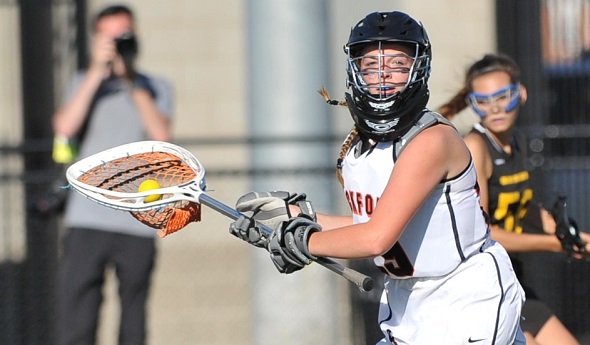
Boys and girls lacrosse continued their record-setting climb, boys lacrosse with 5,114 participants to increase 3.3 percent from 2015-16 and break its record set in 2013-14. Girls lacrosse saw 2,814 participants, an increase of 1.4 percent from the previous year, to continue its streak of setting a participation record every season since becoming a sponsored tournament sport in 2005. Boys cross country also set a record for the second straight season, this time with an increase of 1.7 percent to 9,415 participants total.
Good news also came from girls basketball, which ended a string of 10 straight declines in participation with an increase of 2.2 percent in 2016-17 – those 15,896 participants were the most in the sport since 2013-14. The largest percentage increases by far in 2016-17 were seen in boys and girls skiing, which were up 16.4 and 14.4 percent, respectively, with 837 boys participants and 746 girls after both experienced decreases in participation the school year before.
A number of other sports also saw increases on both the boys and girls’ sides: swimming & diving saw a 5.2 percent increase for boys and 4.1 increase for girls, track & field saw a 2.4 percent increase for girls and 1.9 percent increase for boys, girls cross country joined its boys counterpart with a 1.0 percent increase in participation, and tennis saw a 2.8 percent increase for girls and 0.48 increase for boys. That boys tennis increase ended a string of seven straight years of declining participation.
Other sports to see increases in 2016-17 were girls golf, increasing for the second straight season, this time 2.9 percent to 3,561 participants; boys ice hockey, up 1.8 percent to 3,411 participants; and boys soccer up 0.38 percent to 14,630 participants.
Also of note in this year’s survey:
• The increase in participation for 16 sports during 2016-17 was compared to an increase in 15 sports for 2015-16 and only eight sports in 2014-15.
• After a significant slowing in participation decline in football over the previous three years, 2016-17 saw a decline of 4.6 percent, or 1,805 participants from 2015-16. The number of school-sponsored football programs remained consistent over the last two years – there were 642 in 2015-16 and 640 in 2016-17 (up from 630 in 2014-15). But there was a shift of programs from 11-player to 8-player; there were 15 fewer 11-player programs in 2016-17 than the year before, but 13 more 8-player programs.
• Of the 12 MHSAA sports that saw participation declines in 2016-17, three were by mere hundredths of a percent. Boys wrestling saw a decline of three participants total, girls gymnastics had two fewer participants and boys golf participation decreased by one person.
The participation figures are gathered annually from MHSAA member schools to submit to the National Federation of State High School Associations for compiling of its national participation survey. Results of Michigan surveys from the 2000-01 school year to present may be viewed by clicking here.
The following chart shows participation figures for the 2016-17 school year from MHSAA member schools for sports in which the Association sponsors a postseason tournament:
|
BOYS |
GIRLS |
|||
SPORT |
SCHOOLS (A) |
PARTICIPANTS |
SCHOOLS (A) |
PARTICIPANTS (B) |
|
Baseball |
635/656/6 |
17,989 |
- |
0/9 |
|
Basketball |
722/735/1 |
21,263 |
690/725 |
15,896/4 |
|
Bowling |
363/381/10 |
3,792 |
341/369 |
2,926/24 |
|
Competitive Cheer |
- |
- |
334/349 |
6,720 |
|
Cross Country |
618/649/0 |
9,415 |
609/646 |
8,489 |
|
Football - 11 player |
580/592/87 |
36,460 |
- |
0/111 |
|
- 8-player |
60/61/11 |
1,130 |
- |
14 |
|
Golf |
496/526/59 |
6,170 |
329/342 |
3,561/100 |
|
Gymnastics |
- |
- |
72/88 |
636 |
|
Ice Hockey |
233/257/14 |
3,397 |
|
0/14 |
|
Lacrosse |
147/153/3 |
5,110 |
107/107 |
2,814/4 |
|
Skiing |
92/102/3 |
830 |
89/103 |
746/7 |
|
Soccer |
481/499/23 |
14,541 |
459/483 |
13,212/89 |
|
Softball |
- |
- |
616/646 |
13,641 |
|
Swimming & Diving |
243/274/12 |
4,919 |
256/283 |
5,600/60 |
|
Tennis |
293/309/9 |
6,085 |
327/341 |
8,920/21 |
|
Track & Field |
655/683/0 |
23,232 |
648/681 |
17,009/0 |
|
Volleyball |
- |
- |
704/720 |
19,067 |
|
Wrestling |
459/483/159 |
9,355 |
- |
0/2 |
(A) The first number is the number of schools reporting sponsorship on the Sports Participation Survey. The second number indicates schools sponsoring the sport including primary and secondary schools in cooperative programs as of May 22, 2017. The third number indicates the number of schools that had girls playing on teams consisting primarily of boys.
(B) The second number indicates the number of additional g