


Use of Participate Fees Falls in 2016-17
July 20, 2017
By Geoff Kimmerly
Second Half editor
Just under half of high schools responding to an annual Michigan High School Athletic Association survey assessed participation fees to help fund interscholastic athletics in 2016-17, making it the first school year since 2009-10 that fewer than 50 percent of respondents reported not charging student-athletes to play sports.
The survey, completed by 557 high schools – or 74 percent of the MHSAA membership – showed 49.7 percent charged participation fees, down from 51.5 percent in 2015-16.
There were 750 senior high schools in the MHSAA membership in 2016-17. This was the 13th survey of schools since the 2003-04 school year, when members reported fees were charged by 24 percent of schools. The percentage of member schools charging fees crossed 50 percent in 2010-11 and reached a high of 56.6 percent in 2013-14.
Class A schools remained the largest group charging fees, as 70 percent of respondents did so in 2016-17 and at least 70 percent have charged for the last five years. Class B schools ticked up to 52 percent charging fees, but Class C (42 down from 49 percent) and Class D (35 down from 38 percent) both reported lower percentages of schools charging fees.
Charging a standardized fee for each team on which a student-athlete participates – regardless of the number of teams – remains the most popular method among schools assessing fees, with that rate at 44 percent of schools that assessed fees for the second straight year. Schools charging a one-time standardized fee per student-athlete rose slightly, from 27 to 31 percent over the last year. Also for the second straight year, the survey showed a slight decrease in schools assessing fees based on tiers of the number of sports a student-athlete plays (for example, charging a larger fee for the first team and less for additional sports) and also a slight decrease in fees being assessed based on the specific sport being played.
The amounts of most fees also remained consistent from 2015-16 to 2016-17: the median annual maximum fee per student at $150, the median annual maximum family fee at $300 and the median per-team fee at $75 – all for at least the third straight year. The median fee assessed by schools that charge student-athletes once per year increased again, but only $5 to $125 after showing a $20 increase per student-athlete between 2014-15 and 2015-16.
The survey for 2016-17 and surveys from previous years can be found on the MHSAA Website by clicking here.
The MHSAA is a private, not-for-profit corporation of voluntary membership by more than 1,400 public and private senior high schools and junior high/middle schools which exists to develop common rules for athletic eligibility and competition. No government funds or tax dollars support the MHSAA, which was the first such association nationally to not accept membership dues or tournament entry fees from schools. Member schools which enforce these rules are permitted to participate in MHSAA tournaments, which attract more than 1.4 million spectators each year.
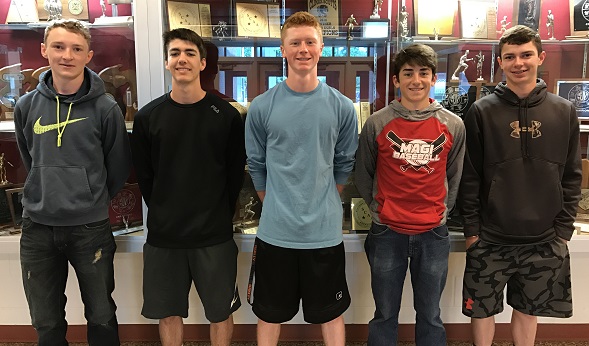
'Yard Squad' Enjoys Unexpected Response
May 20, 2017
By Geoff Kimmerly
Second Half editor
The task itself was a simple one, and the reasons for doing it simple at first.
 An elderly woman called Colon High School – on the advice of her daughter, who teaches in the Upper Peninsula – looking for a student group that might be interested in assisting with some yard work.
Sophomore Andrew Smolarz, meanwhile, always is looking for community service hours to go toward membership in his school’s Varsity Club and National Honor Society chapter.
So he and four track & field teammates volunteered and spent a few hours picking up sticks, raking around her house and cleaning up brush. But they never anticipated the response.
“After the first time we did it, the reaction we got from people – it was more than just doing work for them,” Smolarz said. “When she saw us, the first lady said we’d restored her faith in the youth in the community. She got pretty teary-eyed, so it meant a lot to us, and she wanted a hug from all of us too.”
Since, Smolarz and his “Yard Squad” – sophomores Isaiah Fellers and Andy Stoll and freshmen Philip Alva and Austin Stoll – have taken their cleaning talents to two more homes, with three more and a restaurant also on the schedule.
Colon’s Yard Squad is a recipient of an inaugural MHSAA/Lake Trust Credit Union “Community Service Award” recognizing contributions by Michigan’s high school student-athletes away from the field. The Yard Squad will receive $1,000, which will go toward Colon’s athletic department and equipment for the track & field and baseball teams. Six honorees total are receiving awards this spring; Second Half will feature one a day this week.
While there are a multitude of ways to serve one’s community – over the next few days we will feature some incredibly impressive campaigns to raise money, awareness and donate goods to those in need – Colon’s Yard Squad found a way to help that students at any school can replicate, and to the same unexpected benefits.
That first call ended up on the ear of Colon athletic director Paige Smolarz – also Andrew’s mother and the school’s boys track & field coach – and when she offered the opportunity, these five underclassmen stepped up. It’s not that they don’t have other things going on; all five are dual sport athletes also playing baseball or golf, so clean-ups so far have come on Sundays adding up to about 15 hours total by each student with many more yet to be worked this spring.
Among others they’ve helped were a second elderly woman and her disabled husband, and a young couple where the wife is fighting cancer and the husband is working long shifts to support the family.
The village of Colon, tucked south of Kalamazoo and north of Sturgis, has roughly 1,200 residents, and word quickly gets around. The first woman helped by the Yard Squad told her friends, and there was some Facebook buzz as well. Smolarz said he and the “squad” are just a bunch of friends (and the Stolls are cousins) having fun working together to do something good.
“People think so much more of the little things you do for them than I actually thought (they would),” Andrew Smolarz said. “I just thought we’d go clean up, say thanks, and leave. But they thought so much more over it.
“It’s gotten a lot more fun in my opinion. The reaction is really cool to see on people’s faces. People just can’t believe we’d come out and do that for them.”
The Community Service Awards are sponsored by the Michigan High School Athletic Association and Lake Trust Credit Union to recognize student-athletes' efforts to improve the lives of others in their communities. In addition to the $1,000 award, the Lake Trust Foundation is awarding an additional $500 to each honoree, to be donated to a non-profit, 501 (c)(3) organization of the awardee’s choice.
PHOTO: Colon High School's "Yard Squad" from left: Isaiah Fellers, Andy Stoll, Andrew Smolarz, Phillip Alva and Austin Stoll. (Photo courtesy of the Colon athletic department.)