

Uyl Follows Roberts in MHSAA SUCCESSion
By
Rob Kaminski
MHSAA benchmarks editor
December 7, 2018
The strength of the MHSAA decade after decade has been solid local school administration under the direction of insightful leaders at the state office in Lansing. New Executive Director Mark Uyl is prepared to build on that foundation while meeting challenges old and new as his tenure begins.
Even if he didn’t know it while it was happening, Mark Uyl spent a great deal of his life honing skills that would lead to his selection as the fifth-ever executive director of the Michigan High School Athletic Association.
Growing up in the world of sports officiating, communication, conviction and the ability to enforce rules and regulations come with the territory. Those who can’t cultivate such skills quickly get out, or get found out.
A decorated and lengthy career in officiating at the high school and collegiate levels serve as testimony that Uyl indeed excelled in those areas.
Those traits, Uyl says, figure to serve him well as he trades in his 14-year-old assistant director’s chair for his seat at the helm of the Association.
“I think the biggest adjustment is that you have to have thick skin and the stomach for enforcement of regulations,” Uyl said. “As an assistant director, I worked with committees and forwarded ideas. Now, as the ultimate decision-maker, I know that some people are going to be happy and some will be upset. I understand that some of this comes with territory.
“I think my officiating background helps. At the end of the day, our members expect that we will follow our rules and enforce our rules. Everyone loves having rules until the day comes when those rules affect ‘our school,’ or ‘our community.’ That’s when the ability to stand firm by the rules determined by our membership will help guide us through the process.”
Officials also listen a lot, many times to people who aren’t happy. That, too, is a skill Uyl brings to the table, not only through his experience in stripes or behind the mask, but also from his years as an educator and assistant director with the MHSAA.
“One of the things I am most proud of since coming to the MHSAA is that I believe I served as a caring voice for officials. They are too often the last people to be defended,” Uyl said. “I think people knew they had a guy who could relate to them and was walking in those same shoes. The relationships I was able to build with many officials in our state is important, and I think that's still an incredibly important function today.”
Other satisfactions came from sports more unfamiliar to Uyl prior to his employment at the MHSAA. Again, listening proved valuable.
“Directing our cross country and wrestling tournaments for many years taught me to be a better listener. Some of the really good things we did in both those sports were improved because we listened to those in the trenches,” Uyl said. “It was a really good lesson. I was probably a better administrator in cross country and wrestling because I was less familiar with those sports and relied on committee expertise. I know baseball, and because of that maybe had too many sacred cows – so to speak – and maybe wouldn’t be as open to ideas.”
Prior to his time at the MHSAA, Uyl first taught and coached and then served as athletic director and assistant principal at Middleville Thornapple-Kellogg High School, the latter from 2001-04. Before becoming an administrator there, Uyl served as athletic director at Caledonia High School in 2000-01.
In his 20-plus years of involvement with educational athletics plenty has changed, some for better and some for worse. Ironically, Uyl cites the same catalyst for both ends of the spectrum.
“Where sports have changed for the better, there are more opportunities than there have ever been. The number of sports – not only in-season, but out-of-season – has increased. There are more options available than ever before. That is often a good thing for kids,” he said.
“But, one of the biggest threats to school sports is the non-school sports economy. More people are making more money at youth, travel and club sport levels. Teachers and coaches in school sports are there to help students learn and grow, to become better people – not just athletes. That’s not always the case outside school sports. Too often, there’s a business dynamic that comes with those sports programs. Parents are quicker to get upset because of the money they've invested; they perceive that their kids are shortchanged by coaches’ decisions or officials’ calls.”
Such experiences can put a dent in officials retention throughout the state, a trend that needs to be reversed.
Uyl knows first-hand the values of positive early experiences in officiating.
“My dad has now been a registered official for 50 years. I grew up seeing what it was like to be an official,” Uyl said. “He ran the youth football, basketball and baseball leagues, and when your dad runs the youth program, you become an emergency official. I’ve always been kind of a rules guy anyway, so I liked that aspect and I also liked the money it put in my pocket. That was my job. I never had a job in fast food, landscaping, or anything like that. It was officiating.”
Uyl officiated collegiate baseball from 1997 until last June, putting away the gear following his 11th NCAA Division I Regional assignment. Working major conference baseball across the United States already put Uyl in elite company, but the pinnacle came with his appointment to the 2014 and 2017 College World Series crews in Omaha. He served as a college football referee for 10 years with several NCAA postseason assignments, and was coordinator of officials for the Michigan Intercollegiate Athletic Association. He was registered with the MHSAA for at least three sports beginning in 1992 and worked the Baseball Finals in 1999.
Uyl graduated from Caledonia High School in 1992 and from Calvin College in 1996 with a bachelor’s degree in history and physical education. He later received a master’s in educational leadership from Grand Valley State University. At Calvin, Uyl was a four-year starter on the baseball team, earning all-conference honors twice and serving as team captain.
Following college, there was little doubt as to his career path.
“In high school, I was just very, very fortunate to have a handful of people who made a huge impact on me as role models. Those people were teachers and coaches,” Uyl said. “I thought, ‘These are pretty impressive people, and hopefully there will be a day when I can give others the same kind of great experiences I had.’ Those coaches and teachers at Caledonia were great motivators.”
His passion for education and athletics made it difficult to imagine ever wanting to make a change professionally, until the opportunity at the MHSAA presented itself. Again, it was officiating that helped tilt the scales.
“At that time it was probably the hardest decision I have had to make in my life because I enjoyed teaching and coaching so much, but saw this opportunity in 2004 as the chance of a lifetime,” Uyl recalled. “Being able to help train and support 10,000 officials statewide was too good of an opportunity. If I didn't like officiating so much, I'd likely have stayed in the school system.”
As a sport director, Uyl has sought to create the best experiences for Michigan high school teams, including with the move of the MHSAA Baseball and Softball Finals to Michigan State University in 2014.
 “The foundation built here by Jack Roberts over the last 32 years is the strongest in the country, and I’m honored to have the opportunity to lead our staff in building on that foundation,” Uyl said. “There will be many ways we’ll continue to protect the same values of educational athletics, while also looking for new ways and new opportunities to best serve the students and our member schools in Michigan.”
As assistant director, Uyl was instrumental as the MHSAA became the first state high school athletic association to offer concussion care insurance, which provides gap coverage to assist in covering costs for athletes who are injured while participating in MHSAA-sponsored sports.
As the new school year is underway with more immediate targets such as the changing transfer rule for 2019-20 and football playoffs and scheduling, Uyl and the MHSAA staff will also keep the well-being of student-athletes in their scope.
“Shortly after beginning my new role here, I met with some folks in the medical community, and it was interesting to hear that mental health among adolescents has become a huge priority,” Uyl said. “I had a doctor tell me that where he used to spend most of his days treating injuries and illnesses, now it’s just as much – or more – depression, anxiety and other mental health issues among school-age children that he is seeing. This certainly is an area that we have to keep at the forefront; how can we assist or provide programs to heighten awareness?
“We always assume that kids who play sports are the most healthy because they are busy and engaged and have it together, but now we are hearing that there are real mental topics that we need to discuss.”
Another long-range and continuing point of emphasis focuses on participation and multi-sport participation.
“While we have decisions to make regarding football playoffs and scheduling, the conversation needs to turn to participation numbers in that sport,” Uyl said. “We are losing freshman teams, JV teams, and at the youth level the numbers are down, too. Communities that used to have three and four teams now have one. If we don’t get our arms around participation, then all the playoff and scheduling stuff won’t matter in a few years.”
Participation is a hot topic for more than just the traditional sports like football. The MHSAA will continue to focus efforts toward multi-sport participation to combat specialization trends, and also bolster its presence at the junior high/middle school level, where students get their first taste of school-based athletics.
And even with 18 sports available to MHSAA member schools, Uyl promises to evaluate changing interests of students, which could lead to expanded opportunities.
“We will look with an objective eye to determine whether what we've traditionally offered continues to fit, and also look at expansion,” Uyl said. “The one that gets eyes rolling to anyone over 35 is e-sports, but to 20-somethings that could be the next big thing. We will also continue to be an inclusive organization, working closely with organizations such as Special Olympics. Our goal and purpose needs to involve all kids as their interests change with the times.”
Uyl is the fifth full-time executive in the MHSAA’s 94-year history, following Charles E. Forsythe (1931-42, 1945-68), Allen W. Bush (1968-78), Vern L. Norris (1978-86) and Roberts (1986-2018).
Uyl resides in DeWitt with his wife Marcy, an accomplished educator who has served as a high school varsity basketball coach since 1994. They have three children: Jackson (17), Grant (15) and Madison (11).
“Mark was the obvious choice to become the next executive director of the MHSAA,” said Roberts, who passed the torch after 32 years, and whose name now adorns the Association’s headquarters on Ramblewood Drive in East Lansing. “Mark has the proper student-focused perspective of educational athletics, excellent person-to-person communications skills and a deep practical understanding of what is happening day to day in school sports here and nationally.”
As they say in officiating, it was a good call.
Leading State's Schools a Labor of Love
The names – Norris, Bush, Forsythe – at one time synonymous with school sports in Michigan, are sometimes today more connected to MHSAA awards or meeting rooms at the home office in East Lansing.
But before the Norris Award recognized excellence in officiating, or the Bush Award lauded contributions to the MHSAA, or the Forsythe Award heralded excellence in athletics, these were the men who captained the MHSAA ship ahead of recently retired Jack Roberts.
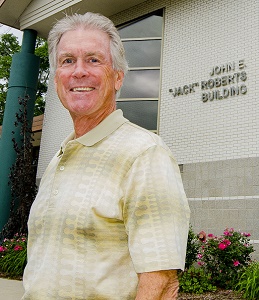
Charles Forsythe was the MHSAA’s first executive director, guiding the Association from 1931-68. He was followed by Allen Bush, who took the reins from 1968-78 after serving under Forsythe as an assistant director from 1960-63 and as associate director from 1963-68. Vern Norris succeeded Bush in 1978 and would direct the MHSAA until 1986. From there it would be Roberts, whose 32-year term was second in length only to Forsythe’s span. During Roberts’ final days in August, he enjoyed a ceremony during which the current MHSAA building was named for him.
The four former executive directors had in common the traits of leadership, vision and passion, and always placed the good of scholastic sports at the forefront when weighing proposals and decisions.
The MHSAA was founded in 1924, when a different Forsythe, L.L., began an 18-year term as president of its Representative Council. In 1931, Charles Forsythe became the MHSAA’s first full-time executive director, a post he would occupy for 37 years.
A native of Milan and graduate of University of Michigan, Charles Forsythe was the athletic director at Lansing Central High School from 1923 until 1929 when he became the assistant director of athletics with the MHSAA. Two years later, he became the first executive director, guiding the Association until 1968 for all but a 37-month tour during World War II as a Navy Commander.
Forsythe was one of the first and finest authors on the topic of interscholastic athletics, and his “Administration of high school athletics” was used by administrators around the globe at that time.
In 1951, he received the Honor Award for the American Association for Health, Physical Education and Recreation, and in 1965 Eastern Michigan University presented him with an honorary Doctor of Laws degree.
Forsythe died in December 1968, months after his August retirement from the MHSAA.
Bush served under Forsythe from 1960 until he began his 10-year term as executive director in 1968. Bush oversaw some of the most significant developments in MHSAA history, chiefly the addition of girls sports – MHSAA tournaments existed for nine girls sports when he retired – plus the addition of football playoffs in 1975, and MHSAA tournaments in baseball, ice hockey and skiing.
Bush was a graduate of Kalamazoo University and later earned multiple bachelor’s degrees from Western Michigan University and a master’s in school administration from University of Michigan. He was captain of the football team at WMU and received its Most Valuable Player and Athletic-Scholarship awards as a senior, and later was named Man of the Year in 1975 by WMU’s Alumni W Club.
Bush also studied at Princeton University and the University of Arizona and served six years of active duty with the U.S. Marine Corps during World War II and the Korean War. He was discharged with a rank of first lieutenant.
Bush died in 2013 at age 90.
Norris served under both Forsythe and Bush, beginning his work at the MHSAA in 1963. He would succeed Bush at the top in 1978.
Norris brought to the MHSAA a wealth of experience having coached at Traverse City, Rockford and Hillsdale high schools. He served as Assistant Director of Placement at Western Michigan University for the five years prior to joining the MHSAA staff, and during that time Norris built a reputation as a highly-regarded game official in the Kalamazoo area – and worked as a referee during the 1963 MHSAA Class A Boys Basketball Final.
Norris served on a number of national rules-making bodies during his 23-year tenure with the MHSAA, and as president of the Executive Board of the National Federation of State High School Associations (NFHS) during the 1983-84 school year. But he was best known for his work with Michigan’s coaches and especially officials.
Norris remained a frequent visitor to the MHSAA office prior to his death last February.
Roberts took the controls in 1986 at age 37, then the youngest leader of a high school athletic association, and would leave last August as the longest-serving active director in the nation after 32 years.
Under Roberts’ leadership, overall participation in high school athletics in Michigan increased 10 percent, and the MHSAA added more than 200 schools in increasing its membership by more than 15 percent at the high school and junior high/middle school levels combined. Most recently, in 2016, 6th-graders were allowed to compete for member schools for the first time as a push was made to increase junior high/middle school membership and serve the state’s students at an earlier age.
But the most significant and arguably lasting work influenced by Roberts came on topics not related to specific sports or competition. The MHSAA has led nationally in concussion care with its first programming in 2000 and return-to-play protocols enacted in 2010, and with concussion pilot testing, mandated reporting and insurance for those who suffer head injuries rolled out in 2015.
He is a 1970 graduate of Dartmouth College and previously served as an assistant director for the National Federation from 1973-80. He came to the MHSAA in 1986 from the Fellowship of Christian Athletes.
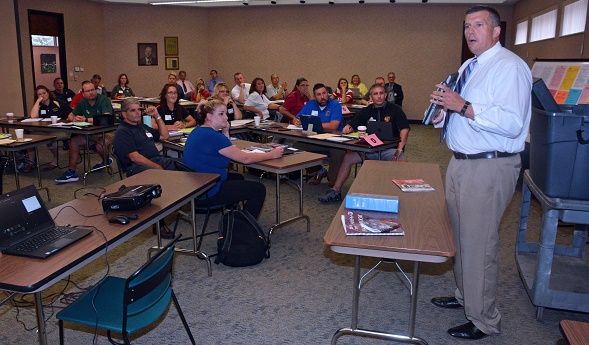
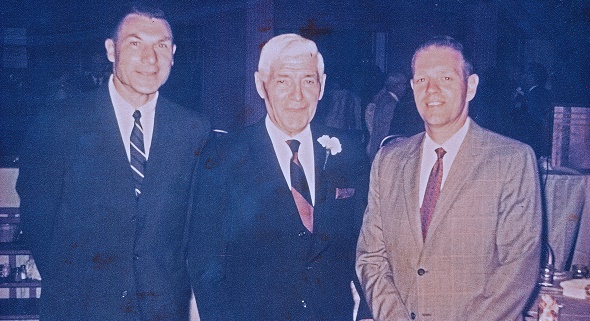
PHOTOS: (Top) MHSAA Executive Director Mark Uyl speaks during an in-service for new athletic directors this fall. (Middle) Jack Roberts stood this summer in front of the building that now bears his name. (Below) Al Bush, Charles Forsythe and Vern Norris.

Assistant Director Mazzolini to Retire
By
Geoff Kimmerly
MHSAA.com senior editor
November 23, 2015
Gina Mazzolini, a pioneering athlete, former high school and college coach, and one of the longest-serving current assistant directors for the Michigan High School Athletic Association, will retire from her post at the end of this school year, effective July 31, 2016.
 Mazzolini has served the MHSAA since 1993 and is the administrator for girls volleyball, swimming and diving, alpine skiing and tennis. She also handles the sanctioning of out-of-state competitions and serves as the MHSAA’s point person on foreign exchange and international student issues.
After standout basketball and volleyball careers at St. Johns High School and Central Michigan University, Mazzolini taught and coached multiple sports during the 1979-80 school year at Ovid-Elsie High School. She then spent two years teaching and serving as an assistant volleyball coach at Michigan State University, where she also earned her master’s degree in physical education. Mazzolini then left to teach and serve as assistant volleyball coach and interim women’s Sports Information Director at the University of Texas.
In 1982, Mazzolini became an activities director with the University Interscholastic League, the service organization to high school activities in Texas. She became an assistant athletic director at the UIL in 1988, and five years later she returned to Michigan as a member of the MHSAA staff.
Mazzolini will receive a Citation from the National Federation of State High School Associations next summer and was the 2010 recipient of the MHSAA’s Women in Sports Leadership Award. She has served on NFHS rules committees for soccer, swimming and diving, and volleyball (chairing that sport’s rules committee from 2004-08). She also has served on NFHS advisory committees for athletic directors and sports medicine.
“Gina’s accomplishments from her days as a pioneer on the court to those as administrator have truly been local, statewide, national and global,” MHSAA Executive Director John E. “Jack” Roberts said. “She has shaped the rules for the games in which our children compete and helped maintain not only a level playing field with her work with eligibility and foreign exchange rules, but a safe field with her national committee work in sports medicine.”
Mazzolini was named the first Female Athlete of the Year at St. Johns High School, graduating in 1974 after an accomplished career that included leading the Redwings to a District title in the first MHSAA Girls Basketball Tournament in 1973. She also played softball and ran track for her high school.
She went on to star in both basketball and volleyball at Central Michigan University; she graduated in 1978 as the leading scorer, rebounder and shot-blocker in CMU history and still ranks among the Chippewas’ leaders in multiple statistical categories – ninth in career field goal percentage (.496), tied for sixth in career rebounds (880), second in career rebounding average per game (10.5), fifth and sixth in season rebounding average per game (11.5 and 11.1) and tied for first for rebounds in one game (24). She was inducted into the CMU Athletic Hall of Fame in 1992.
In addition to her work at the MHSAA, Mazzolini has provided a long list of contributions at the national level. Along with those mentioned above, she has served as the NFHS representative on the board for the Council on Standards for International Educational Travel, which identifies, promotes and supports international youth exchange programs, and has sat on several CSIET committees. She’s currently serving on the NFHS Annual Meeting Planning Committee.