

Voice of Athletes Heard, Recognized
March 17, 2014
By Geoff Kimmerly
Second Half editor
For more than 40 years, Escanaba’s Dan Flynn has served in just about every role possible in educational athletics. He’s lent his expertise to every group involved with sports at the high school level.
But above all, he’s made sure to advocate for those at the center of our games – the student-athletes taking part.
 Flynn has coached, officiated and served as an athletic director, and also was a longtime member of the MHSAA Representative Council. In recognition of his contributions – and the voice he so often provided for those playing sports – Flynn has been named the 2014 recipient of the MHSAA's Charles E. Forsythe Award.
"My focus has been taking care of kids and helping kids have success. It's the essence of education, the essence of coaching," Flynn said. "The coaches help, the schools help, the parents help provide the programs. But the reason is the kids.”
The annual award is in its 37th year and is named after former MHSAA Executive Director Charles E. Forsythe, the Association's first full-time and longest-serving chief executive. Forsythe Award recipients are selected each year by the MHSAA Representative Council, based on an individual's outstanding contribution to the interscholastic athletics community. Flynn will receive his honor during the break after the first quarter of the MHSAA Class A Boys Basketball Final on March 22 at the Breslin Student Events Center in East Lansing.
Flynn, 67, joined the staff at Escanaba High School as a teacher and coach in 1971 and eventually served as the varsity wrestling coach from 1973-84, varsity football coach from 1985-2011 and varsity boys track and field coach from 1992-2002. He also served as athletic director from 1983-96 and an assistant principal for five years.
Flynn also represented the Upper Peninsula as an elected member of the MHSAA Representative Council from 1988-2010 and worked on the Council’s Executive Committee.
“He’s a coach at heart. He was very student-athlete oriented in his thinking about MHSAA policies and programs and was a dependable voice to bring up the student perspective,” MHSAA Executive Director John E. “Jack” Roberts said. “While he spent his career in the Upper Peninsula, he was capable of thinking about the good for the state as a whole. We’re proud to honor Dan Flynn with the Forsythe Award.”
Before beginning at Escanaba, Flynn taught and coached at Ishpeming High School, including leading the wrestling program from 1967-71. He coached Ishpeming to an MHSAA Upper Peninsula wrestling championship in 1971 and then Escanaba’s wrestling team to six MHSAA U.P. titles in nine seasons. As an assistant football coach for the Eskymos he helped lead the team to the MHSAA Class A title in 1981 and a runner-up finish in 1979.
He also served as a track and field official for 42 seasons, and this fall returned to coaching as a football assistant at Marquette High School.
Flynn received an MHSAA Allen W. Bush Award in 2000 for his contributions to the association. He was inducted into the Michigan High School Coaches Association Hall of Fame in 2001, the Michigan High School Football Coaches Association Hall of Fame in 2003 and the Upper Peninsula Sports Hall of Fame in 2009.
“It was awfully important to me that the kids across the state had a voice in the Representative Council,” Flynn said. “I thought I had something to say. And I was taught by some really good people, Jack Roberts, (associate directors) Jerry Cvengros and Tom Rashid, that I needed to listen to take care of people.”
His contributions to his community reach outside athletics as well. Flynn has participated in the Youth Assistance Program and American Heart Association in Delta County and as a CPR instructor for the Superior Upper Peninsula chapter of the American Red Cross.
Flynn grew up in Chicago and received his bachelor’s degree in health and physical education from Northern Michigan University in 1969 and a master’s from NMU in 1993, and played football for the Wildcats as an undergrad. He also studied at Utah State University and the University of Oregon.
Past recipients of the Charles E. Forsythe Award
1978 - Brick Fowler, Port Huron; Paul Smarks, Warren
1979 - Earl Messner, Reed City; Howard Beatty, Saginaw
1980 - Max Carey, Freesoil
1981 - Steven Sluka, Grand Haven; Samuel Madden, Detroit
1982 - Ernest Buckholz, Mt. Clemens; T. Arthur Treloar, Petoskey
1983 - Leroy Dues, Detroit; Richard Maher, Sturgis
1984 - William Hart, Marquette; Donald Stamats, Caro
1985 - John Cotton, Farmington; Robert James, Warren
1986 - William Robinson, Detroit; Irving Soderland, Norway
1987 - Jack Streidl, Plainwell; Wayne Hellenga, Decatur
1988 - Jack Johnson, Dearborn; Alan Williams, North Adams
1989 - Walter Bazylewicz, Berkley; Dennis Kiley, Jackson
1990 - Webster Morrison, Pickford; Herbert Quade, Benton Harbor
1991 - Clifford Buckmaster, Petoskey; Donald Domke, Northville
1992 - William Maskill, Kalamazoo; Thomas G. McShannock, Muskegon
1993 - Roy A. Allen Jr., Detroit; John Duncan, Cedarville
1994 - Kermit Ambrose, Royal Oak
1995 - Bob Perry, Lowell
1996 - Charles H. Jones, Royal Oak
1997 - Michael A. Foster, Richland; Robert G. Grimes, Battle Creek
1998 - Lofton C. Greene, River Rouge; Joseph J. Todey, Essexville
1999 - Bernie Larson, Battle Creek
2000 - Blake Hagman, Kalamazoo; Jerry Cvengros, Escanaba
2001 - Norm Johnson, Bangor; George Lovich, Canton
2002 - John Fundukian, Novi
2003 - Ken Semelsberger, Port Huron
2004 – Marco Marcet, Frankenmuth
2005 – Jim Feldkamp, Troy
2006 – Dan McShannock, Midland; Dail Prucka, Monroe
2007 – Keith Eldred, Williamston; Tom Hickman, Spring Lake
2008 – Jamie Gent, Haslett; William Newkirk, Sanford-Meridian
2009 – Paul Ellinger, Cheboygan
2010 – Rudy Godefroidt, Hemlock; Mike Boyd, Waterford
2011 – Eric C. Federico, Trenton
2012 – Bill Mick, Midland
2013 – Jim Gilmore, Tecumseh; Dave Hutton, Grandville
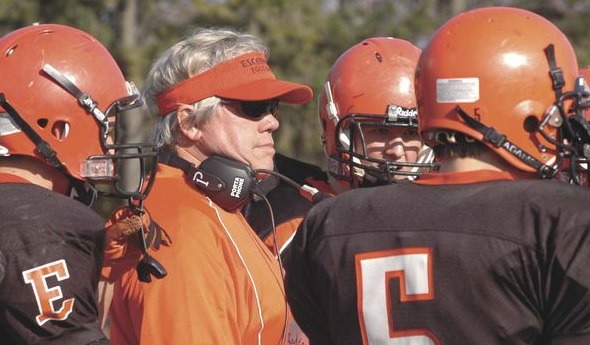
PHOTO: Dan Flynn coaches his football team at Escanaba before stepping down from that post after the 2011 season. (Photo courtesy of the Escanaba Daily Press.)
2020 Class Honored Together, from Afar
By
Geoff Kimmerly
MHSAA.com senior editor
May 15, 2020
Ishpeming Westwood’s girls basketball team was two hours into a three-hour trip to its Division 3 Regional Final on March 12 when the Patriots were told to turn the bus around and come home.
In an instant, the 2019-20 school year – and with it all MHSAA sports across the state – had come to a halt. And two months later, the high school world and its sports community continue to wait for bits of normalcy to return.
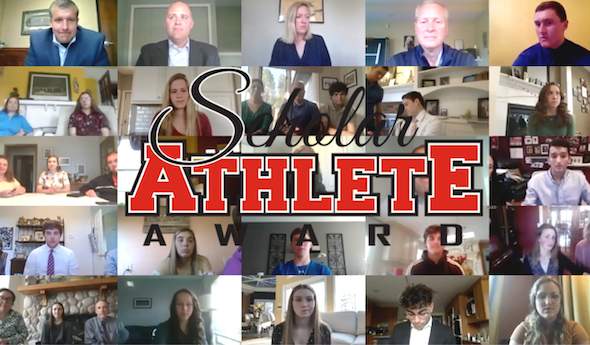
On Wednesday, we were able to enjoy a little bit of normal that’s been part of the annual MHSAA calendar for three decades. A Zoom call brought together 31 families from all over the state along with MHSAA staff and Farm Bureau Insurance CEO Don Simon to celebrate this year’s MHSAA/Farm Bureau Insurance Scholar-Athlete Award winners.
Living rooms, kitchens and home offices replaced Breslin Center as settings for this “virtual” ceremony. And yet, this ceremony may be remembered more than any other because of its necessity – due to the COVID-19 pandemic – and because of how it brought so many together, remotely, while the coronavirus has forced all of us to remain apart.
Below is the ceremony, in full, including words from Simon, MHSAA Executive Director Mark Uyl and Assistant Director Andy Frushour and, for the first time, a student speaker from the class – Ishpeming Westwood senior Madelyn Koski, who was part of that basketball team destined for Sault Ste. Marie. A brief Q&A with Koski follows.
Koski was an all-stater on the court who would’ve finished her high school career with four varsity letters each for hoops, tennis and softball. She will continue at Ferris State University, where she’ll pursue a degree in pharmacy and continue her basketball career.
Second Half: How did you decide what you wanted to say? Was there a message you wanted to get across?
It was easy to write the sad part, because I know what happened – I was there. But it was hard for me to make a positive spin at the end because I don’t think anyone’s over it yet. I was glad to be able to turn it into something that was bigger than sports … more about our whole lives and less about our time in high school.
Second Half: It’s been two months. How have you been navigating the disappointment, the sadness? And is there advice you’d give to other people your age trying to do it?
As time went on, it got a little bit better. The day after was pretty sad; that’s all I could think about. Now there’s so many other things to do – the weather’s nicer, we can go outside. And I’m playing college basketball – not everyone has that chance – but at least I have that to practice for, look forward to.
I guess, it’s just … time heals.
Second Half: Even though you can’t be with them and hang out with them, I’m sure you’re talking a lot of your friends and teammates. What kind of conversations are you having? Is it looking ahead? Is it still thinking about, “We’d be playing softball right now?"
I think we kinda tried to leave the basketball stuff in the past because it was too sad to talk about. We made sure we do talk, obviously not in person, but on social media or FaceTime, we just talk about our memories and everything. That helped. It didn’t close the chapter, but it was nice to talk to them when we were all alone. And now we just don’t talk about that anymore. Nobody really wants to talk about it. We see memories popping up on Facebook and all these other things about, “Oh, we had a softball game last year at this time.” And it’s pretty sad. But no one else is playing. So it’s like we’re all in the same boat.
 Second Half: You can turn on the news and you can see what every adult has to say about what’s going on right now. … You’re 17, you’re finishing your last year of high school, you’re going through something no one has gone through in more than 100 years. How do you see everything that’s happening in the world right now, as you look at it from a 17-year-old’s point of view and see seasons end and school end?
I know we can’t help what happened. But obviously I think it’s unfair that it happened to our class. It stinks for every grade, but (as seniors) we’re missing out on our best parts of high school right now and it’s pretty horrible. We’ve been waiting years for our senior proms and graduations, banquets and award ceremonies, like the MHSAA one. So that kinda stinks.
Ever since March 12, I’ve been staying optimistic. But I’m proved wrong every time because things just keep getting canceled and canceled. … (But) I’m a pretty optimistic person, so I still have some left.
Second Half: What happens next? What does your summer look like? What happens for people who are in your shoes?
I’ll keep working out, and one of the girls on my high school basketball team is going to play at Michigan Tech so (eventually) we can work out together. … I think the biggest thing to do this summer, that I think I’ll do, is appreciate time with my family. I have gotten to spend a lot of time with them. And then maybe once summer rolls around and we’re allowed to be in bigger groups, I’ll be able to be with people other than my mom and dad, like my grandparents and cousins and my aunts and uncles. … (My sister Jillian and I) have been playing the same varsity sports for the last couple of years, and she’s been really successful. It’s been fun to win all these championships and stuff with her.
Second Half: What do you think you’re going to remember from this in five years, 10 years, when people ask you what your experience was like?
I’m probably going to say it’s a pretty bad experience. I guess it was an eye-opener that life can change at any moment. That’s kind’ve it. It didn’t change in a good way.
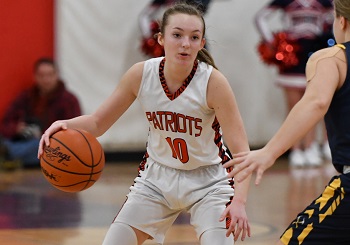
PHOTO: Westwood's Madelyn Koski sets up a play as Negaunee's Breanne Giotto defends her during their Jan. 24 game. (Photo by Cara Kamps.)