

Voice of Athletes Heard, Recognized
March 17, 2014
By Geoff Kimmerly
Second Half editor
For more than 40 years, Escanaba’s Dan Flynn has served in just about every role possible in educational athletics. He’s lent his expertise to every group involved with sports at the high school level.
But above all, he’s made sure to advocate for those at the center of our games – the student-athletes taking part.
 Flynn has coached, officiated and served as an athletic director, and also was a longtime member of the MHSAA Representative Council. In recognition of his contributions – and the voice he so often provided for those playing sports – Flynn has been named the 2014 recipient of the MHSAA's Charles E. Forsythe Award.
"My focus has been taking care of kids and helping kids have success. It's the essence of education, the essence of coaching," Flynn said. "The coaches help, the schools help, the parents help provide the programs. But the reason is the kids.”
The annual award is in its 37th year and is named after former MHSAA Executive Director Charles E. Forsythe, the Association's first full-time and longest-serving chief executive. Forsythe Award recipients are selected each year by the MHSAA Representative Council, based on an individual's outstanding contribution to the interscholastic athletics community. Flynn will receive his honor during the break after the first quarter of the MHSAA Class A Boys Basketball Final on March 22 at the Breslin Student Events Center in East Lansing.
Flynn, 67, joined the staff at Escanaba High School as a teacher and coach in 1971 and eventually served as the varsity wrestling coach from 1973-84, varsity football coach from 1985-2011 and varsity boys track and field coach from 1992-2002. He also served as athletic director from 1983-96 and an assistant principal for five years.
Flynn also represented the Upper Peninsula as an elected member of the MHSAA Representative Council from 1988-2010 and worked on the Council’s Executive Committee.
“He’s a coach at heart. He was very student-athlete oriented in his thinking about MHSAA policies and programs and was a dependable voice to bring up the student perspective,” MHSAA Executive Director John E. “Jack” Roberts said. “While he spent his career in the Upper Peninsula, he was capable of thinking about the good for the state as a whole. We’re proud to honor Dan Flynn with the Forsythe Award.”
Before beginning at Escanaba, Flynn taught and coached at Ishpeming High School, including leading the wrestling program from 1967-71. He coached Ishpeming to an MHSAA Upper Peninsula wrestling championship in 1971 and then Escanaba’s wrestling team to six MHSAA U.P. titles in nine seasons. As an assistant football coach for the Eskymos he helped lead the team to the MHSAA Class A title in 1981 and a runner-up finish in 1979.
He also served as a track and field official for 42 seasons, and this fall returned to coaching as a football assistant at Marquette High School.
Flynn received an MHSAA Allen W. Bush Award in 2000 for his contributions to the association. He was inducted into the Michigan High School Coaches Association Hall of Fame in 2001, the Michigan High School Football Coaches Association Hall of Fame in 2003 and the Upper Peninsula Sports Hall of Fame in 2009.
“It was awfully important to me that the kids across the state had a voice in the Representative Council,” Flynn said. “I thought I had something to say. And I was taught by some really good people, Jack Roberts, (associate directors) Jerry Cvengros and Tom Rashid, that I needed to listen to take care of people.”
His contributions to his community reach outside athletics as well. Flynn has participated in the Youth Assistance Program and American Heart Association in Delta County and as a CPR instructor for the Superior Upper Peninsula chapter of the American Red Cross.
Flynn grew up in Chicago and received his bachelor’s degree in health and physical education from Northern Michigan University in 1969 and a master’s from NMU in 1993, and played football for the Wildcats as an undergrad. He also studied at Utah State University and the University of Oregon.
Past recipients of the Charles E. Forsythe Award
1978 - Brick Fowler, Port Huron; Paul Smarks, Warren
1979 - Earl Messner, Reed City; Howard Beatty, Saginaw
1980 - Max Carey, Freesoil
1981 - Steven Sluka, Grand Haven; Samuel Madden, Detroit
1982 - Ernest Buckholz, Mt. Clemens; T. Arthur Treloar, Petoskey
1983 - Leroy Dues, Detroit; Richard Maher, Sturgis
1984 - William Hart, Marquette; Donald Stamats, Caro
1985 - John Cotton, Farmington; Robert James, Warren
1986 - William Robinson, Detroit; Irving Soderland, Norway
1987 - Jack Streidl, Plainwell; Wayne Hellenga, Decatur
1988 - Jack Johnson, Dearborn; Alan Williams, North Adams
1989 - Walter Bazylewicz, Berkley; Dennis Kiley, Jackson
1990 - Webster Morrison, Pickford; Herbert Quade, Benton Harbor
1991 - Clifford Buckmaster, Petoskey; Donald Domke, Northville
1992 - William Maskill, Kalamazoo; Thomas G. McShannock, Muskegon
1993 - Roy A. Allen Jr., Detroit; John Duncan, Cedarville
1994 - Kermit Ambrose, Royal Oak
1995 - Bob Perry, Lowell
1996 - Charles H. Jones, Royal Oak
1997 - Michael A. Foster, Richland; Robert G. Grimes, Battle Creek
1998 - Lofton C. Greene, River Rouge; Joseph J. Todey, Essexville
1999 - Bernie Larson, Battle Creek
2000 - Blake Hagman, Kalamazoo; Jerry Cvengros, Escanaba
2001 - Norm Johnson, Bangor; George Lovich, Canton
2002 - John Fundukian, Novi
2003 - Ken Semelsberger, Port Huron
2004 – Marco Marcet, Frankenmuth
2005 – Jim Feldkamp, Troy
2006 – Dan McShannock, Midland; Dail Prucka, Monroe
2007 – Keith Eldred, Williamston; Tom Hickman, Spring Lake
2008 – Jamie Gent, Haslett; William Newkirk, Sanford-Meridian
2009 – Paul Ellinger, Cheboygan
2010 – Rudy Godefroidt, Hemlock; Mike Boyd, Waterford
2011 – Eric C. Federico, Trenton
2012 – Bill Mick, Midland
2013 – Jim Gilmore, Tecumseh; Dave Hutton, Grandville
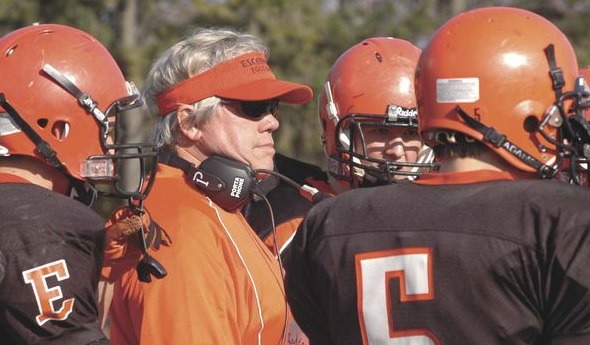
PHOTO: Dan Flynn coaches his football team at Escanaba before stepping down from that post after the 2011 season. (Photo courtesy of the Escanaba Daily Press.)

2018 Scholar-Athlete Finalists Announced
By
Geoff Kimmerly
MHSAA.com senior editor
January 19, 2018
By Geoff Kimmerly
Second Half editor
The 120 finalists for the Michigan High School Athletic Association's Scholar-Athlete Awards for the 2017-18 school year, presented by Farm Bureau Insurance, have been announced.
 The program, in its 29th year, has recognized student-athletes since the 1989-90 school year and again this winter will honor 32 individuals from MHSAA member schools who participate in at least one sport in which the Association sponsors a postseason tournament.
Farm Bureau Insurance underwrites the Scholar-Athlete Awards and will present a $1,000 scholarship to each recipient. Since the beginning of the program, 736 scholarships have been awarded.
Scholarships will be presented proportionately by school classification, with 12 scholarships to be awarded to Class A student-athletes, six female and six male; eight scholarships will be awarded to Class B student-athletes, four female and four male; six scholarships will be awarded to Class C student-athletes, three female and three male; and four scholarships will be awarded to Class D student-athletes, two female and two male. In addition, two scholarships will be awarded at-large to minority recipients, regardless of school size.
Every MHSAA member high school could submit as many applications as there are scholarships available in its classification, and could have more than one finalist. Saline has four finalists this year, while Negaunee, Rochester and Saginaw Swan Valley each have three. Seventeen schools each have two finalists: Bloomfield Hills Academy of the Sacred Heart, Bloomfield Hills Cranbrook Kingswood, Chelsea, East Grand Rapids, Ferndale, Grand Rapids Christian, Harbor Springs, Kingsford, Ludington, Marshall, Northville, Okemos, Paw Paw, Pontiac Notre Dame Prep, Saranac, Sault Ste. Marie and Troy.
Multiple-sport participation remains the norm among applicants. The average sport participation rate of the finalists is 2.63, while the average of the application pool was 2.20. There are 65 three-plus sport participants in the finalists field, and all but two of the 28 sports in which the MHSAA sponsors postseason tournaments are represented.
Of 396 schools which submitted applicants, 39 submitted the maximum allowed. This year, 1,422 applications were received. All applicants will be presented with certificates commemorating their achievement. Additional Scholar-Athlete information, including a complete list of scholarship nominees, can be found on the MHSAA Website.
The applications were judged by a 64-member committee of school coaches, counselors, faculty members, administrators and board members from MHSAA member schools. Selection of the 32 scholarship recipients will take place in early February. Class C and D scholarship recipients will be announced Feb. 6, Class B scholarship recipients will be announced Feb. 13 and Class A scholarship recipients will be announced Feb. 20. All announcements will be made on the MHSAA Website.
To honor the 32 Scholar-Athlete Award recipients, a ceremony will take place during halftime of the Class C Boys Basketball Final, March 24, at the Breslin Student Events Center in East Lansing.
To be eligible for the award, students must have a cumulative grade-point average of 3.50 (on a 4.0 scale) and previously have won a varsity letter in at least one sport in which the MHSAA sponsors a postseason tournament. Students also were asked to respond to a series of short essay questions, submit two letters of recommendation and a 500-word essay on the importance of sportsmanship in educational athletics.
Farm Bureau Insurance of Michigan was founded in 1949 by Michigan farmers who wanted an insurance company that worked as hard as they did. Those values still guide the company today and are a big reason why it is known as Michigan’s Insurance Company, dedicated to protecting the farms, families, and businesses of this great state. Farm Bureau Insurance agents across Michigan provide a full range of insurance services—life, home, auto, farm, business, retirement, Lake Estate®, and more — protecting nearly 500,000 Michigan policyholders
The MHSAA is a private, not-for-profit corporation of voluntary membership by more than 1,500 public and private senior high schools and junior high/middle schools which exists to develop common rules for athletic eligibility and competition. No government funds or tax dollars support the MHSAA, which was the first such association nationally to not accept membership dues or tournament entry fees from schools. Member schools which enforce these rules are permitted to participate in MHSAA tournaments, which attract more than 1.4 million spectators each year.
2017-18 Scholar-Athlete Award Finalists
BOYS CLASS A
Kobie Mueller, Ann Arbor Huron
Adam Good, Auburn Hills Avondale
Jacob Willemsen, Byron Center
William Marano, Dearborn Edsel Ford
Anthony Joseph, DeWitt
Ben Forstner, East Grand Rapids
Anthony Kim, Grand Blanc
Nicholas Weigle, Grandville
Yzrael Silguero, Holland
Danny deForest, Holland West Ottawa
Joseph Corner, Holt
Luke Rambo, Marquette
Aditya Middha, Midland Dow
Paul Cheng McKinley, Okemos
David Paquette, Petoskey
Michael Robert Melaragni, Rochester Hills Stoney Creek
Cole Johnson, Rockford
Anthony G. DeKraker, Saline
Aidan Delfuoco, Saline
Reagan Miller, Saline
Emmett Turner, Saline
Hunter Gandee, Temperance Bedford
Nathan Frazier, Warren Cousino
Nick Seidel, West Bloomfield
GIRLS CLASS A
Maggie Wood, Battle Creek Lakeview
Emily Rooney, Birmingham Seaholm
Susannah Deems, East Grand Rapids
Kelly Ann Giles, East Kentwood
Olivia Perkins, Farmington Hills Harrison
Maria Poortenga, Grand Rapids Christian
Sarah Van Dyke, Grand Rapids Christian
Breanna Probst, Grand Rapids Forest Hills Central
Lauren Sickmiller, Grosse Pointe North
Samantha Hild, Holly
Talia Naomi Edmonds, Kalamazoo Central
Tess Scheidel, Middleville Thornapple Kellogg
Grace VanArendonk, Muskegon Mona Shores
Kendall Dillon, Northville
Roan Haines, Northville
Anushka Murthy, Okemos
Hallie C. Roman, Port Huron Northern
Kendall Jordan, Rochester
Karlyn Kelley, Rochester
Jenna Norgrove, Rochester
Anna Fischer, St. Joseph
Meghan Monaghan, Troy
Megan Worrel, Troy
Julie Smith, Walled Lake Northern
BOYS CLASS B
Jackson Lund, Big Rapids
Lucas Misra, Bloomfield Hills Cranbrook Kingswood
Patrick J. Bertoni, Chelsea
Justin A. Lyle, Dowagiac
Jacob Keener, Ferndale
John Stellard, Ferndale
Vincent Goyette, Flint Powers Catholic
Anthony Harris, Frankenmuth
David Ameriguian, Grosse Ile
Sawyer Perpich, Kingsford
Caleb Schoon, Ludington
William Rayner, Marshall
Thomas Otten, Paw Paw
Anthony Reo, Paw Paw
Hunter Goldensoph, Saginaw Swan Valley
Troy Joseph Distelrath, St. Clair
GIRLS CLASS B
Kate Cao, Bloomfield Hills Cranbrook Kingswood
Caroline Hirth, Chelsea
Hannah Shorkey, Essexville Garber
Katelyn Brown, Jonesville
Jordyn Kriegl, Kingsford
Mackenzie Luce, Ludington
Mackenzie Horn, Marshall
Grace VerHage, Otsego
Celia C. Gaynor, Pontiac Notre Dame Prep
Lauren Neiheisel, Pontiac Notre Dame Prep
Megan Brooks, Saginaw Swan Valley
Emily Buska, Saginaw Swan Valley
Valeta A. Gage, Sault Ste. Marie
Mackenzie M. Kalchik, Sault Ste. Marie
Izabella Marie Taylor, Three Rivers
MacKenzie Desloover, Yale
BOYS CLASS C
Jack Avery Harris, Ann Arbor Greenhills
Parker Hayes, Beaverton
Matthew Harazin, Bridgman
Ilhan Onder, Calumet
Joseph R. Claramunt, Harbor Springs
Thomas Kelbel, Harbor Springs
Evans Brown, Kalamazoo Hackett
Eric Vandefifer, Montrose
Luke Skewis, Negaunee
Colton Yesney, Negaunee
Ben Hogan, North Muskegon
Bryant Kieft, Watervliet
GIRLS CLASS C
Shelby Trevino, Beal City
Kendall Gassman, Bloomfield Hills Academy of the Sacred Heart
Kelleigh Keating, Bloomfield Hills Academy of the Sacred Heart
Ellen Charlotte Laurenz, Breckenridge
Rachel Nesburg, Charlevoix
Morgan Hartline, Marcellus
Clara Johnson, Negaunee
Emily Spitzley, Pewamo-Westphalia
Halie Robinson, Royal Oak Shrine Catholic
Kendahl Grace Overbeck, Saranac
Emma Pachulski, Saranac
Melody Antel, Saugatuck
BOYS CLASS D
Nicholas Burlingame, Ashley
Brendan Delaney, Gaylord St. Mary
Peter Kalthoff, Hillsdale Academy
Andrew Pechette, Kinde-North Huron
Andrew Hager, Mio
Jeremiah Torrey, Onekama
Aaron Jacob Fahrner, Owendale-Gagetown
Thomas Hursey, Suttons Bay
GIRLS CLASS D
Katelyn Smith, Akron-Fairgrove
Corra Hamilton, Athens
Madison Kadlec, Bellaire
Ciera Weber, Fowler
Laura Lyons, Lake Linden-Hubbell
Stephanie Schuman, Lawrence
Ellie Haan, McBain Northern Michigan Christian
Sophie Ruggles, Mt. Pleasant Sacred Heart