

Voice of Athletes Heard, Recognized
March 17, 2014
By Geoff Kimmerly
Second Half editor
For more than 40 years, Escanaba’s Dan Flynn has served in just about every role possible in educational athletics. He’s lent his expertise to every group involved with sports at the high school level.
But above all, he’s made sure to advocate for those at the center of our games – the student-athletes taking part.
 Flynn has coached, officiated and served as an athletic director, and also was a longtime member of the MHSAA Representative Council. In recognition of his contributions – and the voice he so often provided for those playing sports – Flynn has been named the 2014 recipient of the MHSAA's Charles E. Forsythe Award.
"My focus has been taking care of kids and helping kids have success. It's the essence of education, the essence of coaching," Flynn said. "The coaches help, the schools help, the parents help provide the programs. But the reason is the kids.”
The annual award is in its 37th year and is named after former MHSAA Executive Director Charles E. Forsythe, the Association's first full-time and longest-serving chief executive. Forsythe Award recipients are selected each year by the MHSAA Representative Council, based on an individual's outstanding contribution to the interscholastic athletics community. Flynn will receive his honor during the break after the first quarter of the MHSAA Class A Boys Basketball Final on March 22 at the Breslin Student Events Center in East Lansing.
Flynn, 67, joined the staff at Escanaba High School as a teacher and coach in 1971 and eventually served as the varsity wrestling coach from 1973-84, varsity football coach from 1985-2011 and varsity boys track and field coach from 1992-2002. He also served as athletic director from 1983-96 and an assistant principal for five years.
Flynn also represented the Upper Peninsula as an elected member of the MHSAA Representative Council from 1988-2010 and worked on the Council’s Executive Committee.
“He’s a coach at heart. He was very student-athlete oriented in his thinking about MHSAA policies and programs and was a dependable voice to bring up the student perspective,” MHSAA Executive Director John E. “Jack” Roberts said. “While he spent his career in the Upper Peninsula, he was capable of thinking about the good for the state as a whole. We’re proud to honor Dan Flynn with the Forsythe Award.”
Before beginning at Escanaba, Flynn taught and coached at Ishpeming High School, including leading the wrestling program from 1967-71. He coached Ishpeming to an MHSAA Upper Peninsula wrestling championship in 1971 and then Escanaba’s wrestling team to six MHSAA U.P. titles in nine seasons. As an assistant football coach for the Eskymos he helped lead the team to the MHSAA Class A title in 1981 and a runner-up finish in 1979.
He also served as a track and field official for 42 seasons, and this fall returned to coaching as a football assistant at Marquette High School.
Flynn received an MHSAA Allen W. Bush Award in 2000 for his contributions to the association. He was inducted into the Michigan High School Coaches Association Hall of Fame in 2001, the Michigan High School Football Coaches Association Hall of Fame in 2003 and the Upper Peninsula Sports Hall of Fame in 2009.
“It was awfully important to me that the kids across the state had a voice in the Representative Council,” Flynn said. “I thought I had something to say. And I was taught by some really good people, Jack Roberts, (associate directors) Jerry Cvengros and Tom Rashid, that I needed to listen to take care of people.”
His contributions to his community reach outside athletics as well. Flynn has participated in the Youth Assistance Program and American Heart Association in Delta County and as a CPR instructor for the Superior Upper Peninsula chapter of the American Red Cross.
Flynn grew up in Chicago and received his bachelor’s degree in health and physical education from Northern Michigan University in 1969 and a master’s from NMU in 1993, and played football for the Wildcats as an undergrad. He also studied at Utah State University and the University of Oregon.
Past recipients of the Charles E. Forsythe Award
1978 - Brick Fowler, Port Huron; Paul Smarks, Warren
1979 - Earl Messner, Reed City; Howard Beatty, Saginaw
1980 - Max Carey, Freesoil
1981 - Steven Sluka, Grand Haven; Samuel Madden, Detroit
1982 - Ernest Buckholz, Mt. Clemens; T. Arthur Treloar, Petoskey
1983 - Leroy Dues, Detroit; Richard Maher, Sturgis
1984 - William Hart, Marquette; Donald Stamats, Caro
1985 - John Cotton, Farmington; Robert James, Warren
1986 - William Robinson, Detroit; Irving Soderland, Norway
1987 - Jack Streidl, Plainwell; Wayne Hellenga, Decatur
1988 - Jack Johnson, Dearborn; Alan Williams, North Adams
1989 - Walter Bazylewicz, Berkley; Dennis Kiley, Jackson
1990 - Webster Morrison, Pickford; Herbert Quade, Benton Harbor
1991 - Clifford Buckmaster, Petoskey; Donald Domke, Northville
1992 - William Maskill, Kalamazoo; Thomas G. McShannock, Muskegon
1993 - Roy A. Allen Jr., Detroit; John Duncan, Cedarville
1994 - Kermit Ambrose, Royal Oak
1995 - Bob Perry, Lowell
1996 - Charles H. Jones, Royal Oak
1997 - Michael A. Foster, Richland; Robert G. Grimes, Battle Creek
1998 - Lofton C. Greene, River Rouge; Joseph J. Todey, Essexville
1999 - Bernie Larson, Battle Creek
2000 - Blake Hagman, Kalamazoo; Jerry Cvengros, Escanaba
2001 - Norm Johnson, Bangor; George Lovich, Canton
2002 - John Fundukian, Novi
2003 - Ken Semelsberger, Port Huron
2004 – Marco Marcet, Frankenmuth
2005 – Jim Feldkamp, Troy
2006 – Dan McShannock, Midland; Dail Prucka, Monroe
2007 – Keith Eldred, Williamston; Tom Hickman, Spring Lake
2008 – Jamie Gent, Haslett; William Newkirk, Sanford-Meridian
2009 – Paul Ellinger, Cheboygan
2010 – Rudy Godefroidt, Hemlock; Mike Boyd, Waterford
2011 – Eric C. Federico, Trenton
2012 – Bill Mick, Midland
2013 – Jim Gilmore, Tecumseh; Dave Hutton, Grandville
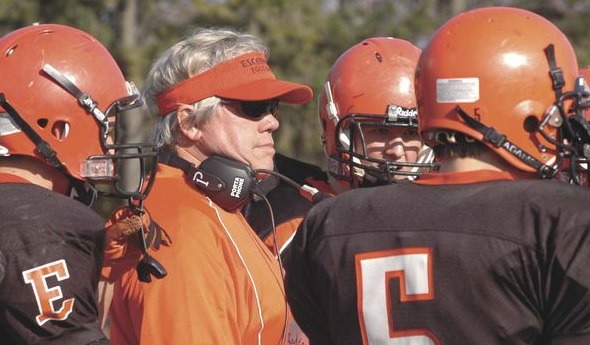
PHOTO: Dan Flynn coaches his football team at Escanaba before stepping down from that post after the 2011 season. (Photo courtesy of the Escanaba Daily Press.)
Goorhouse Gives Back at Home
By
Geoff Kimmerly
MHSAA.com senior editor
January 24, 2014
By Geoff Kimmerly
Second Half editor
Three traits have been key in making Holland Christian grad Mike Goorhouse nationally-recognized as a civic leader on the rise.
He’s a strong communicator, which comes in handy when coordinating support for causes all over the state.
He’s a relationship builder, allowing him to develop strong rapport as he explains how everyone can give something back to their communities.
 Finally, Goorhouse is a philanthropist – not just in job, but in life. He is the vice president for donor development at the Community Foundation of the Holland/Zeeland Area, where he works to raise support for nonprofit organizations. He also has served on the boards of directors/trustees for eight organizations, and he and his wife financially contribute to more than 15.
But a fourth quality, nurtured during his tennis and soccer careers, has been an asset as well for the 2003-04 MHSAA Scholar-Athlete Award winner.
“I always loved the competition side of sports. I talk to people who own companies, run companies, run shops. The reason they hire people who were involved in athletics is because of that drive,” said Goorhouse, 27, who was named in 2011 as one of the top 30 civic leaders nationally under the age of 30 by online networking site Splashlife. “Not everyone has that drive to succeed, to win, get a goal.
“Succeeding in the non-profit world looks a lot different. But it takes the same drive.”
 Goorhouse was among scholar-athletes recognized during the winter of 2004 by the MHSAA and Farm Bureau Insurance, which continues to sponsor the Scholar-Athlete Award program that has grown to honor 32 recipients annually. In advance of this March’s 25th celebration, Second Half is catching up with some of the hundreds who have been recognized (see additional links at the bottom of this page).
Earning a Scholar-Athlete Award likely meant more to Goorhouse than many of the other 607 who have been recognized over the quarter century. His grandfather, father and brother all have served as MHSAA officials, and his dad and brother both coach as well.
Mike also is part of a third generation of Goorhouses who annually attend the MHSAA Boys Basketball Finals, during which the Scholar-Athlete winners are recognized. He joined his dad and grandfather starting at 8 or 9 years old, and every year would read the bios of Scholar-Athlete Award winners in the Finals program and watch them line up on the court during halftime of the Class C championship game.
“Honestly, I wanted to be that,” Goorhouse said. “I had a lot of respect for the ability to balance academics and sports, and be good at both."
Goorhouse won the MHSAA Lower Peninsula Division 3 tennis title at No. 4 singles as a sophomore in 2002 and returned to the Finals at the No. 1 flight as a senior. He also played soccer at Holland Christian and then played tennis at Calvin College.
Tennis exposed Goorhouse to handling pressure on an individual basis while building mental toughness. Soccer was more about blending teammates’ skills and developing communication among the group.
“Everyone has his or her own version of the story, and that makes it more true; sports teaches a lot about leadership, and just about life and navigating the ups and downs, emotions, handling yourself under stress,” Goorhouse said. “I was in two way different sports, and it was fun to be able to see how those two things impacted me differently.”
As high school students begin focusing on college and potential occupations, professional giver probably isn’t an option many realize is possible. Goorhouse would’ve been counted in that group while at Holland Christian until becoming a member of the Community Foundation’s Youth Advisory Council. That opportunity joined him with many of his sports opponents from around the Holland area as they assisted the foundation in grant making for youth causes.
The philanthropy bug stuck. After his freshman year at Calvin, Goorhouse interned with the statewide Council of Michigan Foundations, which then hired him parttime as a college sophomore and fulltime once he graduated.
He returned to the Community Foundation in 2012 and works with 1,500 donors who contribute to the Holland/Zeeland area.
As donations grow, so does the foundation’s ability to give grants. But it’s not all about money. An oft-quoted definition of philanthropy is the “giving of time, talent and treasure” – and Goorhouse, as he speaks to various groups, makes sure to emphasize “and” as the most important word of that statement while encouraging donors to give of themselves in all three ways.
“It’s who I am as a person that fits this job so perfectly. It’s hardly work,” Goorhouse said. “When they’re thinking about giving back to the community, they’re at their best. I get to talk about what they care about.”
Goorhouse earned his bachelor’s degree in secondary education and then a master’s in public administration from Grand Valley State University. He’s able to take advantage of his relative youth in the professional world to connect with high school students and explain to them the opportunities to give back as part of the non-profit world. He serves on the boards of generationOn and Learning to Give, which both focus on integrating service into pre-college education.
While the national recognition in 2011 might’ve carried the most significance among honors Goorhouse has received, another he earned in 2009 has been his most meaningful on a personal level.
He was honored with the inaugural Young Philanthropist of the Year award by the Community Foundation. He didn't begin work for that organization until three years later, but giving back in his hometown always has been close to his heart.
“I love this place. It’s not that I can only do this work here, but it’s extra special to do the work you love in the place that you love,” Goorhouse said. “I could’ve lived anywhere because I would be on the road regardless. But to come home where my family and friends are, to the community I know best, it’s special.”
Click to read the series' first installments:
- 25 Years Later, Scholar Athletes Shine On
- On Call as Doctor, Director, Mom
- "Mailloux Management" Goes Global
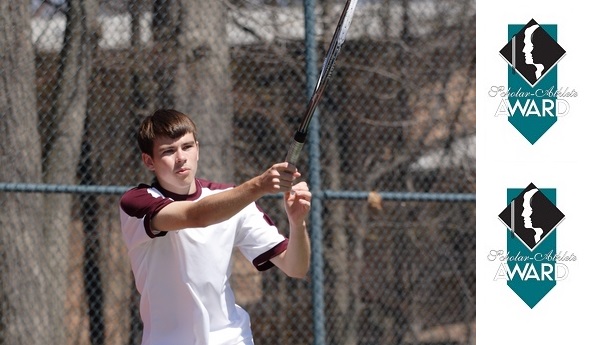
PHOTO: Mike Goorhouse sends a volley while playing tennis for Holland Christian. He won an MHSAA Scholar-Athlete Award in 2004. VIDEO: Goorhouse speaks in 2004 about playing for his high school tennis coach John Knoester.